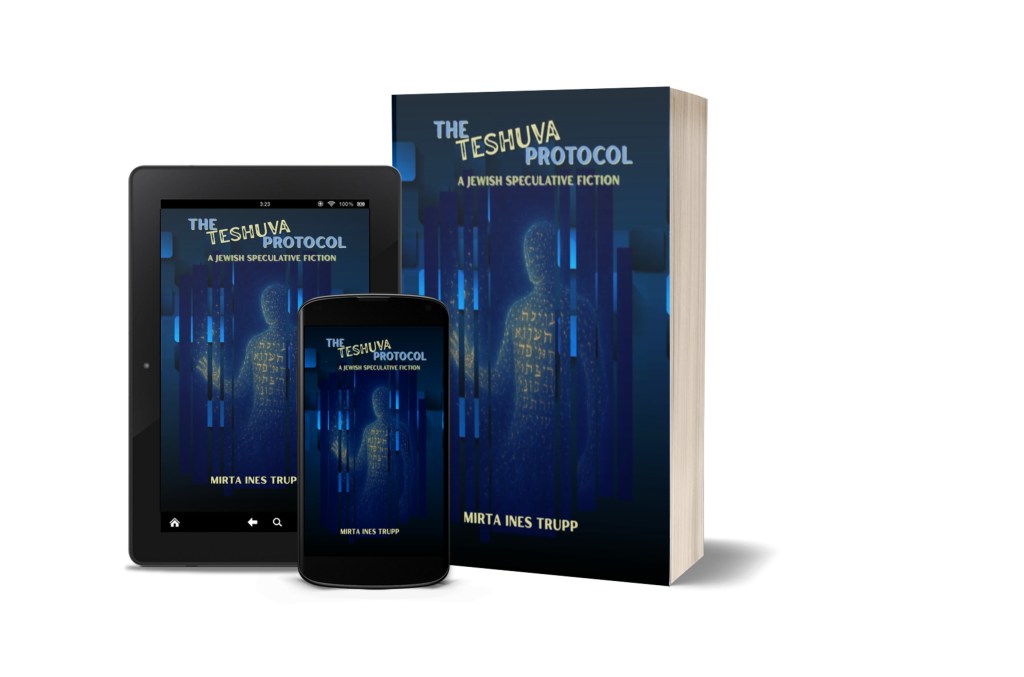
I didn’t know I was going to write science fiction—talk about being out of my comfort zone! It doesn’t really match my tagline: For those who like a little yiddishkeit in their period drama.
Yes, I’m a longtime Star Trek fan, and I’ve seen my share of science fiction and dystopian films. But watching science fiction doesn’t make you qualified to write a science fiction novel.
Then I started reading Jewish speculative fiction. Rena Rossner’s The Sisters of the Winter Wood. Naomi Novik’s Spinning Silver. Helene Wecker’s The Golem and the Jinni. They became some of my favorite books, but more than that, they introduced me to something I hadn’t realized I was looking for. These books weren’t simply Jewish fantasy or Jewish stories with magical elements. They were asking questions. Big questions. And the more I read, the more I realized that this isn’t new to Jewish storytelling. Jewish tradition has always had room for the miraculous, the supernatural, and the impossible. We have angels, dybbuks, talking serpents, mystical journeys—and, of course, the golem.
The golem is perhaps one of the most fascinating examples. In Jewish folklore, a human being creates a creature from clay and brings it to life. The story raises some very modern questions: What does it mean to create a form of life? What responsibilities does the creator have toward what has been created? What happens when the creation no longer behaves exactly as its creator intended? Those questions feel remarkably relevant in a world now asking what happens when we create artificial intelligence.
We have been telling stories that blur the boundary between the ordinary and the impossible for a very long time. And these books weren’t simply using magic for the sake of magic. They were using the impossible to explore very human questions. Questions we don’t always like to face or talk about amongst ourselves. But asking hard questions is part of being Jewish. We’ve been arguing with our texts, our rabbis, and each other for a very long time. One answer doesn’t necessarily end the discussion. Sometimes it just gives us another question. And that is one of the things I discovered I loved about this genre. You can change the circumstances. You can change the world. You can introduce something that doesn’t exist—or perhaps something that shouldn’t exist—and suddenly you can look at something very familiar from a completely different angle.
That was the beginning of The Teshuva Protocol. Or at least, part of the beginning.
The first piece of the story actually came from work (my day job, that is—before I retired). I’ll explain.
A few years ago, I was communicating with Central I.T. about a problem with a computer system. I had entered some data and statistical reports. The system accepted it. It allowed me to click SAVE. It gave me a document number. I walked away, certain that I had completed the task in a timely manner. The next day I logged in, and I found the following message attached to the document number:
LOGICALLY DELETED.
I thought I had made a mistake, so I entered everything again. Very carefully.
The next day:
LOGICALLY DELETED.
Central I.T. laughed it off.
“Oh, yeah,” one of the guys said. “See, the system syncs overnight. Whatever it can’t process—whatever doesn’t meet its design parameters—gets logically deleted.”
It made complete sense to them, but left me…uncomfortable.
The system decided?
The system has the right to tell me: You’re out of bounds. You’re coloring outside the lines?
This was long before we heard the term A.I.
This was long before I would think about writing a science fiction novel.
Then came October 7, 2023.
After the horrific events of the day, I participated with an online group of women of different levels of Jewish observance. We talked about our pain, anger, and fears. We also talked about WHY. At one point I said something that I knew, almost as soon as I said it, was going to make people uncomfortable. Some people were taken aback, and I regretted opening my mouth. I am not a scholar. I am not frum. But then another woman said something that stopped me. There are significant studies, she said, and liturgy that ask a similar question:
What are we doing to cause these atrocities to happen to our people?
Let me be very clear about what I am not saying. I am not saying that Jews deserve to be despised and persecuted. I am not saying that victims of violence are responsible for what was done to them.
What I am asking is: What if we’re not capable of understanding the expectations? We are so limited in our thinking. We try to interpret this and analyze that. What if we have taken something simple, mangled it up with our human computations, and have completely missed the point?
That question eventually led me to the idea of the Covenant. Our liturgy tells us that we are “the chosen.” But the way I understand it, the Israelites chose to enter into a covenant that had been rejected by others. At Sinai, after Moses read the Commandments, the people responded, Na’aseh venishma.
We will do, and we will listen.
We chose. We accepted the Covenant before we could possibly have known everything that living within that covenant would demand. We chose and said we would listen. We would learn. And that distinction matters to me because a covenant is not simply a declaration of privilege or superiority over others. It is an agreement, an obligation, a set of responsibilities.
Somewhere in all of this, that old software phrase came back to me.
What if the Commandments weren’t simply written on “paved work of sapphire stone”?
What if they were a form of technology, a kind of software program in which the user had to function within certain parameters?
What if, when the user attempted to revise the program, override the protocols, or operate outside the parameters, the system didn’t send down lightning bolts from heaven? It simply returned with:
LOGICALLY DELETED.
The user wasn’t being punished by a father figure in the sky.
The user was experiencing a consequence.
We can inherit the consequences of decisions we didn’t make.
That doesn’t make us guilty, but this is where I get into the question that makes people uncomfortable. Could choices made years—or even generations—earlier have changed what we’ve experienced as Jews? Not solely in Israel on October 7, 2023, but in Germany, Russia, and Poland. In Spain and Portugal…
I don’t know. No one can know. Counterfactual history can only take us so far. But I think we have to be willing to ask. Not because we are looking for someone to blame. Because if we believe that everything is inevitable, there is very little to learn from history. And if choices matter, then we have to look honestly at choices and how we live our lives. That can be painful. It can also be the beginning of change.
“Everything is foreseen, yet free will is given.” ~ Pirkei Avot 3:15
It was at this point that the pieces I’d been carrying around for years—the computer system, the phrase LOGICALLY DELETED, the questions about October 7, and the idea of the Covenant—started to come together. I needed a way to explore those questions without writing a theological treatise. I needed characters who could argue with each other. And I needed someone—or something—to help them find a way back.
That is when Zokar came into the story.
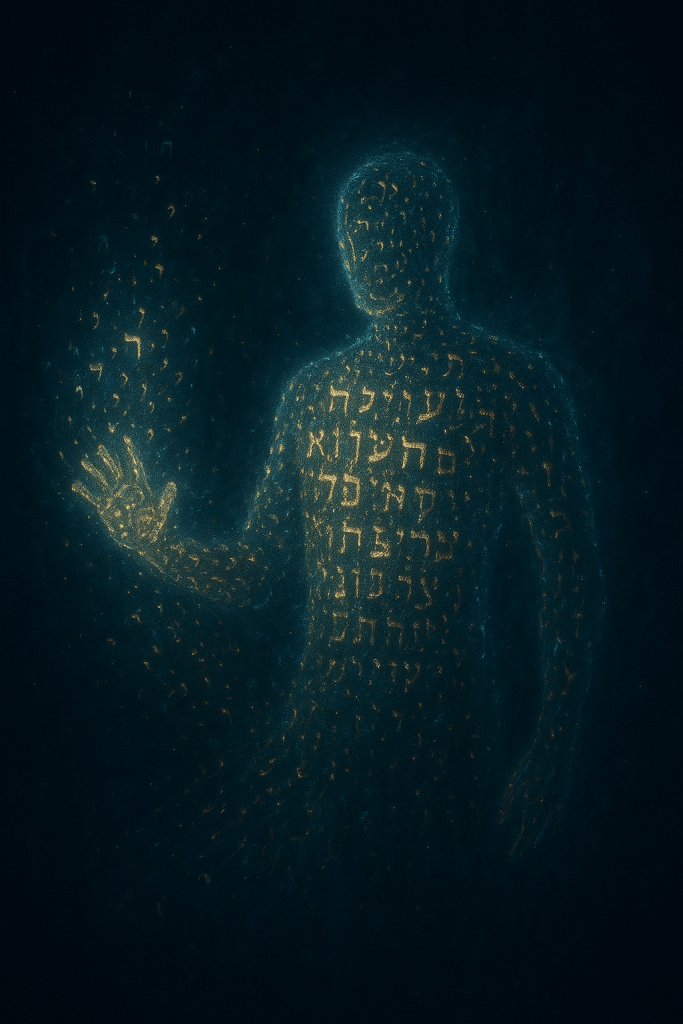
I didn’t set out to write about a golem or AI. The central non-human character in my novel is a hologram. My inspiration was the Doctor from Star Trek: Voyager. He was a holographic projection, but he had a voice, a personality. He didn’t feel like a machine simply working through a program. I wanted something like that for Zokar.
But the hologram served another purpose for me. It gave me a mask.
I wanted to ask some provocative questions without readers immediately thinking, Oh, that’s what the author believes. So I gave those questions to four unlikely characters and the answers to a more unlikely hologram.
You can’t be angry with a hologram, right?
What mattered was that Zokar could ask questions that I wasn’t sure I was brave enough to ask in my own voice, and he could challenge the characters—and the reader—to consider possibilities that might otherwise be too uncomfortable. Most importantly, he came to help them return.
The word teshuva is often translated as repentance. But I have been drawn to another meaning: return. Or perhaps even turning. Something happened. You recognize it. You confront it. You take responsibility for what is yours. And then you turn. You go somewhere else. The past isn’t erased, but you don’t have to remain where you were. That’s the whole point of Yom Kippur, isn’t it? I don’t believe God requires perfection from us. Our tradition is full of stories about human beings getting things wrong, arguing with God, making mistakes, and trying again.
We pledged to understand the covenant. Not forget it. Not simply rewrite it whenever it becomes inconvenient. But, for many of us, that is what we’ve done. We may have inherited a broken timeline, and we may suffer the consequences of generations that drifted far from the path. But the choices of previous generations do not define our destiny. And we shouldn’t assume that because we are imperfect, the covenant no longer matters.
I could have simply written a blog post. But I didn’t. I wrote a story. Because fiction allows us to sit with people—or beings—we might not otherwise sit with. It allows us to entertain an idea without necessarily accepting it. It allows us to ask a question we might be afraid to ask in our own voice. And perhaps that is one of the reasons speculative fiction works so well for questions like these. You can create a world that isn’t quite our world. You can create a being that isn’t quite human. And then you can ask very human questions.
What does it mean to remember and honor a pledge?
What does it mean to inherit consequences?
What does it mean to choose to return?
What happens when the system tells you: This is not working—not for you, not for the world.
Maybe the question isn’t whether the system is right.
Maybe the question is whether we are willing to look at what we’ve been doing—and ask whether we need to change.
With love,