New Post

Celebrating Chanukah~ A Look at the Festival of Lights During the Regency Era

What’s a nice, Jewish girl to do when the vast majority of the population is snuggling by a roaring fire with Hallmark movies and Dickens’ classics? Well, I’ll tell you. If that nice, Jewish girl happens to write Jane Austen Fan Fiction, she may share a little bit of history on the Jewish Festival of Lights. She may also share a snippet or two from her novels to illustrate the true meaning of the season.

I’ll stop writing in the third person now…

I realize that we’re still in the fall season here in the northern hemisphere, and there are other holidays to commemorate before we head into the darkest part of the year. However, I felt that this post was well-timed as the Jewish community has been experiencing “the darkest part of the year” since the horrific events of October 7, 2023. To date, we are still waiting for all of our hostages to be returned.

In just a few weeks’ time, we will begin preparing our latkes and sufgenyiot for our holiday meals. Dreidels and coins will decorate our tables too. The battles that were won, the significance of the dreidels and coins, the reasons why we eat fried foods—or, even dairy—are all well documented; you can read more about it here.

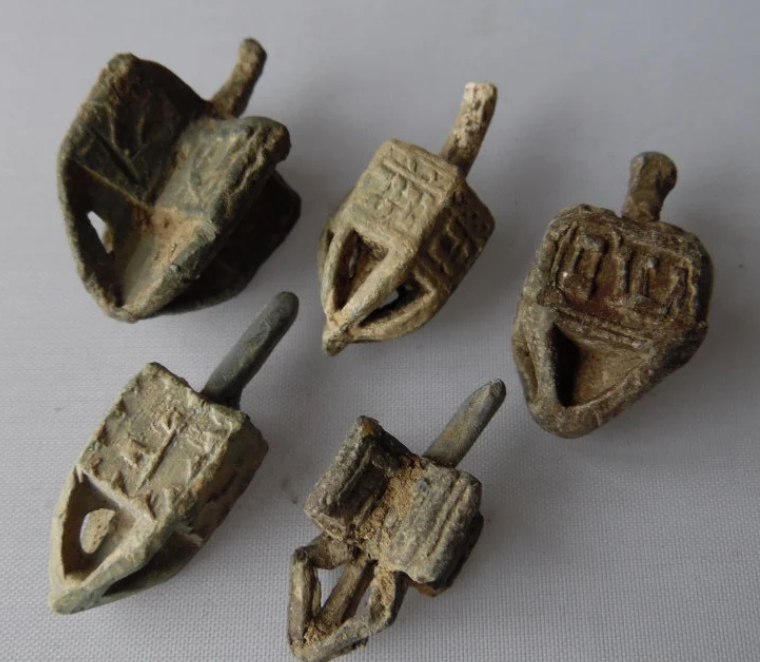
A Great Miracle Happened There!

Chanukah tells the tale of an impossible victory over the mighty Greek army in the 2nd century. This was a true, historical event—a terrestrial miracle that serves as reminder that Jerusalem and the Temple were lost and recovered due to the Maccabean revolt against tyranny and forced assimilation.
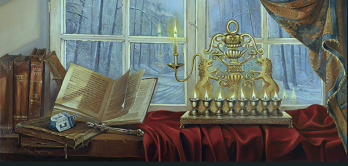
The second miracle of the holiday, however, is not so tangible. It is the story of how a small vial of sanctified oil was able to keep the Temple’s menorah lit for eight days and nights. The flames of the chanukkiah (the Chanukah menorah) speak to faith (emunah) and trust (bitachon). In celebrating this holiday, we are encouraged to emulate these characteristics, even when the world is enveloped in darkness—even when we are heartbroken and our spirits are brought low. As an author of Jane Austen Fan Fiction (J.A.F.F.), I wanted to highlight these themes, and show how I have attempted to underscore their importance in my J.A.F.F. or Jewish Austen Fan Fiction.

The Hebrew greeting noted above is transliterated as Chag Chanukah Sameach, which means Happy Chanukah Holiday. No doubt, you have seen many different spellings of Chanukah, Hanukkah, even Januca—as it is written in Spanish. While many people call it a minor holiday—it’s not included in the Torah (the Five Books of Moses a.k.a. Pentateuch)—it has been commemorated by Jews for centuries… even in Jane Austen’s time.
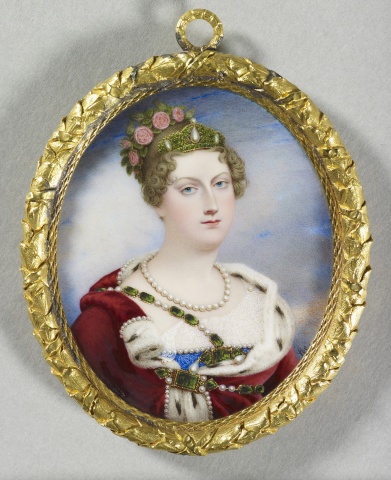
On November 5, 1817, just prior to the holiday season in Regency England, tragedy struck. Princess Charlotte, the Prince Regent’s daughter, and heiress-presumptive to the throne, died after giving birth to a still-born son. The whole of the empire had been following this pregnancy; Charlotte was a favorite amongst the British people and her marriage to Prince Leopold of Saxe-Coburg-Gotha had been a love match. The public were besotted by their fairy-tale union and by what the couple’s future foretold; however, Charlotte’s death at the age of twenty-one threw a stunned nation into deep mourning.

The outpour of grief for the young woman and her child was said to be unprecedented. Mourning protocols were highly respected during this period of time. Needless to say, when the deceased was a member of the royal family, and a favorite at that, the public were united in their sorrow.

“It really was as though every household throughout Great Britain had lost a favourite child.” ~ Henry Brougham

The Royal Exchange, the Law Courts, merchants, tradesmen, and schools closed down. There was a shortage of black cloth, as everyone wished to show their respect by wearing mourning armbands. Jane Austen and her family would have participated in these rituals. Naturally, the Jewish community aligned themselves with their compatriots.

Per the Gregorian calendar, November 19, 1817 correlated to the Hebrew date of the 10th of Kislev, 5578. Prior to the tragic news, Jewish congregations throughout the land would have been planning for the upcoming Festival of Lights; Chanukah falls on the 25th of Kislev. However, all such preparations came to a halt upon receiving the sorrowful news.
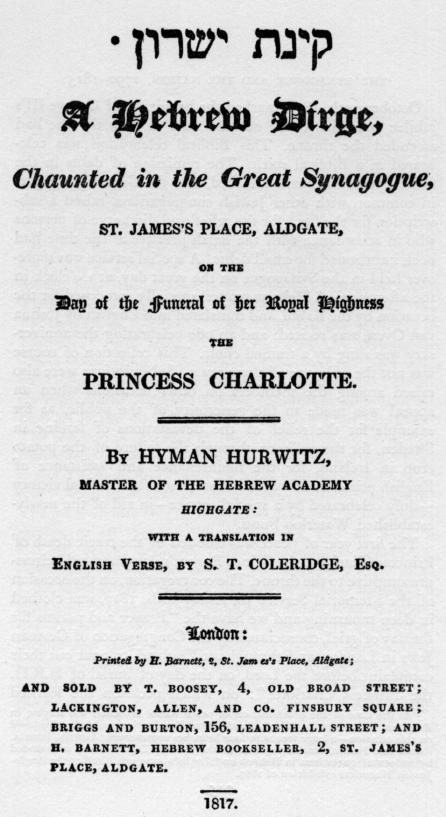
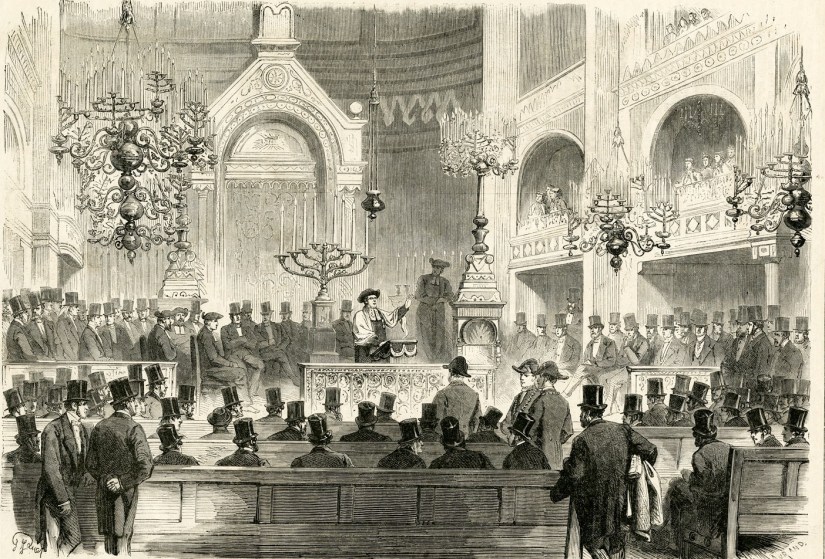
On November 19th, a memorial service was organized for “prayer and psalms for the day of grief” in the Great Synagogue, St. James’s Place. Congregants were allowed to “pour out their complaint before the Lord, on the day of burial of H.R.H. the Princess Charlotte.”

Hyman Hurwitz, the head master of a “fashionable” Jewish school at Highgate, composed Mourn the Bright Rose: A Hebrew Dirge and it was chanted to the tune of a well-known composition, typically recited on the Ninth of Av—a tragic and solemn occasion on the Hebrew calendar.

Rabbi Tobias Goodman, known amongst his congregation as Reb Tuvya, spoke on “the universally regretted death of the most illustrious Princess Charlotte of Wales and Saxe-Coburg.” Rabbi Goodman quoted Ecclesiastes in saying, “A good name is better than precious ointment, and the day of death than the day of one’s birth.  It is better to go to the house of mourning than to the house of feasting, for that is the end of all men; and the living will lay it to his heart.”
I don’t know what followed. Perhaps the rabbi repeated the time-honored phrase, “Od lo avda tikvatienu,” (our hope is not extinguished) capturing the essence of Chanukah. He might have referenced Joseph and his brothers in Egypt, by saying: “Praiseworthy is he who places his faith in God” and “Remember I was with you.” Whatever else was said that day, I can only imagine the congregation went home with words of consolation and hope.

Jane Austen said, “My characters shall have, after a little trouble, all that they desire.” That speaks to her genius, of course. As in any book, there needs to be an arc to the storyline. There needs to be growth. The heroine must face her fears and rise above the obstacles placed in her path.

In my novels, these concepts are interwoven in Becoming Malka, Destiny by Design: Leah’s Journey, Celestial Persuasion, and most recently in The Jews of Donwell Abbey: An Emma Vagary. In keeping with Miss Austen’s playbook, my characters—Molly, Leah, Abigail and even Harriet Smith—all have a little trouble, but it is ultimately their faith and trust that helps achieve their Happily-Ever-After ending.

Of all my books, I think The Meyersons of Meryton highlights the Chanukah message best. In this story, due to a variety of unforeseen circumstances, Mrs. Meyerson—the rabbi’s wife—and Mrs. Bennet find themselves much in one another’s company. Miss Catherine Bennet (Kitty, as we know her) has endeared herself to the rebbetzin and her young daughter, Rachel. In a rather poignant moment, Kitty makes an emotive declaration and both Mrs. Meyerson and Mrs. Bennet are moved—most profoundly.

The passage below is a snippet of the final chapter, where Mr. and Mrs. Bennet have an interesting exchange.


An Excerpt from The Meyersons of Meryton

When the happy couples at length were seen off and the last of the party had departed Longbourn, Mr. and Mrs. Bennet were found in the dining room quite alone, sharing the last bit of port between them.

“What shall we do now, Mrs. Bennet, with three daughters married?”

Surprised at being asked her opinion, Mrs. Bennet gave the question some thought before replying. “I suppose we have earned a respite, husband. Let us see what Life has in store for us.”

“No rest for the weary, my dear, for soon Mary will leave us and then Kitty. We shall have to make arrangements for the inevitable. Perhaps you shall live with one of the girls when I am gone and Mr. Collins inherits the place.”

“Mr. Bennet,” she giggled, “you should have more bitachon.”

“I beg your pardon?”

Perhaps it was the port, or perhaps it was pure exhaustion, but Mrs. Bennet found she had no scruple in sharing the entire tale of Chanukah with her most astonished husband. “Pray Mr. Bennet,” she finally concluded, “what was the true miracle of this holiday?”

“The logical answer,” he replied dryly, “would point to the miracle of such a small group of men overcoming a fierce and mighty army.”

“No, that is not it.” She giggled, as a hiccup escaped her lips.

“Well then,” he sighed, “the esoteric answer would point to the miracle of the oil lasting eight nights.”

“No, Mr. Bennet. Again, you are incorrect.”

“Pray tell me, wife, what then was the miracle, for I can see that you may burst with anticipation for the sharing of it!”

“The miracle, sir, was that they had bitachon. I do hope I am pronouncing correctly. At any rate, it means trust. They knew they only had one vial of sacred oil and had no means to create more. They lit the candle and left the rest up to the Almighty. And that is exactly what we should do in our current circumstance.”

“My dear, it is a lovely tale and I am certain that it has inspired many generations before us and will inspire many generations after we are long gone, but it does not change the fact that Mr. Collins is to inherit Longbourn…”

“Longbourn is entailed to Mr. Collins if we do not produce a son.”

“Yes, and well you know that we have produced five daughters, although you are as handsome as any of them, Mrs. Bennet. A stranger might believe I am the father of six!” he said with sincere admiration.

“You flatter me, Mr. Bennet. I certainly have had my share of beauty, but I wish to say…”

“You were but a child when we wed,” he waved her silent, “not much more than Lydia’s age, if I recall. But, my dear, that is neither here or there, for in all this time a son has not been produced and there’s nary a thing to do for it!”

“Mr. Bennet, there is something I have been meaning to tell you. That is, if you could spare a moment of your time—or does your library call you away?”

His wife’s anxious smile made him feel quite the blackguard. Had he not made a promise in Brighton? Did he not vow he would change his ways? Mr. Bennet decided it was high time he put the good rabbi’s advice into practice. Bowing low, he replied, “Madam, I am your humble servant.”

Happier words had never been spoken.


No matter which holiday you celebrate this December, whether the lights of your chanukkiah or the lights of your Christmas tree shine brightly against the dark, wintery nights, I hope your home and your hearts are blessed with peace.

With love,

New Post

Juana Libedinsky, Jane Austen’s World-wide Fandom, and me!

Today’s post is a little bit of this and a little bit of that. It’s not an Author’s Interview—not in so many words. It’s not about one of my books—not in so many words.

You see, I didn’t interview Juana Libedinsky; in fact, it was the other way around. And while I will share a little of our conversation, this post is about the world-wide cultural phenomenon that is Jane Austen’s fandom. But let me go back and start over…

Juana is a columnist for one of Argentina’s most popular daily newspapers, La Nación, and is a cultural correspondent in New York for Uruguay’s newspaper, El País. A graduate of the University of San Andrés, she completed master’s degrees in Sociology of Culture at the National University of San Martín and in Reporting and Cultural Criticism at New York University. In addition, Juana was a New York Observer Fellow at New York University and a Wolfson Press Fellow at the University of Cambridge. Juana’s work has been published periodically in Vanity Fair and Spain’s Condé Nast Traveler. If that weren’t enough, Juana is the author of English Breakfast and Cuesta abajo—a first-person testimony about the dramatic skiing accident suffered by the author’s husband.

Before all the above was accomplished, Juana, of course, was a child much like any other. Born and raised in Argentina, her parents enjoyed attending flea markets and collected interesting objects to fill their home. I learned from Juana that, come hail or high water, the family would search through “the ugly, the kitsch, and the banal” like impassioned archeologists searching for buried treasure—much to Juana’s displeasure.

What did Juana prefer to do? She preferred reading. She discovered Jane Austen early on thanks to a distant relative, a relative with British ancestry. Partaking tea and scones whilst enjoying Austen apparently was a thing in the town of Acassuso, a locality of San Isidro. There, Juana fell in love with Austen’s happily-ever-after stories.

Unfortunately, these early reading experiences were based on poor translations that distorted the author’s original intent. Austen’s humor—that infamous irony—was all but removed by sentimental, decorous, dialogue. It wasn’t until much later, that Juana discovered the power of Austen’s genius— thanks to updated translations that were finally made available. Here Juana discovered the truth: underneath the romance, the author was a keen observer of society. Austen’s novels were actually witty commentary on class issues, gender issues, and a hypocritical society. Austen wasn’t simply an author of classics, but “a modern, ironic, political writer who was deeply observant of her social environment.”

Jane Austen Society of North América

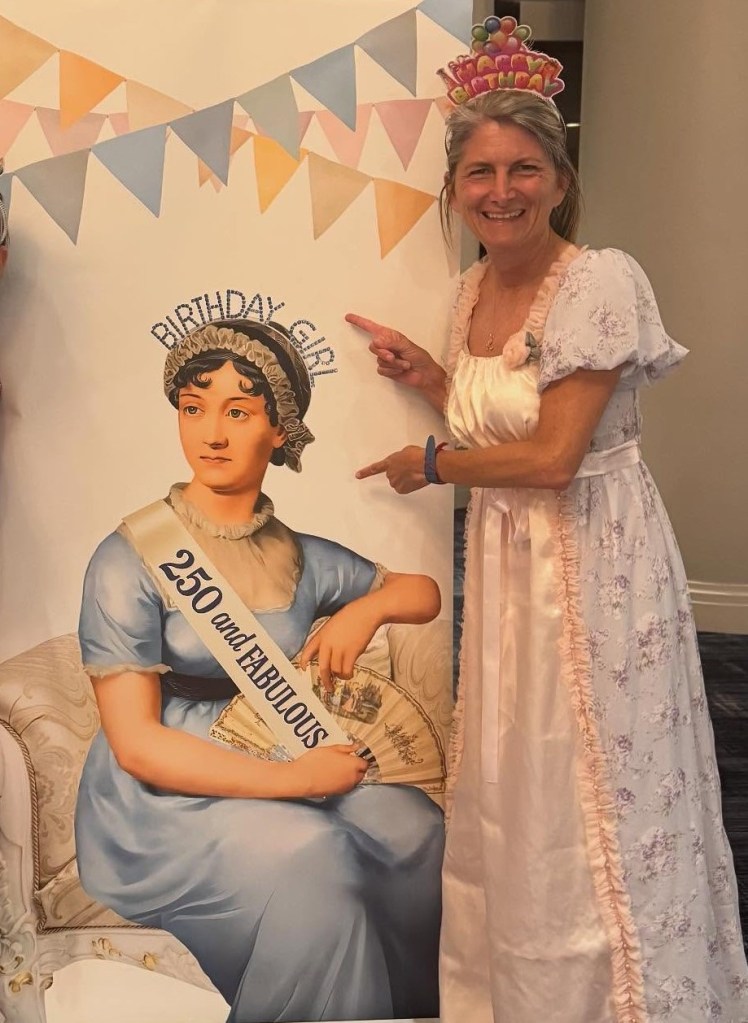
Wanting to join in the celebration of Jane Austen’s 250th birthday, Juana—along with being a wife and mother and journalist—came up with an idea for a new book. This “little book,” as she calls it, was not meant to convince anyone to love Jane or celebrate her work. Juana simply wanted to share a chronicle of adventures she undertook while experiencing Austen’s world-wide fandom.

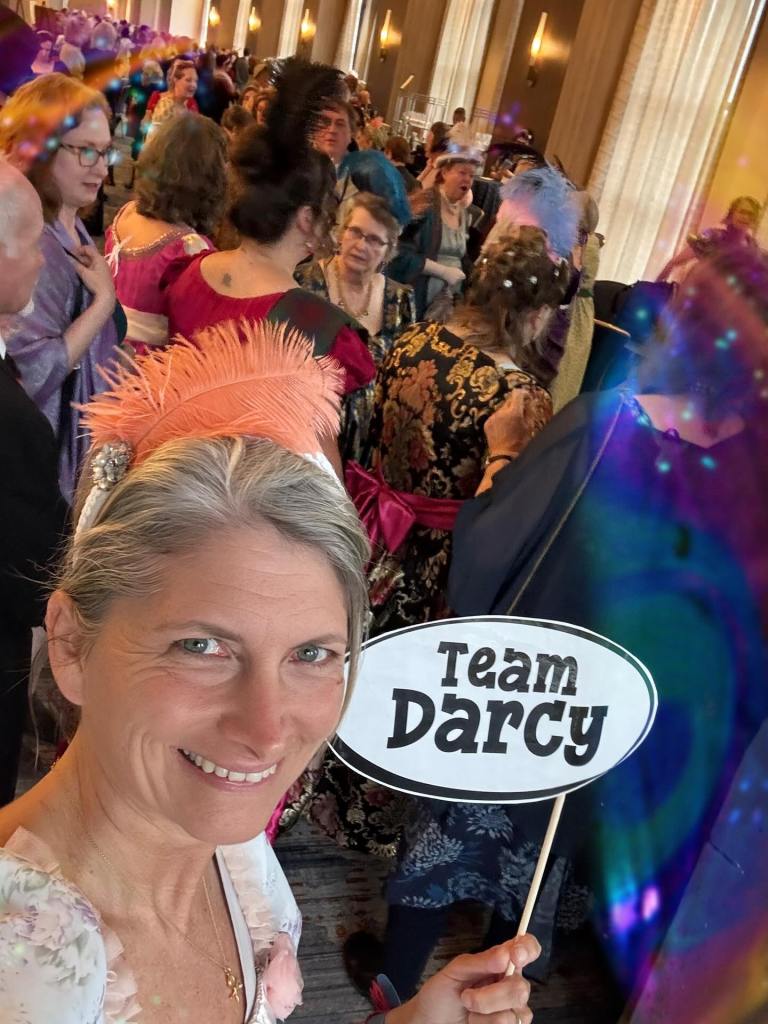
Living in New York, Juana was fortunate enough to participate in the Jane Austen Society of North America’s various celebrations. But, it didn’t stop there! She traveled across the pond and visited London, Winchester, Bath and Chawton, attending balls, routs, and soirées in Regency attire.

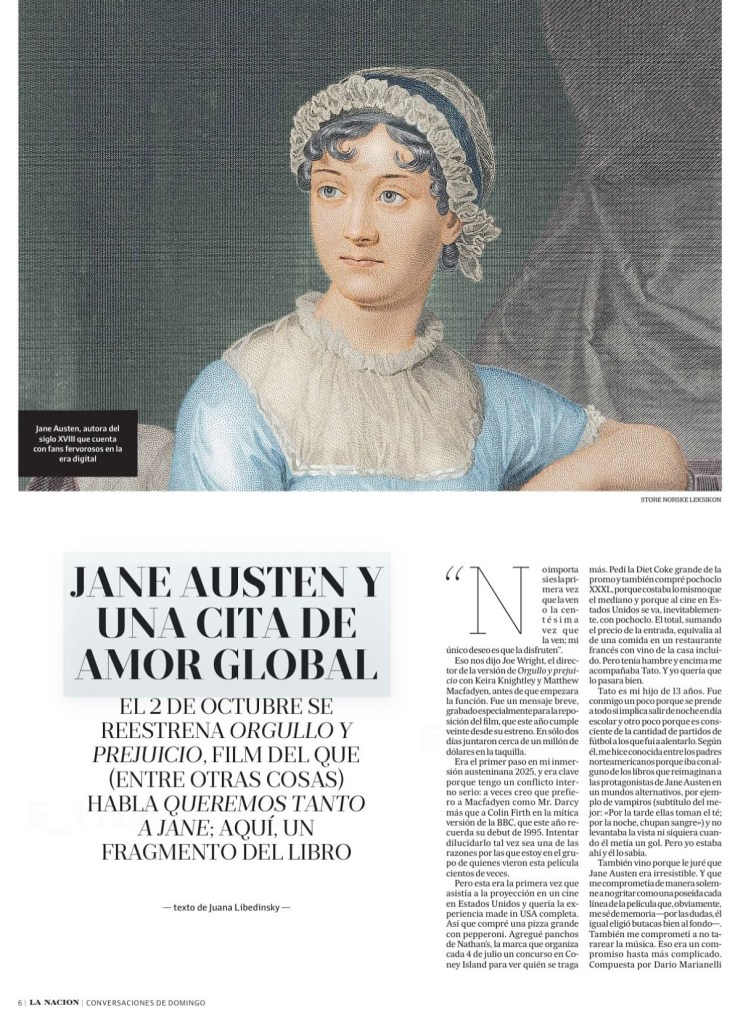
Nos llaman los Janeites. El término, utilizado ya desde el siglo XIX, designa a quienes sentimos una conexión emocional intensa con las novelas, los personajes y el universo moral de Austen. Carga con un matiz de burla –por los excesos que puede implicar esa devoción–, pero también con un fuerte componente de orgullo por la pertenencia.”

Credit: La Nacion

This is when Juana contacted me…when she was in England…out of the blue…to my Total. And. Complete. Shock.

Imagine it! I receive an email from this renown journalist—from La Nacion—asking if I would be interested in being interviewed for her new book.

She told me that she had read, The Meyersons of Meryton, and was excited to find that we had so many things in common.

We spoke of our love of Austen, of our ties to Argentina, and how we both experienced frustration as young readers with regards to fiction and Judaism. I laughed when I heard the trials she had experienced with her name. The “J” and “H” are quintessential problems for Spanish/English speakers. “Juana” was pronounced Kuana or Guana or Huana—it reminded me of my own experiences as Mirna, Mirda or worse yet, Merda. Ugh!

In any event, we shared emails, WhatsApp messages, and Messenger texts as Juana continued to travel. We finally set a date for the interview where I had the honor of participating in a dialogue that ended up in Juana’s book.

But she wasn’t done yet.

After traveling through England, Jane Austen Argentina was the next stop! She happily returned to Buenos Aires to partake in Austenesque activities and, of course, took the opportunity to visit her parents. They even had time to return to the flea markets in San Telmo, where she found old copies of those “imperfect” Austen translations. Juana shared that she no longer resented those works—or the time spent seeking buried treasure—because these experiences lead her to Jane in the first place. I love how she states the sentiment: “I suppose that, like Elizabeth, Emma, Anne, Catherine, Fanny, Marianne, I grew up.”

Con picardía y erudición en el tema, Juana Libedinsky ha escrito un libro festivo, que celebra la creatividad y fineza de una autora que ha resistido la destemplada prueba del tiempo y es una voz imprescindible del canon de la literatura occidental.”

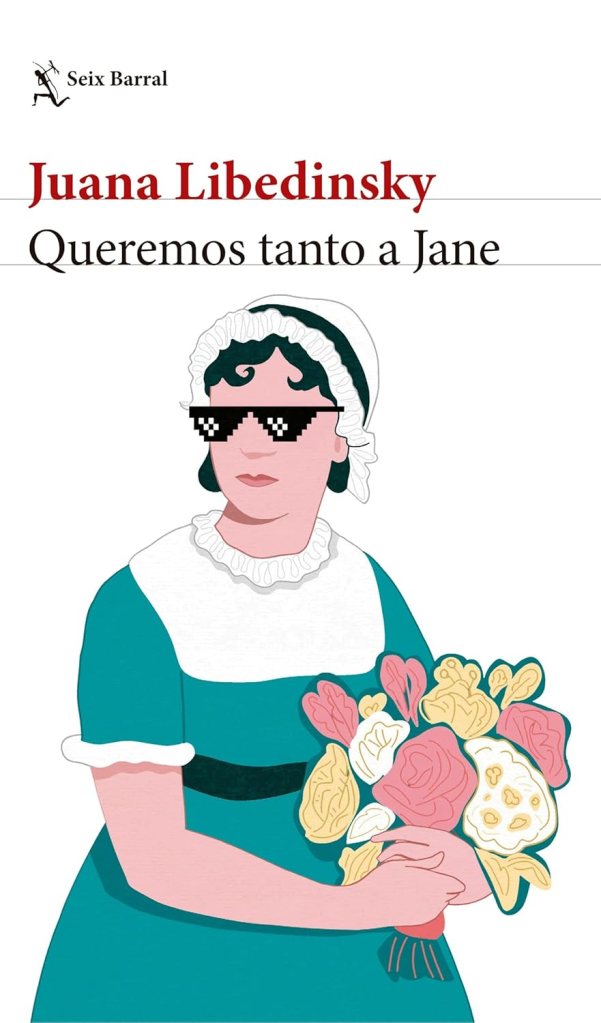
Juana’s book, Queremos tanto a Jane, was recently published. It is available in Spanish, which speaks to Austen’s popularity throughout Latin America. In the passage below, I share a translated version of our interaction (thanks to AI).


In fact, back in Winchester, during an impromptu chat with other enthusiasts at the café across from the cathedral, I discovered an author I hadn’t heard of before: Mirta Ines Trupp. I immediately felt that her books needed to reach my Argentine friends. Her story would turn out to be as astonishing as Amy’s and her Mr. Darcy, the bookseller on Corrientes Street.

Trupp’s book, The Meyersons of Meryton, was first recommended to me. Written in 2020, it featured Jewish characters: As far as we know, Jane Austen never met any Jews, although Jewry Street—which commemorates the Jewish moneylenders and merchants who lived there before their expulsion from England in 1290—runs through Winchester, where Austen went to receive medical treatment for a then-unknown illness, possibly autoimmune, and where she died at age 41.

But that detail, Mirta told me, was secondary. I had been put in touch with her by the prestigious Jewish Book Council in the United States, an organization with which she collaborates. Mirta told me that, when she was a girl, all the stories with Jewish characters were like The Diary of Anne Frank, Fiddler on the Roof, or The Merchant of Venice. Spoiler: they didn’t end well, and she would have given anything to read one where a Jewish girl could see herself represented—without death or sacrifice.

Moreover, there are no traces of antisemitism in Jane Austen’s novels, something rare for her time. According to theologian Shalom Goldman, although the phrase “rich as a Jew” appears in Northanger Abbey, it’s not spoken by Austen herself—it comes from John Thorpe, a thoroughly unpleasant character, suggesting that Austen used the phrase to expose his pomposity and prejudice, not to normalize it.

Jane Austen was the daughter of a clergyman; I don’t doubt her capacity to love and to recognize and value the humanity in everyone. I have faith that her most beloved characters would have been able to move beyond prejudice. In a sense, that’s what one of her greatest novels portrays,” Mirta explained to me over the phone from Las Vegas, where she lives.

Trupp’s first J.A.F.F. book introduces the Meyersons into the world of Pride and Prejudice. But it’s in her second, Celestial Persuasion, that the real surprise appears: she moves Austen’s characters to the Río de la Plata. Captain Wentworth from Persuasion crosses paths with San Martín, Alvear, and Mariquita Sánchez de Thompson, as well as with young English Jews who arrive, full of hope, drawn by the ideals of independence in a land free from inquisitions and persecution.

Of course, all of that serves as a backdrop for a grand love story.

Mirta was born in Buenos Aires, but when she was very young her family moved to Houston and, later, to Los Angeles. “My dad started working with Pan Am. That allowed us to travel to Argentina frequently—sometimes, for several months at a time; my life was always with one foot on each side,” she says.

In high school, she read Pride and Prejudice as part of the curriculum—and lost her mind. “The classic story: I fell in love with English history, with the fashion of the era, and above all, with Mr. Darcy. I could never think of anyone else again,” she laughs.

Although—she did. She met her “Mr. Darcy from Almagro,” as she naturally calls him, during one of her trips to visit family. They married in California, had three children, and later moved to Las Vegas. But it wasn’t until the kids left for college—and the empty nest syndrome hit—that Mirta began writing her Austen adaptations.

I had already done something autobiographical about my ancestors who came from Russia to the Jewish colonies in Entre Ríos and La Pampa; then I wrote a couple of fiction books about that. It was something I enjoyed researching, and I did it for fun, but I got so many comments, so many requests to continue, that I began to investigate what might have happened to Jews who arrived even earlier—and that became the theme of a new novel.”

The spark was the 1813 painting entitled, The National Anthem in the Home of Mariquita Sánchez de Thompson—the scene of the anthem’s first performance—an oil by Pedro Subercaseaux that hangs in the National Historical Museum. When Mirta saw it, she had an epiphany. The women, in their empire-waist dresses, could have stepped straight out of a Jane Austen novel. And though the painting doesn’t identify everyone depicted, it’s believed that one of the military men represents Martín Jacobo Thompson, Mariquita’s husband and Argentina’s first naval prefect, who trained in the British navy and maintained ties with English sailors all his life.

For Mirta, the conclusion was immediate: “He could easily have been friends with Captain Wentworth! And through him, could have met Mariquita, San Martín, Alvear… All of them were highly educated and could have crossed paths with English Jews of certain standing and education in England who, through the navy, also came to know the southern part of the Americas.”

In Persuasion, Captain Frederick Wentworth proposes to Anne Elliot when they are young, but she rejects him under family pressure—he had no fortune or position. Hurt, he goes to sea. Austen’s novel mentions some ships and destinations, but she never specifies a route or offers detailed geography. What matters is that Wentworth returns triumphant and wealthy enough to marry her, completely reversing his initial situation.

For Mirta, this means he could have been in the Río de la Plata—and that when he returned to England, his heart wasn’t entirely closed to a second chance with Anne thanks to the “persuasion” of the good friends he had made there.

The book is utterly charming, and today—to her surprise—Mirta has become a recognized figure in the world of Jane Austen retellings. Scholars consult her for research; she participates in conferences, book fairs, and podcasts commemorating the 250th anniversary of Austen’s birth.

She admits that jumping between Las Vegas, Regency England, and the Viceroyalty of the Río de la Plata isn’t easy—but she has the time now. “I retired last year from my job within the local government. My husband and I don’t go to casinos, and we’ve already seen Céline Dion and The Phantom of the Opera too many times, so now I can dedicate myself to this.”

What she loves most, she says, is when she’s invited to Jewish book fairs. “I go dressed as a Regency character, bring extra costumes, and people—the ones you least expect—get interested and sometimes even dress up too. Around me, there are brilliant books about the Inquisition, the pogroms, the Holocaust, the current surge in antisemitism. Clearly, I’m not Tolstoy. But there’s always a line at my booth. And if what I do serves, even just a little, to lift people’s spirits, I think Jane Austen would have approved.”


I am thrilled to have participated in Juana’s inspired project. To say that it was an honor to have been included along with other renown authors, professors, and academics doesn’t suffice. There is something very special about sharing this interest—this love—with other Janeites. I’m certain that Juana’s experience with Austen’s fandom was just the beginning of many more brilliant opportunities to gather, to discuss, and to debate the genius of Austen.

Juana—Juanita—I hope you’ll call me before you go on your next world-wide tour, because—to paraphrase your own words—I don’t want to take off my empire dress anymore!

Here’s to more celebrations and more engaging conversations!

With love,

New Post

An “Emma” Vagary

The manuscript is finally with the editor. The nail biting has now begun. This stage in the process is the most unsettling. It has “my baby is leaving home” vibes all over it! Putting eighty thousands words down on paper, worrying about points of view, gaps in the story line, or the character’s arc is nothing compared to this stage. Soon, I will receive the manuscript with the editor’s corrections and suggestions—and the real work will begin.

I can’t wait to share this new story with you! A cover and title reveal is coming soon; but for now, I can only say: expect an Austen vagary. I know some of you will say, “What? Another fan fiction?” Some of you might ask, “What is a vagary?” Still others will ask, “Why??”

Jane Austen is known for her six published novels, however, she had been writing and compiling her work since she was eleven years of age. There are three bound notebooks containing twenty-nine poems and short-stories, now referred to as the Juvenilia. There are letters to family members and unfinished manuscripts. Since Austen’s death, her devoted fans have crafted stories to honor her wit and beloved, enduring characters.

Jane Austen Fan Fiction, also known as J.A.F.F. is a world-wide phenomenon. Some authors are passionate about including their culture or ethnicity into their stories. Others focus on secondary characters and reimagining plots to better suit their own creativity or tastes. As one author stated, readers have more options now. They can choose from “drawing-room” romance or “bedroom” romance or anywhere in between. The irony is that Jane Austen did not write “romance novels,” nor did she consider herself capable of writing such stories! That is the beauty of fan fiction. In writing a vagary or variation, the author is retelling a cherished story in a new light, with new characters, locations, and plot lines.

I, too, have written six books, including “The Meyerson’s of Meryton,” which is a variation-continuation of “Pride and Prejudice,” and “Celestial Persuasion,” which is a prequel of sorts to Austen’s “Persuasion.” This new book, number seven, is an “Emma” vagary.

The idea came to me in a dream one night. I recall waking the next morning and having to jot down the thought, before it became nothing more than a vague, ethereal memory. I quickly scribbled two or three sentences and they stared back at me from that white sheet of paper—every.single.day.

They were a constant reminder that I hadn’t written any more.

Well, now I have! Practically seventy-five thousand more words…on paper—waiting for the editor’s red pen and anticipating the delete button.

Thankfully, some of the suspense has been relieved by several lovely people who have volunteered to be “beta-readers.” These readers have pointed out the typos and grammatical errors, the nonsensical wording and aggravating gaps. However, they have also provided me with encouraging words, words of appreciation—words to inspire me to work harder still.

Pamela said: “Believe me when I say that I RARELY cry over a book, but reading that letter towards the end, must surely touch the heart (and tear-ducts) of all readers!”

Delia said: “A fascinating, surprising story of Harriet’s family history, new-found faith, and a maturing love.”

I suppose that’s enough coddling and “high-fiving” for now. I’m off to face the editor…

Wish me luck!

New Post

The Association of Jewish Libraries

The Association of Jewish Libraries (AJL) has launched a new podcast entitled, “Nice Jewish Books.” A leading authority on Judaica librarianship, this AJL series focuses on adult Jewish fiction.

Host, Sheryl Stahl is the director of the Frances-Henry Library on the Jack H. Skirball campus  of the Hebrew Union College-Jewish Institute of Religion. She is an avid reader herself; and after serving the AJL in various capacities, she has now taken on the role of Podcaster. Stahl’s background comes into play as she interacts with authors and provides a platform to discuss their work. The premise for the show is to talk about Jewish literature, although her preference is not to include books based on war, political thrillers or Holocaust-related works. That, of course, was what drew my attention! Here— at long last— was a place to discuss my passion for Jewish historical fiction.

Do me a favor, won’t you?

Make yourself a nice cup of tea and tune in!

I am honored and delighted to announce that I was a guest author on the program. Please follow the link and listen in. Leave a comment on the website for Sheryl and the AJL community of readers and bibliophiles. I’d be so proud to know you stopped by. Happy reading (and listening)!

New Post

Jane Austen & Jewish Themes Part V~ Delving into Diversity

I’ve been addressing Jane Austen’s work and the correlating themes found in Judaic text. The reason for this exercise stems from my desire to find historical fiction or historical romance novels that contain a modicum of Judaica. Of course, Austen’s work isn’t considered historical fiction. Her stories were contemporary; her readers would have recognized their world amongst the backdrop of her settings. But that’s not my point. Sorry!

While I have scoured endless book titles and conducted mind numbing Internet searches in the hopes of finding some hidden gem, I have very little to show for my effort. That was the impetus to take pen in hand, so to speak, and to write my own fanfiction. And why not? Jane Austen’s work continues to inspire and entertain a diverse, world-wide audience. We are presented with modern interpretations of her classics novels, time-travel storylines, and narratives that focus on any number of ethnicities and cultures. Evidently, our thirst for new and tantalizing Austenesque plots and themes is not so easily quenched! And for this particular reader, it seemed only logical that the Jewish community be represented in Austen’s fandom.

That being said, I am not an advocate of racelifting. By that I mean, I have no need to replace a character’s Anglican faith for Judaism. I am satisfied with the introduction of Jewish protagonists and themes that are a true reflection of our community as a whole. For other authors and readers, I understand that it is imperative to see a Jewish character cast in the original role. And that’s okay. That’s the magic of fanfiction. In The Meyersons of Meryton, I introduce a rabbi and his family to Austen’s fictional town in Hertfordshire. In Celestial Persuasion, I create a friendship in-between Captain Wentworth and the Isaacs siblings that stretches far beyond England’s shores. With Destiny by Design~ Leah’s Journey, I showcase a story that is loosely based on my ancestors’ experiences. Although this novel is not a J.A.F.F. (Jane Austen Fan Fiction), there is a definite nod to the author and her work. These novels, along with my first title, Becoming Malka, are my small contribution to the lesser known genres of Jewish Historical Fiction and Jewish Historical Romance.

As we are now officially in the “holiday season,” there is an opportunity to address diversity and Jewish characters in other forms of entertainment. For example, Hallmark has attempted to incorporate Jewish storylines and characters in their holiday lineup. These shows are a bit cringe-worthy, I’ll admit it, but at least they’re trying. I’d encourage them to try a little harder. While I do want to see Jewish representation in these soapy movies, I do not want to see Hanukkah downgraded to a Christmas-wanna-be. The whole point of the Maccabean revolt was not to assimilate to the dominating culture. It is a fine line, I understand. Hallmark can do better.

Over at Disney, we were introduced to a Jewish heroine for one episode of Elena of Avalor. The character is supposed to be a Sephardic princess, but she uses Yiddish terminology and speaks of Ashkenazi traditions. And, I’m sorry to say, the princess is not very attractive. Like the folks over at Hallmark, the imagineers could have put forth more effort. This piece needed a little more research into the character’s cultural background and a lot more generosity in developing her aesthetic. Perhaps they could have taken a page from the variety of diverse characters showing up in other animation, comics, and television series and given the Jewish community a proper heroine.

And speaking of television, did you hear the collective “oy!” when fans of Downton Abbey found out that Lady Crawley’s father was Jewish? The writers did not stop there. The series also introduced a Jewish family of the upper echelons of society. Apparently, Lord Sinderby’s family had fled the pogroms and persecution of Imperial Russia some sixty years ago. Sparks fly when his son, Ephraim (he goes by his second name, Atticus) meets and falls in love with Lady Rose…who is not Jewish. This all-too-familiar predicament, as well as other issues of anti-Semitism in Edwardian England, are brought to the forefront. While I was not entirely pleased with the outcome, I was glad that at least our community’s presence was addressed.

With the success of Sanditon and Bridgerton—and the plethora of costume dramas in the world today— it seems clear we are in need of the escapism that these shows provide. We fantasize and yearn for the days of polite society and social graces. How much more pleasing is it to read a novel or watch a show that allows one to identify with a character— someone who stands to represent one’s community, one’s values, and heritage in a positive light? It is time to come out from the shadows of the likes of Heyer, Dickens, and Shakespeare. Their Jewish characters were cliché and demeaning. The Jewish community has played a proud and active role in nearly every culture around the world. We are connected to that history by a chain that spans over five thousand years.

Jane Austen certainly instilled her biblical knowledge and values into her novels. She commented on societal issues with her wit and keen power of observation. Her readers, no doubt, recognized and identified with these truths. If one of my books brings a sense of connection, a sense of community, a sense of pride to a Jewish reader, I would have fulfilled my goal. My books are a link in that ancient chain. They are another opportunity to say: Hineini —I am here. We are here. And we’re not going anywhere.

Chag Chanukah Sameach!