
Even in the midst of all this anguish, we still wake up and thank God for returning our souls to our bodies—such is His faith in us. We fulfill our commitments, never setting aside the pain, never forgetting the fear—knowing we are not alone. Klal Israel is our meshpucha.
A new day will rise, life will go on. Everyone cries, don’t cry alone…” Written Keren Peles, interpreted by Yuval Raphael
For several months, I have been preparing for the 27th annual Jewish Book Council Network Conference. This is a whirl-wind, high-tech event where traditional and independent authors are allowed exactly two-minutes to pitch their books to organizations across North America, including JCCs, synagogues, Hillel groups, Jewish Federations, and cultural centers.
My initial draft was revised and rewritten numerous times even before I had my coaching session with a program advisor. There were Zoom meetings for technical support, ensuring visual and audio were functioning at optimum performance levels—not to mention the many questions and concerns presenters had regarding virtual backgrounds, appropriate attire, and what the program director meant by ‘Up Next’ and ‘Up Now.’
After my practice session and the group orientation, I felt energized and ready to go. My office was reorganized and spruced up. I changed my outfit three times. I adjusted the camera at least as many times. I went to sleep…well, I went to bed, but couldn’t rest. I kept repeating my lines and thinking of different ways I might change my cadence, projection, or tone.
Before tossing the bedsheets aside the next morning, I murmured, “Modah ani lefanecha…” Thank you, God. I had been waiting for a day such as this! I was excited. I was motivated. I was going to nail my presentation. It was only a few minutes later when I heard the devastating news. A young couple had been murdered in the nation’s capital. Senselessly. Without cause. Without any consequence to the situation in the Middle East.
After October 7th, after watching endless protests, after hearing antisemitic vitriol being spewed from the mouths of useful idiots, I thought my heart was beyond breaking.
I was wrong.
At some point, I went online and checked my emails. I wondered if the conference would be postponed—cancelled, even—but then remembered that putting off a simcha or joyful event was not in keeping with Jewish tradition. Was that only for weddings? No, it wasn’t; but, more to the point, we have been here before. We don’t retreat. We don’t back down.
The conference was not cancelled.
The Jewish task is not to fear the real world but to enter and transform it.” Rabbi Lord Sacks
At the appointed time, the authors joined the webinar. We supported each other in our grief and shock, and we went on. I heard the others present their stories; some poignant, some humorous. Each, at its core, a testament to our resilience as a people.

At the end, we all held up our books, those little pieces of ourselves that we are bravely sending out into the world, and took a group picture. I was so nervous! I guess the point is that I shouldn’t have been. After all, I was speaking to my meshpucha…
The following is what I managed to say within the allotted time:
Hi! I love everything about Jane Austen and Fan Fiction. By incorporating Jewish storylines into Austen’s work, I hope to showcase that Jews were an integral part of every-day, Regency society. By 1815, the year that “Emma” was first published, Jewish communities had re-established themselves all throughout England—many in the upper echelons of society. I’m thinking of the Rothschilds, Goldsmids, and Montefiores. “The Jews of Donwell Abbey: An Emma Vagary” allows readers to escape to the charm of the Regency era, but there is so much more.
Miss Harriet Smith, a secondary character in Austen’s original story, faces judgement and scorn due to her humble—and questionable—circumstances. Characters struggle with romantic angst and foolish misunderstandings, pettiness and bigotry too; however, in keeping with Austen’s morality and Jewish teachings, there also is spiritual growth. Yes, Harriet finds herself attending fine dinners, assemblies, and soirees, but it’s her inner battles that provide an element of introspection and self-determination. What is more Jewish than that?
Jane Austen wrote: “Think only of the past as its remembrance gives you pleasure.” These words encourage us to recall our triumphs—even over small, every-day challenges. Given the times, our community craves such assurance and inspiration.
The Jews of Donwell Abbey delivers a touch a whimsy, but it also inspires pride and cultural cohesion. It nurtures that quintessential Jewish quality called: hope. Let’s indulge in an afternoon of tea and conversation! We’ll talk about Jews in the Regency era and their often— overlooked—contributions to society.
Having had time to think back on the day’s events, I might have changed a word or two. With all due respect to Austen and her well-meaning advice, I’d update the statement to say:
Think only of the past, as it remembrance gives you strength and propels you forward.
We will overcome this darkness, we will dance again, and laugh again, and write heartwarming love stories. Baruch dayan ha’emet and may Yaron and Sarah’s memory be for a blessing.




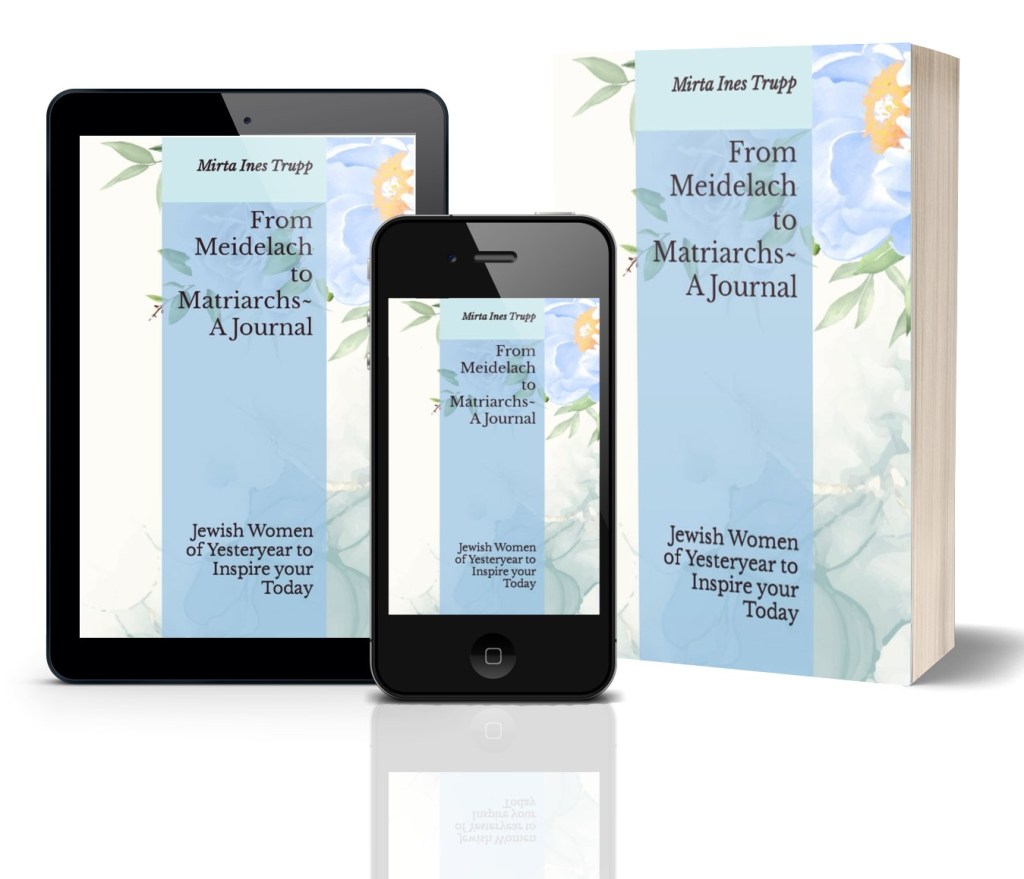
 Mirta Ines Trupp~ Author