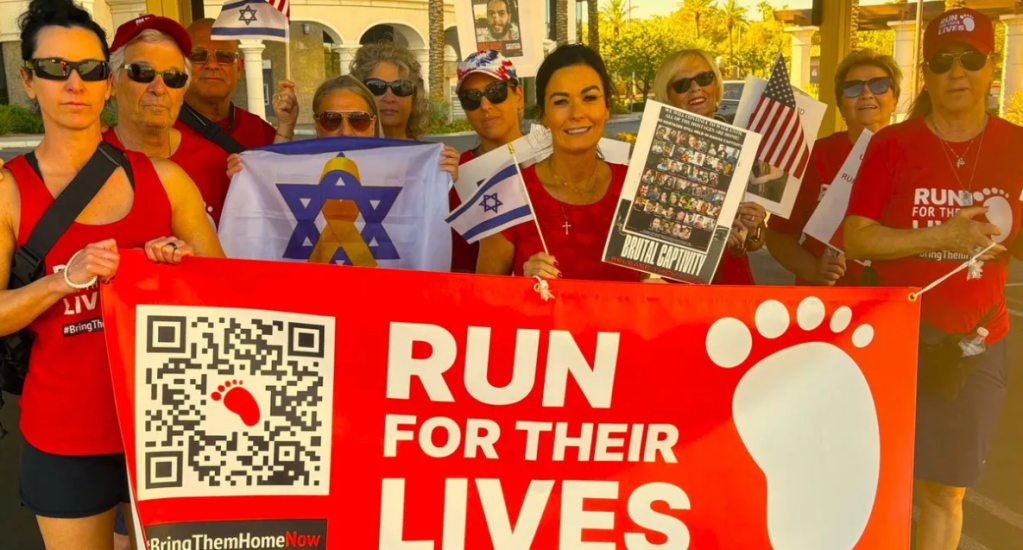
A Funny Thing Happened on the Way to a “Run 4 Their Lives” Hostage Awareness Walk. For those of you in this audience who are today-years-old, my opening statement alludes to an old vaudeville line—and a 1962 musical that is filled with humorous situations and mistaken identities. But I digress…
I wish with all my heart that I could have met today’s guest author under different circumstances; but, until our meshpucha (our family) are released from captivity, we will walk in our neighborhoods—across the country and around the world—to raise awareness that the hostages Are. Still. There.
On one such walk, after having walked together week after week, Lauren and I discovered that we both write historical fiction. Up until that moment, we saw each other as concerned Jews; two middle-aged women outraged at the lack of basic, human rights for innocent people held hostage for two years as of today.

Needless to say, we were very excited to learn we had other—more pleasant—things in common. And before any of you “couch referees” or “armchair critics” judge my choice of adjective or lack of vocabulary, excited is absolutely apropos! As you will soon learn, Lauren is much accustomed, shall we say, to that particular sentiment.
According to her website, Lauren Tallman “is a fearless voice in modern erotica and candid conversation.” Yes, you read that correctly. Lauren, also known as Lady Tallman or Lady of Glencoe, founded the Erotic Writers Group of Las Vegas in 2014. She has been a member—and is the current vice president—of the Henderson Writers Group (HWG) since 2009, where her stories have been accepted into six HWG anthologies.
In addition, my lady, Lauren is a columnist for the Vegas Voice where she writes about Health & Wellness and informs us that, “Seniors Still Do It.”
After doing a little research of Lauren’s online presence, I learned my new friend was born in Lithuania. Her arrival to Nevada was quite the trajectory, as stated here: “Her journey spans six cities across four countries, with thirty unforgettable years spent in Israel before making Las Vegas her home in 2006. Her diverse life experiences fuel her writing — bold, raw, and unapologetically honest.”
Lauren’s books, How To Have An Affair And Not Get Caught, Harem of the Dragon, Taste the Kiss Feel the Fire, Anthology X, and Come Again? have received world-wide recognition.
Talk about spicy!
“How did you come to write these provocative narratives,” I asked.
Lauren didn’t miss a beat.
“Because I’m good at it,” she replied.
I wasn’t altogether sure if she meant if she was good at writing or, you know… Very well, I’ll say it: sex.
Naturally, I shared my—um—passion for Jane Austen Fan Fiction with Lauren. And, after giving it a bit of thought, she and I are not so far apart in our writing style. We both are fulfillers of fantasy, we both are devisers of dreams. Certainly Austen cannot be considered a purveyor of erotica, but her writings did contain sexual undertones and innuendo. Think of Northanger Abbey and Mansfield Park.
In this JSTOR post by Beth Lau, Catherine Moreland is shown to “be an astute sexual and social strategizer who ends up marrying the most eligible man in the novel.” And in this essay, author Avrom Fleishman urges caution in “simply assuming that Jane Austen came under Evangelical influence…in order to explain a presumed moralizing tone in the novel.”
“Sexuality is not a topic which springs immediately to mind on considering Jane Austen’s novel, “Mansfield Park,” but, in fact, much of the energy of the novel derives from the powerful machinations of sexual politics and much of the novel’s interest comes from the usually suppressed—though all the more fervid for that—love of Fanny for Edmund.” ~
Giulia Giuffre, “Sex, Self and Society in Mansfield Park”
No, Austen’s contemporaries were certainly not puritanical. Courtesans were prominent in London society. Sexual relationships were often discussed openly, and literature and art were often a celebration of sensuality. If we had a ha’penny every time we read about a couple “anticipating their vows”, we Regency fans would be set for life!
In fact, when comparing the Georgians, Victorians, and Edwardian eras, the Georgians (the era, not the country!) “were considered less prudish about sexual relations compared to the Victorians, who were often seen as more repressive due to strict moral codes. The Edwardians, while still influenced by Victorian values, began to show more openness towards sexuality and social norms.”
I have whet your appetite, I do believe, and expect that you are hungry for more. Do try to curb your frustration. Restrain your lust for the upcoming salacious dialogue because, without further ado, I’ll get on with the interview!
Host: You are very welcome, Lauren. Please tell us about your work.
Guest: As a writer of erotica, I say my genre is “historical fiction with sensual undertones.” It very well tells what I write: erotica. Several books were published after Harem of The Dragon. After many requests, the sequel is now in the works.
Host: That’s fascinating — “historical fiction with sensual undertones” really captures how you weave emotion and history together. Humanity’s struggles are naturally a combination of frenzied passions, often seen through a cultural or spiritual lens. With that in mind, what are your thoughts on Jewish Historical Fiction? Why is it an important, stand-alone, genre?
Guest: It’s imperative! Fiction always has a seed of truth, based on things we heard at family dinners or read in history class. Those seeds make the story line. Making the stories fiction allows us to read fascinating tales while unwittingly absorbing facts about our people. It’s difficult to read our history. It’s clever to blend it into fiction while still getting truths and facts across.
Host: That’s a wonderful point — by weaving truth into fiction, readers can connect emotionally to history they might otherwise find too painful or heavy to face directly. It’s such an effective way to preserve culture and pass on knowledge through story. Here in the United States, our exposure to Jewish narratives often centers on two main threads — the Holocaust and Fiddler on the Roof-type themes of shtetl life. But as you suggest, there’s so much more to explore, from different eras, places, and diverse perspectives. Could you share some titles of your favorite non-Holocaust Jewish fiction — stories that reveal other sides of Jewish experience and identity?
Guest: My Name Is Asher Lev by Chaim Potok – a Hasidic boy with artistic inclinations which almost destroys his family and life. A little heavy but very well done.
I felt I was hearing Flavius Josephus when I read The Wars of The Jews. I was there with him. I could see the battles and survival.
Exodus by Leon Uris – I literally took the book to the library (that’s how long ago I read it) and read what I could about the creation of Israel. I looked up the facts such as the name of the real Exodus captain and found where Moshe Dayan was jailed (as used in the book). Ben Gurion was quoted: “…as a piece of propaganda, it’s the greatest thing ever written about Israel.”
The Source by James Michener is a must— I read it while living in Israel. When I realized it was about Megiddo, I drove out there. I searched every inch of the tell. The story was etched in my brain. I studied the tunnel and saw how the rock had been chipped by hand to make way to the source/water, the bringer of life. Trust me, I just stood there and understood the need to live, to survive, for themselves and thousands of years later, for me.
Host: Those are such powerful selections, Lauren, each one not only captures a pivotal moment in Jewish history but also brings it to life through deeply personal storytelling. I love how you described standing at Megiddo after reading The Source — that image of tracing history with your own footsteps is incredibly moving. I appreciate authors who weave accurate history throughout the storyline. While completing research for your novels, did anything particularly affect or move you? Were there any discoveries or moments that truly took you by surprise?
Guest: In Harem, I had 125 pages of research, indicating what they ate, where they slept, their customs, and so much about the difference between Emperor and commoner. No matter what you write, you can’t help but be moved when reading history. How could you know that gold/yellow could only be worn by the Emperor during the Ming Dynasty, and anyone daring to wear it was executed. How could you know that the Star of David worn by Holocaust victims was yellow indicating the color of urine. Without a word, the star was made to be a symbol of the lowest of low. What comes as a surprise? The agility, the rage, and the ability of people to rise up, to become greater than before, yet not as great as they would be in the future.
Host: Lauren, that’s a powerful observation. The resilience of people to rise, transform, and keep striving for something greater is truly timeless. It’s that same human spirit that often defines the heart of historical fiction, even when the setting or circumstances change. As you know, Regency Romance is a favorite genre of mine; however, Jane Austen did not consider herself to be a romance author and she was not labeled as a “Regency” novelist during her time. That being said, Austen’s narratives did impart a sense of physical attraction, of longing. We “Janeites” are familiar with the social taboos of sexual conduct and the corresponding gossip that usually follows. Talk to us about the taboos of today—in a society where apparently “everything goes.”
Guest: It doesn’t go. America is straight-laced compared to most countries. As a writer of erotica, I see people show their disdain for written sensuality. They feel ashamed or, worse, embarrassed about desire. There are affairs – I know, I wrote the book, How to Have an Affair and Not Get Caught. In public, people walked past me at a book signing. But they bought the book online or through my website (laurentallman.com). They don’t talk the talk, but they certainly walk the walk. In short, ‘everything goes’ may happen behind closed doors but speaking to the average Joe about passion doesn’t fly. Taboo means ‘something that is not acceptable’. Passion, want, need, and pure desire have been labeled taboo. How sad.
Host: That’s an insightful statement, because those “unacceptable” feelings have driven some of the greatest stories ever told. Authors lend authenticity to their narratives by not shying away from natural emotions or diverse, complicated scenarios. Which leads me to my next question regarding walking the same ground, so to speak, as your characters. Have you visited any of the locations you’ve written about?
Guest: I try to. I write a monthly column in The Vegas Voice, regarding senior relationships. When I wrote about the hot springs in Cali, I spent the night there. Making love under the stars? I stayed out under the stars, to see if it was doable. (It is doable.) Actually, being at a location gives me far more information than just calling on the phone or looking up a place on the net. And people love to talk and share information that you would never have known otherwise.
Host: Lauren, you are an adventurer! How long have you been writing? When did you first consider yourself an author?
Guest: Oh, forever! Even as a child I could tell a good story. Not that I knew anything about the art but the stories weaved in the senses: rain dripping from tree leaves and hurling to the ground, ivory clouds, the sound of skates on ice. My first book, The Erotic Tales of Renni (not published, long story) was written 35 years ago. When I first published the affair book, I realized I was a true author. Since then I’ve written short stories, my forte, as well as books. At first it was difficult to say “I am an author.” Someone told me, “You worked hard on your book. You researched, edited, and marketed it. You deserve the title author.” They were right.
Host: I wholeheartedly agree! Of late, the term “Historical Romance” seems to equate with a narrative containing sexual language or scenes ranging from “clean reads” to soft porn to something rated XXX. While some readers prefer “drawing room romance” to “bedroom romance” —where adult activities are carried out behind closed doors—there is a massive audience that wants the spice level turned up all the way. In your experience; and, speaking in general terms, how does an American audience differ to that of an Israeli audience?
Guest: Day and night. In Israel I can speak about Harem, which has ‘edgy’ erotica, or any of my many short stories, without missing a beat. They commend me for writing an interesting, and truly sensual, story. Here, I had to change the wording on Harem’s cover, from erotic to sensual. Israelis listened, sipped their coffee, and asked questions!

Americans would first say, “I don’t read porn.” And I’d answer, “Neither do I.” They’d stare are me. I often explain, “Erotica is a whisper. It is sensual. It is tender. It can be edgy because sensuality comes in different levels.”
By the way, my books don’t have one “dirty” word in them. A nice Jewish girl from Brooklyn doesn’t say those things. So I turned to erotica which shows you sensuality rather than tells you. I wouldn’t write, “He grabbed her (fill in the blank).” Rather, I write, “Her skin felt like silk under his fingers.”
Host: I love that you make it your own and have no need to apologize or explain your style.
“I could not sit seriously down to write a serious Romance under any other motive than to save my life, and if it were indispensable for me to keep it up and never relax into laughing at myself or other people, I am sure I should be hung before I had finished the first chapter. No – I must keep my own style and go on in my own way; and though I may never succeed again in that, I am convinced that I should totally fail in any other.” ~ Jane Austen
Host: Lauren, thank you for participating on another fascinating, Author’s Interview! Before we end our chat, is there anything else you’d like to add?
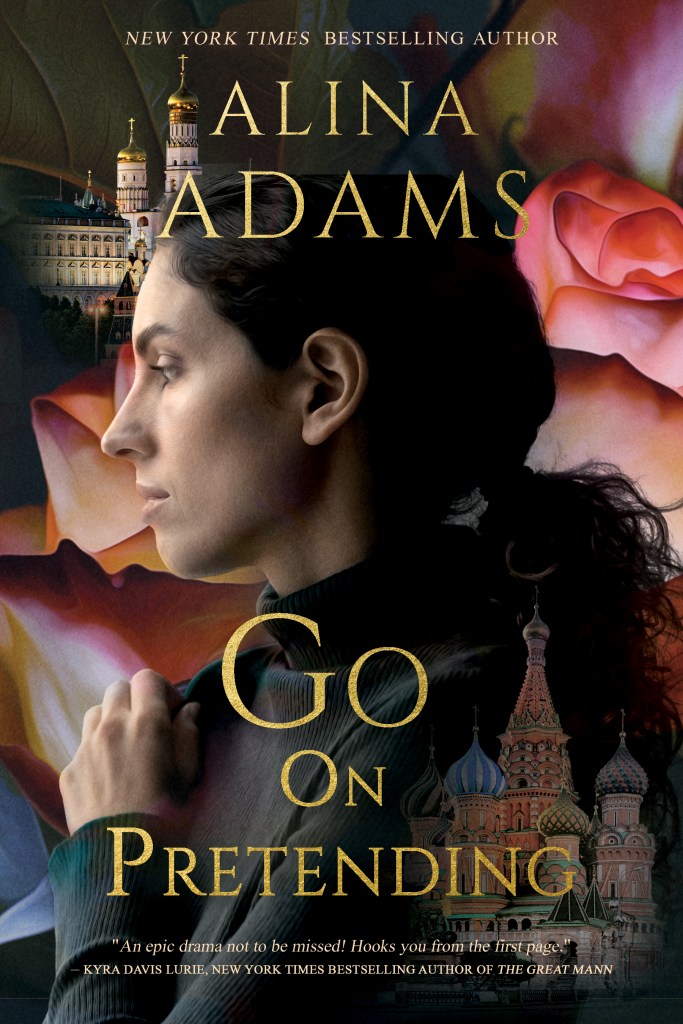
Guest: Yes, thank you. My books can be found on my site laurentallman.com. My podcasts and columns are on The Vegas Voice site (thevegasvoice.net). Id like to share the last paragraph in Harem:
I jumped out and walked alone until I reached the edge of the mighty wall.
I breathed in the brisk air. My nostrils flared and my chest burned as a fire waited to burst forth.
The waves crashed but dared not splash onto me.
The wind swirled but did not have the courage to dry my eyes.
I raised my arms, clenched my fist, and shouted out to the ebb and flow of the water.
“I am Long, Chief Eunuch of the Emperor’s Harem. Hear me waters. Hear me wind. Scream my name to the sky and say, I am the dragon.”
Thanks, again, Lauren! And thank you, reading audience! I hope you’ve enjoyed the post and I look forward to hearing your thoughts in the comments below.


 Mirta Ines Trupp~ Author