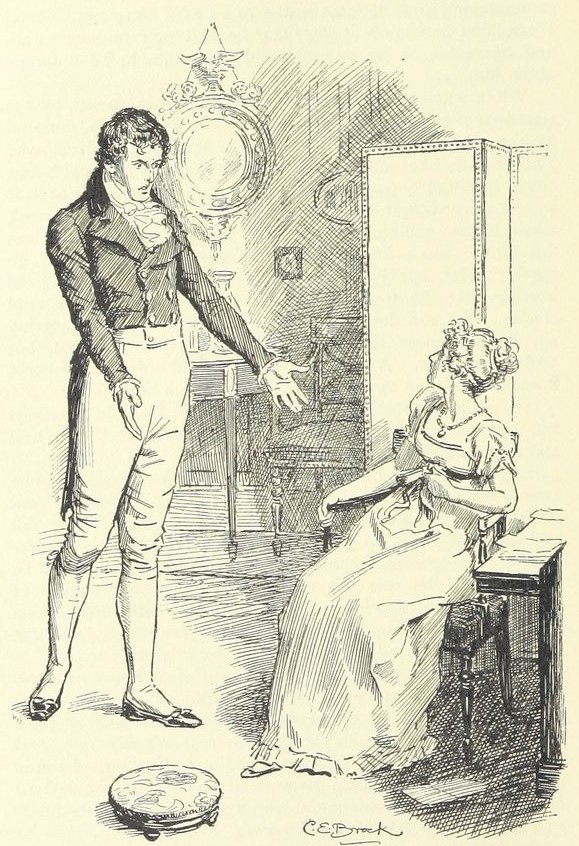
Miss Caroline Bingley provides a definition of a “lady of quality” in Jane Austen’s Pride and Prejudice. However, in trying to call attention to Miss Elizabeth Bennet’s lack of social graces (the young lady would rather read, than play cards. Heavens!) Miss Bingley miscalculates and misses her mark. Mr. Fitzwilliam Darcy sees past the thinly veiled attack and offers a rejoinder of his own.
All this she must possess,” added Darcy, “and to all this she must yet add something more substantial, in the improvement of her mind by extensive reading.”
Pride and Prejudice~ Jane Austen
Without a doubt, Jane Austen was familiar with Proverbs 31. After all, she was the daughter of a Anglican rector. No doubt, she drew inspiration from the words that described a Woman of Valor. In fact, Austen’s own brother made certain to memorialize her using a quote from the same passage.
She opens her mouth with wisdom; and in her tongue is the law of kindness”
Proverbs 31:26
Miss Elizabeth Bennet is known to be witty—a nicer way of saying sarcastic—and quick to judge. Certainly, the opposite of speaking with wisdom and kindness. Like any character worthy of notice, however, she goes through a series of events that spark introspection and change. Austen provides the arc for this character’s spiritual and emotional growth.
When Miss Bennet arrived at Netherfield, Mr. Darcy observed her skirts covered “six inches deep in mud…her hair, so untidy, so blowsy!” Instead of censuring her for her lack of grace as Miss Bingley was quick to do, Mr. Darcy saw a woman whose mission that day was to attend to her sister, Jane, who had taken ill. Clearly, the young lady had no improper pride; she was not there to exhibit or to lay claim to her many accomplishments. Later, when the party gathered in drawing room, he saw a young lady who would not be swayed by peer pressure. Elizabeth Bennet stood her ground against Miss Bingley and read a book, rather than play at cards.
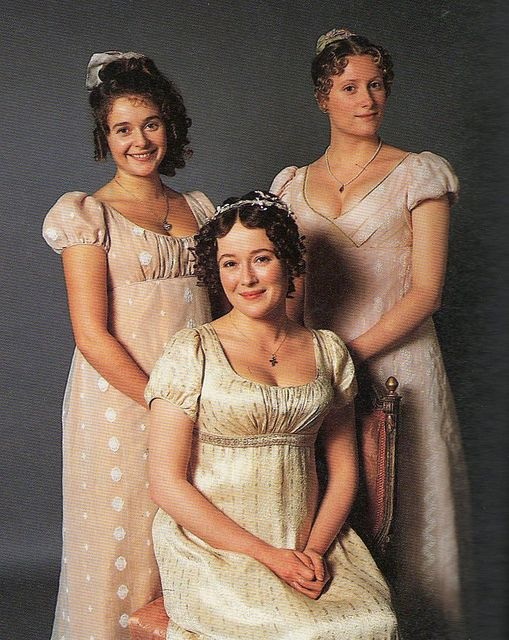
In the 1995 version of Austen’s novel, Lizzy is asked to perform at the piano during a visit to Pemberley. She had no great talent, and often admitted her failure to practice. Lizzy does play, however, and the room is delighted. It is probably one of the most beloved scenes of the series. The admiration on Mr. Darcy’s face says it all. Throughout the novel, he was known to be a man who despises cunning and deception. He cannot, therefore, fail to notice Lizzy’s strength of character, her kindness, her vivacity, and grace.
It’s my belief that, in showing the character’s ability to reflect, to admit her own failings, and to seek to come up a bit higher, Austen created an Eishet Chayil —a Woman of Valor.
There are many in Austen’s fan base that have crafted devotionals inspired by the author’s work and personal life. I hope to add to the flavor, so to speak, by offering my own take on Women of Valor with this motivational journal.
This month, the British empire suffered a tremendous loss. I dare say, the world at large lost a dedicated and devout leader. Queen Elizabeth’s death touched people from all walks of life, none more so than the Jewish community under her protection.
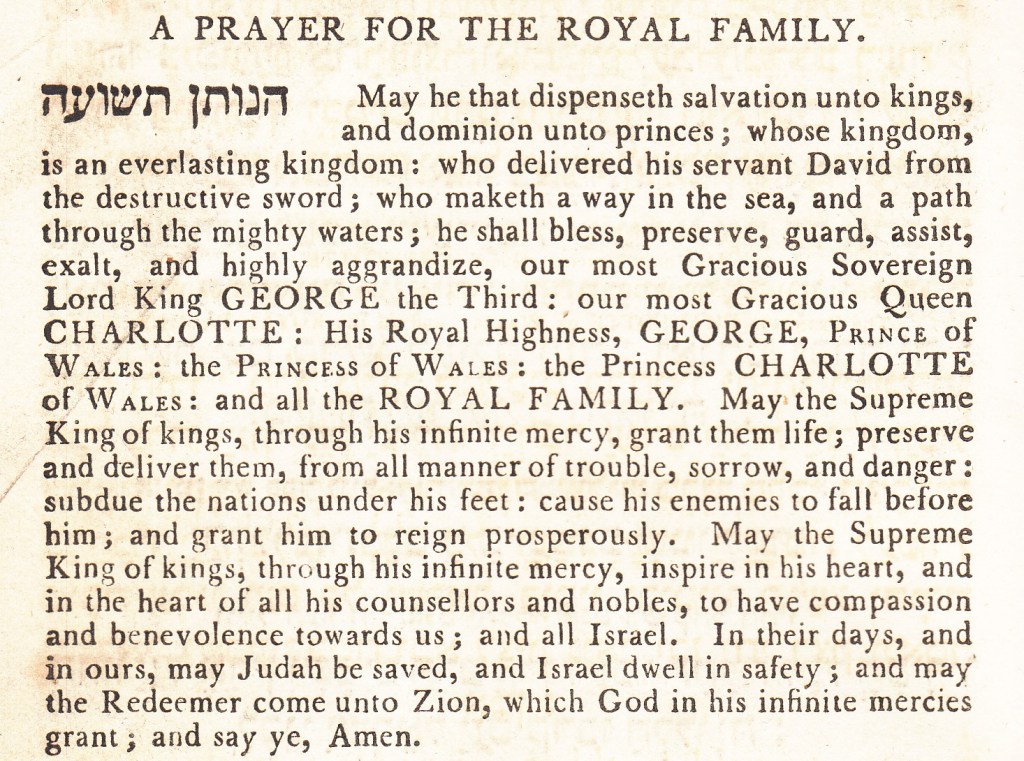
For over seventy years, congregations across the land concluded their Sabbath service praying that “He who gives salvation to kings and dominions to princes, guard her and deliver her from all trouble and sorrow.” But Jewish prayers for the monarchy, or for any ruling government, are not unusual. After the Israelites first expulsion from Jerusalem in 586 B.C.E., the prophet Jeremiah urged the community to pray to the Lord in order for Him to guide their foreign rules with wisdom and compassion. These prayers were eventually incorporated into the siddurim (weekly prayer book) in the 14th century.
However, the supplications were not solely reserved for the Sabbath service. In England, any royal event may have called the community to prayer. Indeed, if Jane Austen attended a Jewish service in 1787, she would have heard a prayer calling for the preservation of King George lll “from the hands of an assassin.” And in 1817, while the empire mourned the death of Princess Charlotte, Hyman Hurwitz composed Israel’s Lament: Mourn for the universal woe, With solemn dirge and fault’ring tongue, For England’s Lady is laid low, So dear, so lovely, and so young!
Of course, there were occasions for happier prayers, such as the Golden Jubilee of Queen Victoria in 1887 and that of Queen Elizabeth II in 2002 and again in 2022.
Her crown is honor and majesty; her scepter, law and morality. Her concern has been for welfare, freedom and unity, and in the lands of her dominion she has sustained justice and liberty for all races, tongues and creeds.”
Rabbi Ephraim Mirvis, the Chief Rabbi of the United Kingdom and the Commonwealth
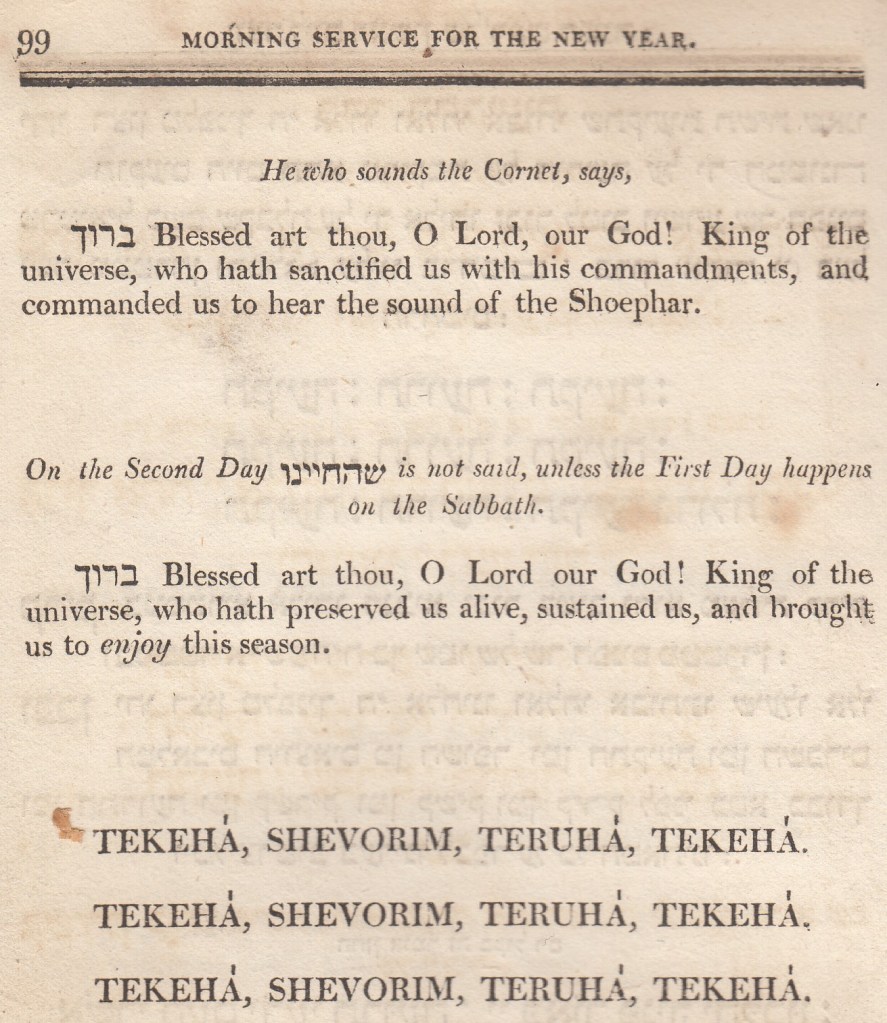
Did you know that the concept of jubilee hails from the Torah (Pentateuch)? According to the Book of Leviticus, a commemoration was held at the end of seven cycles of shmita (sabbatical years). Slaves or prisoners would be freed, debts would be forgiven and “the mercies of God would manifest.” The sounding of a ram’s horn (a shofar) would proclaim the celebration. In fact, the ancestral summons was used to announce a variety of events, including a king’s coronation or the proclaiming of a period of mourning—so apropos during these sad days of September.
This is the moment history stops; for a minute, an hour, for a day or a week; this is the moment history stops.”
BBC NEWS
If we were living in biblical times, the shofar would have certainly announced this momentous occasion and the community would have responded in kind. Today, Jews worldwide recognize the cry of Tekiah as the call to prepare for the new year and the Day of Atonement.
For over 5,700 years during the month of Elul (which usually falls during August or September in the Gregorian calendar), the piercing sound of the shofar has beckoned us to examine our behavior—to ask for forgiveness and to prepare to make amends for the new year.
I came across another blog post about Anglo-Jewry while preparing this article. Naturally, it led me to another post where I discovered an interesting historical figure by the name of Solomon Bennett. For a variety of reasons, Mr. Bennett made it his life’s work to torment Solomon Hirschell, the Chief Rabbi of the German and Polish Jews of England. To be honest, I would say that both Solomon Bennett and Solomon Hirschell were full of themselves! If ever anyone ought to have heeded the sound of the shofar…The series of events that transpired between these two men borders on the ridiculous. Therefore you cannot fault me, dear reader, for immediately envisioning Mr. Collins and Mr. Bennet of Austen’s Pride and Prejudice.
Mr. Collins is a clergyman. He is tall and maintains formal manners; he comes across as pompous and grave. He takes great pains to inform everyone about his social status, which mostly stems from his noble patroness. Mr. Collins is excessive in his compliments and excessively snobbish. His counterpart is Mr. Bennet of Longbourn. This landed gentleman has a sarcastic, cynical sense of humor which he purposefully uses to irritate his prey. However, his dry wit and composure in the midst of mayhem serves him ill, for Mr. Bennet is weak and largely ineffective as a husband, father, or property owner.
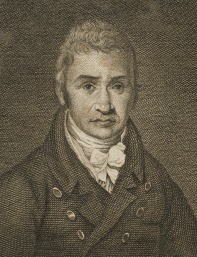
Solomon Hirschell
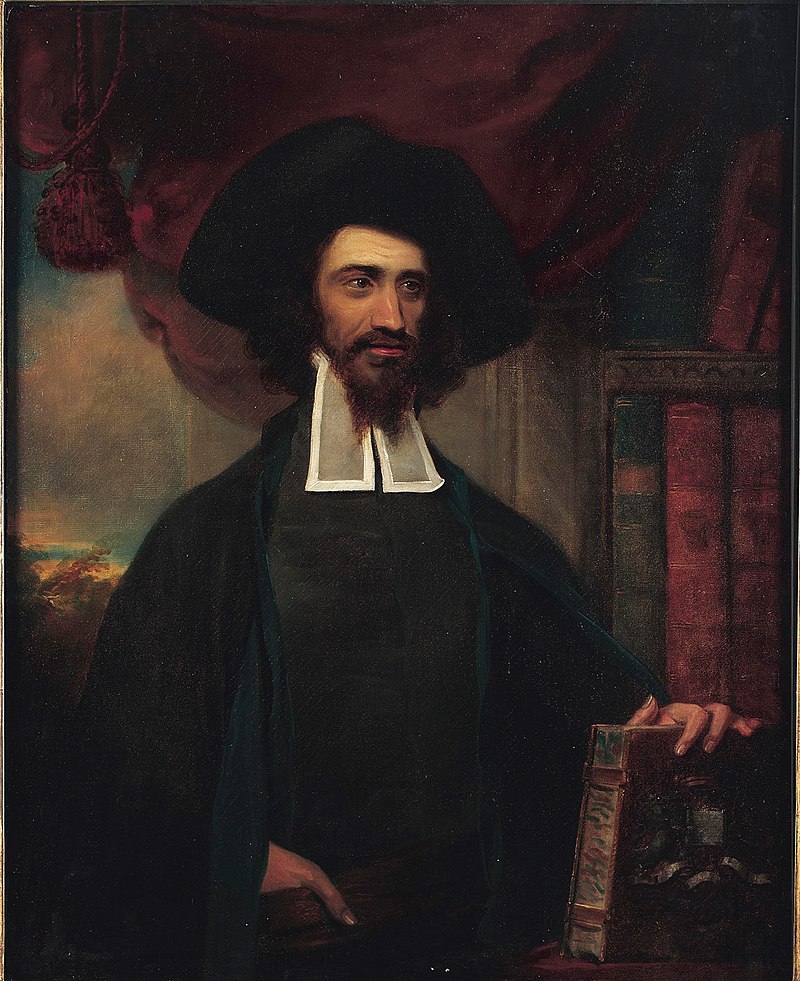
I now present Rabbi Solomon Hirschell. He was said to be a tall and imposing sort of man. He was a traditionalist and did not apologize for wanting to maintain ancient standards and customs. The rabbi liked to boast of his long line of impressive ancestors and benefactors, such as Sir Moses Montefiore and the Goldsmids. Although he had no formal secular education, Hirschell was proud of his Talmudic training and made it known that he possessed an impressive rabbinic library.
In 1811, the European Magazine published an interview with the clergyman. Hirschell proclaimed that he was direct descendant of the royal house of David. He believed his election as chief rabbi to be a natural turn of events. His fiercest enemy, Solomon Bennett, had a field day with that announcement. An author, artist, and a Hebrew scholar in his own right, Bennett publicly ridiculed the rabbi by declaring that he was only given the position due to his connections. But it didn’t end there. He claimed that Hirschell was barely competent in the English language and that he hid behind his father’s precious library to mask his illiteracy.
Of one thing you may be assured, Hirschell could only have known my English publications at second hand because he could not even understand them in the original language, of which his knowledge is so slender.”
Bennett continued to write scathing remarks about the shocking lack of rabbinical publications put out by the Hirschell administration. The Magna Bibliotheca shows that the chief rabbi only published three sermons. Of note: one marked the battle of Trafalgar in 1805 and another, which warned the community against sending their children to secular schools. The rabbi was so set in his ways, the sermons were given in Yiddish and had to be translated into English for publication.
Sometime around 1815, Rabbi Hirschell endorsed a book of Jewish studies written by another Solomon —Solomon Jacob Cohen. Bennett was highly critical of the work and published a 66-page pamphlet where he called the rabbi “a proud, savage, and tyrannical Pontiff…in his orthodox piety on the one hand, and his ignorant malice on the other.”
Solomon Bennett
The public did not appreciate Bennett’s wit and he did not succeed in defaming his nemesis. In fact, the project was a complete failure and Bennett lost money— a £100 to be exact. Short of funds, he was unable to pay his publishers and was sent to debtor’s prison—blaming Hirschell for his misfortune all along the way.
For all that was said against him, Rabbi Hirschell appeared to hold England dear. In one particularly poignant speech, the rabbi expressed his gratitude that “providence permitted me to return to this my beloved native Land.” During the Napoleonic wars, Hirschell encouraged his congregants to enlist and to serve their adopted nation. It was also said that the rabbi secured permission for Jews to “stay away from church parades and to be sworn upon the Book of Leviticus—instead of the New Testament.” This was in keeping with his lack of interaction with his Christian counterparts and his sermons against the newly established Reform movement. On the other hand, Hirschell was known for his charitable organizations and worked to help the relatively newer community of Eastern European Jews.
In 1811, he aided the Westminster Jews’ Free School to open its doors. In 1817, the Jews’ Free School was founded. In 1820, the Western Institute for Clothing and Apprenticing Indigent Jewish Boys was opened; and in 1824, the Society for the Relief of Indigent Poor began providing widows with five shillings per week.
During his administration as chief rabbi, the problem of poverty was investigated, reforms were suggested, and solutions were implemented (certainly not in keeping with a Mr. Collins). In the face of these good deeds, Mr. Bennett’s cynicism should not have prevailed; however, it did. To this day, Solomon Hirschell’s legacy remains tainted. He has been labeled as a pompous, unwavering traditionalist, ignorant and out of touch.
Without wishing to overstep the boundaries of a simple blogger (who has no right to sit in judgment), it would seem that the call of Tekiah fell upon deaf ears with these two men. Talk about pride and prejudice! Perhaps they ought to have heeded Elul’s message; they should have recognized the error of their ways and made amends. History might have been kinder to both if the had learned to compromise a bit; but to paraphrase Jane Austen’s Northanger Abbey, I leave it to be settled, by whomsoever it may concern, whether the tendency of these two gentlemen is to recommend tyrannical rivalry or reward stubborn constancy.
May the sound of the shofar awaken us to be kind to one another and to cherish the moments that make up the days of our lives. May we all be inscribed in the Book of Life and may the new year be blessed with health, happiness and goodwill.
It’s been a while since I’ve added to the blog. I thought long and hard on what I could present to this group of well-informed and clever people. In keeping with my modus operandi, I knew that I needed to combine my cultural heritage with my love for all things Austen; and so, I looked to the calendar and found my mark.
It’s May, and here in the United States, we just celebrated Mother’s Day—but not so in other parts of the world. Let me persuade you to take a turn about the globe with me. It’s so refreshing!
Cassandra Leigh Austen
Naturally, I will begin in England! Jane Austen would have been familiar with the festive occasion known as Mothering Sunday. Usually occurring during the season of Lent, it was a day for church, as well as acknowledging one’s matriarch. Even servants were given the day off, so that they could visit with their own mothers and perhaps share a token of their love. I did a little research on Jane Austen’s mother and found that Mrs. Austen was considered witty and quite talented herself with a quill and a bit of foolscap. It is generally acknowledged that the Rev. Austen supported his daughter’s love for reading and writing. However, it appears that Jane might have inherited her talents from her mother. I can easily imagine Mothering Sunday in the Austen household. After church, our dear girl would very likely read from her latest scribblings to honor her mother. Then perhaps, they would have tea with iced cakes or some such. They certainly didn’t head out for brunch or to the nearest salon for a mani-pedi!
In the United States of America, Mother’s Day is celebrated on the second Sunday in May. It is considered a secular holiday; but when first established by Anna Jarvis on May 10, 1908, it was celebrated during church services—at St. Andrew’s Methodist Church in Grafton, West Virginia, to be exact. I read that Jarvis was critical of the commercialization that quickly took over the occasion and continued to encourage all to reflect upon and honor the important contributions of mothers.
In my native country of Argentina—where Catholicism is the State religion—Mother’s Day originally coincided with the Feast of the Maternity of the Blessed Virgin Mary, celebrated in October. The feast day was later moved to January, which coincided with summer picnics and family gatherings at the beach. Argentines, however, decided that Mother’s Day would continue to be celebrated on the third Sunday of October. Needless to say, there is a plethora of spring flowers, cards and gifts to help celebrate the occasion.
In Israel, the commemoration of Mother’s Day came along with its own brand of controversy. It all began when the newly founded country couldn’t decide on which day to celebrate the occasion! The Ezra Society, headed by Sarah Herzog, the mother of then-president Chaim Herzog, established the first Mother’s Day on April 6, 1947. However, the city of Haifa initiated its own version when the mayor proposed that the day be linked to the Maccabean matriarch, Hannah. The mayor’s wife was also named Hannah. Hmm? In any event, Haifa celebrated Mother’s Day for many years during the Hanukkah season. Towards the end of 1951, the newspaper Ha’aretz Shelanu declared its own Mother’s Day initiative—perhaps hoping to settle the issue definitively. The editors asked its young readers to suggest a date to honor all Israeli mothers.
Side Note: Sorry! My mind took an unexpected detour. I was suddenly reminded of two other times when young writers responded to newspaper editorials. In October 1860, eleven-year-old Grace Bedell of Westfield, New York, wrote to presidential candidate, Abraham Lincoln. She urged Mr. Lincoln to grow a beard because “all the ladies like whiskers” and believed he would have a better chance at winning the election! In 1897, eight-year-old, Virginia O’Hanlon wrote to The Sun and asked whether Santa Claus was real. The newspaper’s response was published anonymously in September of that year. Due to its popularity, it was republished every year during the Christmas season until 1950, when the paper ceased publication. Now back to my story in Israel…
Eleven-year-old Nechama Frankel, responded to the newspaper query and suggested a date to honor the memory of Henrietta Szold, founder of Hadassah. Although childless, Szold had run an organization that rescued 30,000 Jewish children from Nazi Europe. The suggestion was easily accepted; but on a final note, Mother’s Day recently became known as Family Day. At 72 years of age, Nechama Frankel (now Biedermann) didn’t appreciate the change in the name and wrote her local newspaper—again! She asked that the “lost dignity of Mother’s Day be restored.” Sounds very much like her American counterpart, Anna Jarvis, don’t you think?
Me and my beautiful mom
All these meanderings have brought me to this point: Words have the power to effect change, to stir passions, and to alter the paths of women and men who otherwise might not take action. The importance of a well-written missive is not lost on us Janeites, whether it comes from a loved one across the ocean or a gentleman across the room.
My own mother, of blessed memory, wrote more letters than I can recall. They crossed back and forth from Argentina to our home here in the United States. They were filled with every possible emotion, from the simplest piece of gossip to the greatest despair. But these letters kept us united with our family half way around the world and that was her life-long goal. I am grateful to my mother for the many lessons she taught me. I miss her, and think of her, every. single. day.
In my novel, Celestial Persuasion, Miss Abigail Isaacs also receives a life-altering communication. I hope you enjoy the following excerpt.
“Might you share the letter?” Mrs. Dashwood enquired. Long accustomed to having her young friend’s housekeeper-cum-companion present in times such as these, she handed Mrs. Frankel some tea and cake.
Abigail nodded slowly and proceeded to read her letter aloud. She had no wish to hide the contents of Captain Wentworth’s message; and in fact, she was curious to hear the ladies’ opinions. “And there you have it. Papa and Jonathan are gone from this world.”
“Whatever shall you do?” Mrs. Dashwood asked.
“I am a woman alone, with little means of support and head full of impractical aspirations. In truth, I have no idea at present.”
“You might do well to follow Jonathan’s example,” murmured Mrs. Frankel, setting down her plate of seed cake. “You might apply to the Royal Navy.”
“Never say so!” Mrs. Dashwood cried. “Has the Crown gone through all our fine men and boys, that we are now enlisting young ladies to battle the French?”
“No, no.” Abigail shook her head in gentle reproach. Mrs. Frankel ought to have known better than to mention such a radical scheme.
“For some time now, Miss Isaacs and I have been following the news of an extraordinary woman by the name of Mary Edwards,” Mrs. Frankel, now a little recovered, continued unabashed. “The London paper had a full story on her work as a computor for the British Nautical Almanac. She is one of a very few women paid by the Board of Longitude.”
“But what is her work?” insisted Mrs. Dashwood.
“It is rather intriguing,” supplied the housekeeper. “With her mathematical talent and computational skills, she is tasked to calculate the position of the sun, moon, and planets at various times of day. I have no doubt that our dear girl could do the same.”
“Whatever for? I am sure I have never heard of such a thing!”
However sensible Abigail was to her own sad mental state, it did not follow that the dear lady ought to be left to feel bewildered, so she provided further explanation.
“They use the information for nautical almanacs, Mrs. Dashwood. According to The Times, Mr. Edwards took on piecework to supplement the family’s income. After his death, it was revealed that Mrs. Edwards had done most of the calculations. It all came out into the open when she asked that they continue supplying her with work. She had to support herself and her daughters, you see, and they happily complied. This is what Mrs. Frankel was referring to when she suggested that I apply to the Royal Navy.” Abigail saw at once that her friend was aghast at the mere suggestion and waited patiently for her reply.
“I have always thought your education seemed rather …excessive,” offered Mrs. Dashwood. “As your poor mother was no longer with us and able to voice her concerns, I daresay your father was pleased to provide you any pleasure.”
Abigail smiled at the memory of her father’s affection and shrugged her acquiescence.
“You were the light of his life, and I told him so many a time. He was quite amused at my observations and went so far as to explain that your name, Avigail, means a father’s joy in the language of your ancestors. I must say, my dear, they chose your name wisely.”
“Avigail Yehudit—such noble names!” Mrs. Frankel exclaimed. “Such fine examples of female wisdom and valor.”
“Papa prevailed with his first choice,” said Abigail, “but Mama was appeased with the second. Judith was her favorite biblical heroine— or so I have been told. But it was all for naught, for Jonathan had wished for a brother and thought the names too feminine! I simply became Avi to him. But it is of no consequence. Whichever name I choose, be it the English version or that of my ancestors, Isaacs will remain the same.”
Mrs. Dashwood would not have any of it. “But my dear, you are young yet. Might you not consider marriage? Mr. Green has shown great interest in you…”
“Mr. Green, ma’am, is a widower with three children. His only interest in me is knowing that I would make a proper physician’s wife, and I have begun to believe that I am not meant for love. I am intelligent and have received an excellent education, thanks to my doting father and my…my brother’s enthusiasm.” Abigail paused and sipped her now-tepid tea while she attempted to compose herself.
“You might apply to Sarah Guppy and ask for her advice,” Mrs. Frankel insisted. “She too has worked for the Royal Navy. You have yourself informed me of her numerous creations and inventions. Of course, the patents were secured through her husband—”
“My dear…” Mrs. Dashwood set down her tea things with trembling hands.
“Pray forgive Mrs. Frankel. I believe she is merely attempting to call my attention to various alternatives, unconventional though they might be,” Abigail quickly added. “In truth, ma’am, the day’s events have taken their toll. I am pained knowing that Jonathan will not return to us. He was my beloved brother, but he was also my partner, my teacher and confidant. My friends, I am lost. I am drifting at sea without the North Star to guide me.”
“Might you not receive a pension for your poor brother’s service? What would your good mother have thought?”
I’ll sign off now with an amended version of my mother’s famous salutation: With Love, A Jewish Regency Author~
There are those among us that could recite the so-called Hunsford Proposal—dismal and pathetic as it might have been—verbatim and with great flare. Mr. Darcy’s declaration of love is etched into our souls. Scenes from our favorite film adaptations—every raised brow, every clenched fist, and heaving breast—are easily recalled.
My feelings will not be repressed. You must allow me to tell you how ardently I admire and love you.”
At this juncture of Austen’s novel, Mr. Darcy and Miss Elizabeth Bennet are yet at odds with one another. Although he is besotted with the young lady, Mr. Darcy can’t see beyond his pride. His sense of Miss Bennet’s “inferiority,” her family connections and other obstacles are degrading in his view. Still, he feels strongly enough to forge ahead with the alliance and is certain that the lady will throw herself at his feet! However, our dear girl does nothing of the sort.
Although Lizzy’s reaction is in keeping with the insulting proposal, her own view of the gentleman is not without fault. Her sense of pride has been wounded since she overheard Mr. Darcy’s first words at the Meryton assembly and his unexpected declaration only served to further sanction her ire.
Austen’s work is often characterized as lovesick fiddle-faddle; however, the truth of the matter is the author is more a sociologist than romance novelist. What happens afterthe failed Hunsford proposal can only be called brilliant, because it is here, where Austen’s sharp observations of the highs and lows of human nature come into play. And when our dear couple finally find themselves thrown together once again, the results are as satisfying as a resolving chord after several measures of dissonance and tension.
My affections and wishes are unchanged; but one word from you will silence me on this subject for ever.”
In my J.A.F.F, The Meyersons of Meryton, I introduce a new family to the Bennets of Longbourn. Thanks to his alliance with Mr. Gardiner, Mr. Moses Montefiore and his brother-in-law, Mr. Nathaniel Rothschild, Rabbi Meyerson comes to Hertfordshire to establish a synagogue for the small Jewish community. But there is more to the story as the good rabbi is withholding some important facts. His dear wife will be shocked at his disclosure. The Bennet family will also have to deal with the consequences—none more so than Elizabeth and Mr. Darcy.
Their wedding is postponed, and the unexpected (and undesired) arrival of Mr. and Mrs. Wickham causes the anxious bride to have more than her fair share of the jitters. The following scene finds Elizabeth sharing her troubling thoughts with her betrothed.
“What is the matter, Elizabeth? You have not been yourself. Pray, tell me, what have I done?”
She winced at his concern, feeling penitent and undeserving. Still, she owed him some reply. “You have done nothing, sir. I feel…that is to say—I feel that I am ill prepared, Mr. Darcy.”
“Are we back to mister, again?” he whispered.
His sweet murmuring sent shivers down her spine, but she hardened herself and would not succumb to his charm. “A woman has so few opportunities to decide for herself, Mr. Darcy. Pray allow me to reconcile my doubts. A woman ought not to enter the matrimonial state half-heartedly.”
“I was not expecting such a practiced homily, certainly not at a time such as this.”
“I am my mother’s daughter,” she said, lifting her chin with a decisive flair. “I am outspoken and given to fits of impertinence—and well you know it. You witnessed my unpardonable display with Lydia, did you not? Lady Catherine accused me of being lost to every feeling of propriety and delicacy. Perhaps she was right.”
“Good God, Elizabeth! What does my aunt have to do with any of this?”
“Under the circumstances, one cannot help but be sensible to the lady’s objections. Already you have had to intercede on my family’s behalf, thanks to Lydia’s passionate and foolish nature. Now our wedding must be postponed due to my father’s involvement in espionage and heaven knows what. In reviewing my own behavior, I cannot help but find myself wanting of those talents which, surely, Mrs. Darcy of Pemberley should possess. Seen in this prodigious light, can you not acknowledge that Lady Catherine might have good reason to object to your connection to Longbourn?”
Is that our dear girl? Is that the Lizzy we’ve grown to know and love? Some readers have found the protagonist of my variation to be untrue to Austen’s vision. In my defense, I can only say that I followed Austen’s example of observation and delved a bit deeper into this beloved character. We know Elizabeth Bennet enjoys long walks and appreciates nature. She is lively and a brilliant conversationalist. Unfortunately, she is also a bit proud and not a little prejudice in her own right. And under certain, dire circumstances, Miss Elizabeth Bennet can be riddled with a common, ugly human flaw: self doubt.
In keeping with Pride and Prejudice, a series of events take place that find our dear couple thrown together after a brief separation. Much like Austen, I created a scene where Mr. Darcy bares his soul—again. But this time Elizabeth believes.
I hope you enjoyed the post and take a chance on The Meyersons of Meryton! If you like the video, please give it a thumbs up on YouTube. Until next time~
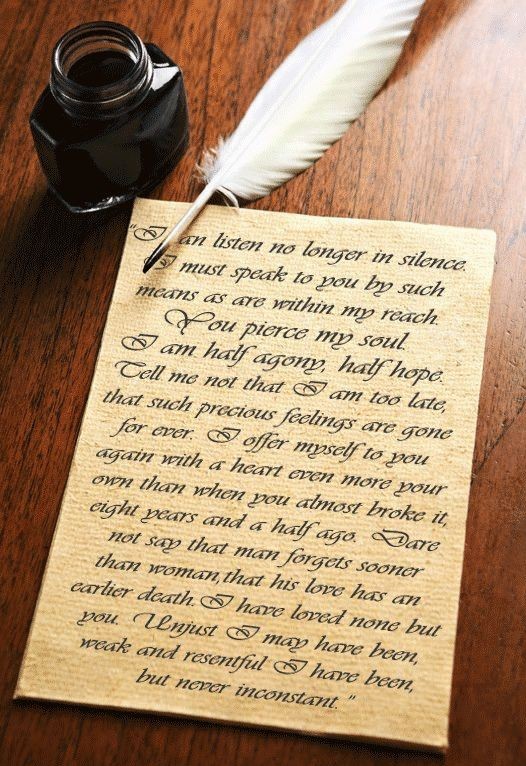
For those of us who have read Austen’s Persuasion, there can be no doubt. Captain Wentworth’s letter to Miss Anne Elliot is exquisite. It is a pivotal moment which brings tears to our eyes and returns hope to our bruised hearts.
But have you ever given any thought to what might have occurred before the good captain returned to England? The man was distraught! He was possessed by bitterness, regret, and a profound sense of grief. Did he pour out his heart? Did he attempt to contact his one true love and see if he could secure her trust and affections? No. No, he did not. The brave and battle-born sea captain dug in his heals and refused to give quarter! When he finally returns to England, he shows Anne Elliot no mercy and our hearts cry on her behalf. It’s not until the very end of the story that our injured souls truly begin to heal, and that is principally due —in my humble opinion—to Austen’s finest work: Captain Wentworth’s letter.
But what brought on the change in his behavior?
In “Celestial Persuasion,” Miss Abigail Isaacs and Captain Wentworth are thrown into a relationship that would have been considered quite rare during the Regency era. In fact, they become correspondents—pen pals, if you will, thanks to Jonathan Isaacs’ plotting and planning.
Abigail undergoes a series of trials; and as we usually discover in novels such as these, our protagonist finds her way through some dark and troubling times. Along the way, she shares her thoughts and experiences with her new friend. In her final letter, Abigail urges the captain home to England and back to his Anne. It remains to be seen if he was easily persuaded…
I’ve been addressing Jane Austen’s work and the correlating themes found in Judaic text. The reason for this exercise stems from my desire to find historical fiction or historical romance novels that contain a modicum of Judaica. Of course, Austen’s work isn’t considered historical fiction. Her stories were contemporary; her readers would have recognized their world amongst the backdrop of her settings. But that’s not my point. Sorry!
While I have scoured endless book titles and conducted mind numbing Internet searches in the hopes of finding some hidden gem, I have very little to show for my effort. That was the impetus to take pen in hand, so to speak, and to write my own fanfiction. And why not? Jane Austen’s work continues to inspire and entertain a diverse, world-wide audience. We are presented with modern interpretations of her classics novels, time-travel storylines, and narratives that focus on any number of ethnicities and cultures. Evidently, our thirst for new and tantalizing Austenesque plots and themes is not so easily quenched! And for this particular reader, it seemed only logical that the Jewish community be represented in Austen’s fandom.
That being said, I am not an advocate of racelifting. By that I mean, I have no need to replace a character’s Anglican faith for Judaism. I am satisfied with the introduction of Jewish protagonists and themes that are a true reflection of our community as a whole. For other authors and readers, I understand that it is imperative to see a Jewish character cast in the original role. And that’s okay. That’s the magic of fanfiction. InThe Meyersons of Meryton, I introduce a rabbi and his family to Austen’s fictional town in Hertfordshire. In Celestial Persuasion, I create a friendship in-between Captain Wentworth and the Isaacs siblings that stretches far beyond England’s shores. With Destiny by Design~ Leah’s Journey, I showcase a story that is loosely based on my ancestors’ experiences. Although this novel is not a J.A.F.F. (Jane Austen Fan Fiction), there is a definite nod to the author and her work. These novels, along with my first title, Becoming Malka, are my small contribution to the lesser known genres of Jewish Historical Fiction and Jewish Historical Romance.
As we are now officially in the “holiday season,” there is an opportunity to address diversity and Jewish characters in other forms of entertainment. For example, Hallmark has attempted to incorporate Jewish storylines and characters in their holiday lineup. These shows are a bit cringe-worthy, I’ll admit it, but at least they’re trying. I’d encourage them to try a littleharder. While I do want to see Jewish representation in these soapy movies, I do not want to see Hanukkah downgraded to a Christmas-wanna-be. The whole point of the Maccabean revolt was not to assimilate to the dominating culture. It is a fine line, I understand. Hallmark can do better.
Over at Disney, we were introduced to a Jewish heroine for one episode of Elena of Avalor. The character is supposed to be a Sephardic princess, but she uses Yiddish terminology and speaks of Ashkenazi traditions. And, I’m sorry to say, the princess is not very attractive. Like the folks over at Hallmark, the imagineers could have put forth more effort. This piece needed a little more research into the character’s cultural background and a lot more generosity in developing her aesthetic. Perhaps they could have taken a page from the variety of diverse characters showing up in other animation, comics, and television series and given the Jewish community a proper heroine.
And speaking of television, did you hear the collective “oy!” when fans of Downton Abbey found out that Lady Crawley’s father was Jewish? The writers did not stop there. The series also introduced a Jewish family of the upper echelons of society. Apparently, Lord Sinderby’s family had fled the pogroms and persecution of Imperial Russia some sixty years ago. Sparks fly when his son, Ephraim (he goes by his second name, Atticus) meets and falls in love with Lady Rose…who is not Jewish. This all-too-familiar predicament, as well as other issues of anti-Semitism in Edwardian England, are brought to the forefront. While I was not entirely pleased with the outcome, I was glad that at least our community’s presence was addressed.
With the success of Sanditon and Bridgerton—and the plethora of costume dramas in the world today— it seems clear we are in need of the escapism that these shows provide. We fantasize and yearn for the days of polite society and social graces. How much more pleasing is it to read a novel or watch a show that allows one to identify with a character— someone who stands to represent one’s community, one’s values, and heritage in a positive light? It is time to come out from the shadows of the likes of Heyer, Dickens, and Shakespeare. Their Jewish characters were cliché and demeaning. The Jewish community has played a proud and active role in nearly every culture around the world. We are connected to that history by a chain that spans over five thousand years.
Jane Austen certainly instilled her biblical knowledge and values into her novels. She commented on societal issues with her wit and keen power of observation. Her readers, no doubt, recognized and identified with these truths. If one of my books brings a sense of connection, a sense of community, a sense of pride to a Jewish reader, I would have fulfilled my goal. My books are a link in that ancient chain. They are another opportunity to say: Hineini —I am here. We are here. And we’re not going anywhere.
It is a truth universally acknowledged that our sages and their faithful students have been reinterpreting biblical texts in the hopes to discover new insights, to make them more accessible, or even to reveal different conclusions. As I mentioned in the original post of this series, it is in keeping with our traditions to recreate these sacred passages, to personalize the story with our own life experiences or our imaginations. In Judaism, these reworkings are known as midrash.
Jane Austen was the daughter of an Anglican minister. Her upbringing in the church would have given her sufficient exposure to Judaic theology to help me make my point: Austen used her knowledge of sacred text and reimagined the lessons into the workings of her famous novels. Today we’re going to examine Emma for Judaic themes.
TESHUVA ~ Repentance
In most cases, it is the author’s duty—and the reader’s expectation—to allow a story to unfold in such a manner that the protagonist evolves throughout the tribulations of the novel. The transformative journey is, after all, what the audience craves. Setting aside the specifics, it is within this transformation that the reader intimately identifies with the struggle, the lesson, and the resolution.
But it hasn’t always been this way. Interestingly enough, in many ancient cultures, such as within Greek society, it was not an accepted belief that one could change one’s behavior. Rather, it was thought that a person behaved just as his or her destiny foretold. Great Britain’s Rabbi Sacks (baruch dayan ha’emet) spoke of this message in a sermon fittingly prepared for Yom Kippur, the Day of Atonement. He even mentioned Jane Austen’s Emma.
A well-to-do, “handsome” young lady, it could be said that Emma Woodhouse has been spoiled the whole of her life. In addition to that, she is a bit of a snob.
She possess the power of having rather too much her own way, and a disposition to think a little too well of herself.
With little else to do, she goes about the county doing—what she believes to be—good works. In fact, Austen’s heroine is a yenta. She imagines that her matchmaking skills will bring about much happiness and shalom bayit to every hearth and home in Highbury. But Emma’s attempts at pairing her acquaintances are not as successful as she would have hoped. This is not surprising in the least! How can a young lady understand the workings of the heart in others, when she doesn’t understand herown? It is through personal struggles that Emma comes to understand her errors. When she is faced with her own heartache, Emma determines to change her ways.
Every year, as we commemorate the High Holy Days, we repeat the words of the Unetaneh Tokef prayer and consider our missteps, our mistakes, and our failures. But then we hear: “Teshuvah (Repentance), Tefillah (Prayer), and Tzedakah (Charity) avert the evil decree.” During the ten days in between Rosh Hashanah and Yom Kippur, we are meant to examine our lives and to reflect on bettering ourselves. In Rabbi Sacks’ sermon, he postulates that Judaism was probably the first religion to ponder Free Will for this very reason. We can decide to do better.
Jane Austen presents us a storyline that highlights a young woman’s emotional growth. Three thousand years after the sacred text of the High Holy Days appear in our liturgy, Austen allows her protagonist to confess her sins, to show remorse, and to show a desire to improve herself.
Emma grows before our very eyes when she decides to learn from her mistakes. She becomes more charitable towards the other members of Highbury’s diverse society. She becomes more charitable towards herself when she opens her eyes, and her heart, to Mr. Knightly.
In my latest novel, Celestial Persuasion, I introduce Miss Abigail Isaacs, a young lady whom most believe to be past her last prayers. While she has had an offer of marriage, Abigail’s dreams have been shattered on more than one occasion. Her friends encourage her to marry, for security at the very least. This she cannot accept. Rather than opening her heart to the possibility of love, Abigail retrenches and strives to build a life of seclusion, safe within the confines of an astronomer’s observatory.
I have begun to believe that I am not meant for love.”
According to those familiar with her upbringing, Abigail’s education and access to the world of academia has had secondary effects. She is quick to judge and often times thought to be haughty. Her snobbish ways are not unlike Emma’s—though she is not a woman of means—and her comments are usually kindly meant. She is bookish and awkward in the company of strangers. In truth, she is an innocent; and more often than not, Abigail misjudges perilous situations and societal obligations. It is when she is entrusted into the care of Lieutenant Raphael Gabay that Abigail meets her greatest challenge. The gentleman has little patience with her improper pride.
Might I suggest you set down your astronomer’s paraphernalia to examine what is before you, here on earth, and not in the night’s sky? You have excused me of shielding my truths with incessant jesting, but it is you, madam, who hides behind instruments and tomes.“
Will the young lady repent and change her ways? Can she forgive, and forget, and give love another chance? Join Abigail on her journey to the Viceroyalty of Rio de la Plata and find out for yourself. But stay tuned! Next time, I’ll discuss Sense and Sensibility.
As an emerging author in the realm of Jane Austen Fanfiction (J.A.F.F.), I have introduced Jewish characters thus far into the world of Pride and Prejudice, as well as Persuasion. I purposely didn’t alter the beloved characters created by Austen’s imagination. I mean, of course, that Anglicans remain Anglicans. Instead, I present the reader with a different—more inclusive—makeup of the communities where said characters reside.
Some people may question why I chose this path, rather than the racebending or race-lifting phenomenon we are seeing today in fandom. Transforming the Bennets or Mr. Darcy as Jewish role models would not have satisfied my creativity. Instead, I wanted to personalize the canon with my heritage, so that our collective experiences in that period—known as The Regency—would not go unacknowledged. Some may question why I would want to meddle with works of art in the first place. They are classic novels, loved the world over. The answer is simple: It goes back to the practice of creating a midrash.
I’ve read several editorials and essays that pose an intriguing hypothesis. The authors stipulate that the concept of fanfiction is an accepted and familiar practice in Judaism. And I wholeheartedly agree. It is a truth universally acknowledged that our sages and their faithful students have been reinterpreting biblical texts in the hopes to discover new insights, to make them more accessible, or even to reveal different conclusions. It is in keeping with our traditions to reimagine these sacred passages, to personalize the story with our own life experiences or even to postulate the unknown—the “what-ifs.” These new interpretations or reworkings are known as midrash.
According to penlighten.com, “Fanfiction is basically fiction written by fans or, to put it in a better way, admirers of the original work. Fanfiction writers include much of the same characters and also sometimes choose to add new ones. Fanfiction stories often reflect the writer’s view (in this case, the view of the reader of the original work) as to what should have happened in that particular story.”
The great Ibn Ezra’s opinion on Midrash Aggadah was pretty clear. There are words, and there are meanings. As long as the reader gets the meaning of the text, it doesn’t matter how the message is communicated. Therefore (Finally! I’m getting to my point!) in my next series of blog posts, I mean to provide a ‘drash on Judaic themes in Regency literature by expressing how we can find Judaism in Austen’s work. Hopefully, this will encourage other authors, and readers, to open their minds to this particular genre. And that might have the happy chance of prompting even more discussion!
While Austen was the daughter of an Anglican minister, she didn’t follow the admonishments of clergymen such as James Fordyce, a Presbyterian minister infamous for his Sermons for Young Women. However, her work—or her “pestiferous” novels, as labeled by Fordyce—were characterized by morality. This could be recognized by her characters manners, their sense of duty to society, and their religious affinity. Furthermore, no self-important or indolent clergyman was safe from Austen’s eagle eye and sharp wit.
Without a doubt, she had strong opinions of correct and proper behavior, but Heaven help the poor soul that was caught in her crosshairs! She examined and cross-examined everyday life. Everyone was fair game. Everything was questioned and brought to light.
That is the epitome of Jewish study, is it not?
Throughout Austen fandom it has been said that Jane very likely never met a Jewish person; but her upbringing in the Anglican church would have given her sufficient exposure to Judaic theology and that is enough for me to proceed. Without further ado, ladies and gentlemen, today’s post will deal specifically with Pride and Prejudice.
EISHET CHAYIL~ A Woman of Valor
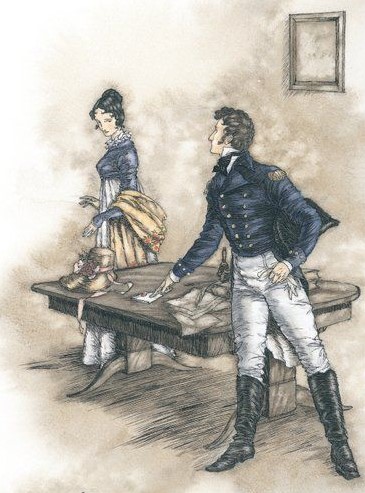
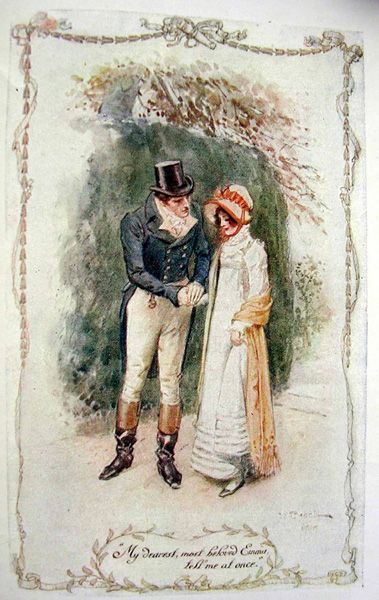
In Chapter Eight, we find Mr. Darcy, Miss Elizabeth Bennet, Miss Caroline Bingley, Mr. Bingley and Mr. and Mrs. Hurst in the drawing room. Miss Bennet is holding her own against Miss Bingley’s abuse. She is being chided for wishing to read, instead of joining the party at cards. The point of the conversation is to draw Mr. Darcy’s attention to Miss Bennet’s lack of social graces and accomplishments. But Miss Bingley miscalculates in offering her definition of a lady of Quality and Mr. Darcy, indubitably, puts her in her place.
All this she must possess,” added Darcy, “and to all this she must yet add something more substantial, in the improvement of her mind by extensive reading.”
Elizabeth Bennet expresses her amazement at Mr. Darcy’s description of an accomplished woman. To my ears, it all sounded vaguely familiar.
I am no longer surprised at your knowing only six accomplished women. I rather wonder now at your knowing any.”
Where do we find similar commentary within our liturgy?
Take a look at Proverbs, and in particular, Eishet Chayil, A Woman of Valor Who Can Find? Austen’s use and understanding of biblical language seems to be jumping off the page! Without a doubt, Jane Austen was familiar with these words. Her own dear brother made certain to memorialize her using a quote from the same Proverb 31.
She opens her mouth with wisdom; and in her tongue is the law of kindness”
In today’s society, a woman is expected to be a superhero. She must be a good daughter, wife and mother. She must be teacher, nurse, caregiver, friend, homemaker, and provider. As Jewish families gather around the Shabbos table, husbands sing King Solomon’s praise of their Eishet Chayil. I would guess many women, exhausted and possibly overwhelmed, may secretly wonder if they are worthy of such a tribute. Can anyone truly live up to such perfection? I believe that is Elizabeth Bennet’s question. She challenges Mr. Darcy’s remark with great bewilderment.
I never saw such capacity, and taste, and application, and elegance, as you describe united.”
But according to a midrash, King Solomon was not actually describing one perfect woman. He was describing the combine attributes of our matriarchs and biblical heroines. They each brought their own treasured qualities and values. King Solomon did not expect one woman to do it all. Rather, the idea was that each woman should be held in high regard for her own precious and unique gifts.
Mr. Darcy, through the wisdom and creativity of Austen, was able to comprehend “a great deal.” He observed Miss Bennet’s skirts covered “six inches deep in mud…her hair, so untidy, so blowsy!” Instead of censuring her lack of grace, he saw a woman who cared not for her appearance. Her mission that day was to attend her sister, Jane, who was ill and needed nursing. He saw a woman who could not be swayed by the pressure of the group and stood her ground to read a book, rather than to play at cards. We know that Mr. Darcy despises cunning and deception; and in my view, Austen portrayed Elizabeth Bennet —at least in this chapter—as an Eishet Chayil. Her true character is showcased by her good actions and generous spirit.
LASHON HARA~ Gossip
We are introduced to George Wickham, that evil cur, in Chapter Fifteen when he arrives in Meryton to join the militia. He is handsome and amiable. Miss Elizabeth Bennet quickly falls for his charms. Although she prides herself for being astute and a good judge of character, Elizabeth is easy prey for Wickham’s mean-spirted insinuations and outright lies.
Mr. Wickham was therefore at leisure to talk to Elizabeth, and she was very willing to hear him, though what she chiefly wished to hear she could not hope to be told—the history of his acquaintance with Mr. Darcy.
It is not until Chapter Thirty-six, when Elizabeth is presented with a letter from Mr. Darcy, that she comes to terms with her error in judgement. Had she behaved according to the precepts of her faith, her upbringing, and her own good sense, Elizabeth would have refrained from participating in such idle gossip.
She grew absolutely ashamed of herself. Of neither Darcy nor Wickham could she think without feeling she had been blind, partial, prejudiced, absurd.
In allowing herself to listen to Wickham’s diatribe against Mr. Darcy, Elizabeth all-too eagerly solidified her poor impression of an innocent man. And in doing so, Elizabeth causes needless distress to herself, Mr. Darcy, to her family, and to Meryton at large. Shortly after, George Wickham’s evil nature is exposed for all to see when he steals away with Lydia Bennet, the youngest sister. Elizabeth suffers cruelly for the part she played in her family’s undoing, not to mention her own broken heart. Again, I say, this speaks to how much Austen’s Judeo-Christian upbringing influenced her work.
In our tradition, we are commanded to remember how siblings, Miriam and Aaron, listened to gossip about Moses’ private affairs with his wife… “And God heard.” Miriam was considered the instigator of the incident and was severely punished with Zora’at—leprosy. When you take into consideration that brother and sister spoke to Moses privately and apparently with his best interests at heart, it is clear that the sin of lashon hara is grave, indeed. Mr. Wickham and Elizabeth spoke behind Mr. Darcy’s back. A worse affront, to be sure. Elizabeth’s penalty was not of biblical proportions; nevertheless, Austen’s message comes through all the same.
ZELOPHEHAD and his FIVE DAUGHTERS
Several years ago, a clever man suggested that the film, Fiddler on the Roof, shares common themes with Austen’s Pride and Prejudice. In his blog, Robert Lockard brings up the similarities in between the Mother/Father relationship, rejecting a marriage proposal, forbidden love, soul mates, and losing one’s home. Needless to say, the author also mentions that the Bennets have five daughters, as do Tevye and his wife. I’m willing to take it one step further. Could Austen have been thinking of Zelophehad and his five daughters when she plotted out her storyline?
In Numbers 27, we are introduced to a family of five sisters: Mahlah, Noah, Hoglah, Milcah and Tirzah. As their father, Zelophehad, has died, the women are dependent on marriage to secure their future. Just as we see in the Bennet household with regard to the entail of Longbourn, these sisters may not inherit their father’s land. But here is where the two stories differ. Unlike the Bennets, these sisters speak up! They take their claim to Moses, who refers the question to God. And He says:
The plea of Zelophehad’s daughters is just: you should give them a hereditary holding among their father’s kinsmen; transfer their father’s share to them
Numbers 27:7
Of course, if Austen followed the suggestion found in her bible, her plot would have lost its arc. Mr. Darcy— and his ten thousand a year— would have been superfluous! Perish the thought! I still hold fast to my hypothesis and will continue with my examination of Judaic themes in Austen’s novels; only now, I will offer up my own work as an example.
LECH LECHA~ Go forth or Go towards yourself
In my book Celestial Persuasion, Abigail Isaacs finds herself at a crossroads. With few alternatives before her, Abigail chooses to heed her brother’s wishes and leaves home and hearth to make her way to a strange and distant land. I can’t help but connect this with the message that was given to Abram.
Go from your land, from your birthplace and from your father’s house, to the land which I will show you.”
Genesis 12:1
In researching this parsha (this section), I was drawn to a Kabbalistic interpretation of these famous words. Go from your land, becomes Go from your will—set aside your plans, your limited views of what you can become. From your birthplace, is understood to mean, walk away from your emotional self—which, as often is the case, is the product of one’s environment. From your father’s house, refers to the intellect or that which has the authority over one’s feelings and behavior. This interpretation fits my protagonist to a T.
Abigail Isaacs is a woman torn. She had set her eyes on a certain path and dedicated herself to fulfilling that one goal. In the process, Abigail closed the door on love, on the possibility of being hurt, of making mistakes. Tucked away in her observatory, she was safe. She set hard boundaries and felt secure. When her brother seemingly speaks to her from beyond the celestial veil, Abigail—much like Abram—is challenged to go forth and to become what she was always meant to be. I only can add that I hope you pick up a copy of the book and see how the story unfolds.
That’s all for today, my friends, but stay tuned. Next time, we’ll take a look at Emma.
How many of you have seen the film, My Big Fat Greek Wedding? Swap out “Greek” and insert “Argentine” and you would have a clear picture of my family. Every character reminded me of a relative; every embarrassing scenario was relatable and every corny saying sounded familiar. The movie had my family in stitches. We laughed, we cried, and we pointed fingers at each other, saying: That is so you! This movie, in fact, was one of three impactful works that played a part in my writing (the other two were I Remember Mama and Fiddler on the Roof). I aspired to accomplish something in that same vein and wrote my first book, With Love, The Argentina Family~ Memories of Tango and Kugel, Mate with Knishes.
Interestingly enough, I came across a blog post that spoke of the similarities in between Pride andPrejudice and Fiddler on the Roof. Both stories feature five daughters, three of which are married by the end of the piece.
Both showcase awkward scenes of rejected marriage proposals. The mother and father relationship in Fiddler shares similar characteristics with those in P & P. Both stories have forbidden love and worries of losing one’s home. In short, this author spoke to my love of meshing the world of Period Dramas and Jewish Historical Fiction.
In all fairness to the original post, I encourage you to take a peek at it here: Read it and tell me if you don’t agree. An Anglican woman in England and a Jewish man in Imperial Russia wrote two very different stories that are remarkably the same, and remarkably relatable to a wide and diverse audience.
Last week, I binged on the third season of Shtisel. Have you heard about it? It is a hit show on Netflix. I devoured the entire season in two days. No doubt, you’re wondering why I’m writing about a modern-day series that evolves around a Haredi family living in Israel. You’re rolling your eyes at this point thinking: I signed up for a historical fiction blog—why is she writing about Shtisel-mania? Good question; but before I answer, I have a question for you…
How many Jane Austen variations are there in the Fan Fiction world? I couldn’t even begin to tell you, but I know this: Keep her storyline and exchange the Anglican family with a Hindu family, a Black family, a Jewish family; or even a family of Zombies, you still get an Austenesque novel. Austen’s work centered around her commentary about the human condition. She used humor and irony to make her point. She wrote about heartaches, financial concerns, and dysfunctional families. Her stories are still relevant to millions of people around the world who are not necessarily English, Anglican, or actually living in the Regency era. 😉
Shtisel has taken the world by storm and it has many people scratching their heads in wonder. How is it possible that in today’s society, where everything goes and everything is permissible, a story about an ultra-orthodox Jewish family is a Number One hit? They dress modestly. They have strict dietary restrictions. The roles for women and men are clearly defined. But, take away all the trappings, the clothes, the language, the seemingly archaic rules, and exchange them with any other culture or religion and you still get the very essence of the show. The humanity remains. The power of the emotions expressed and experienced by these characters are universal.
Three or four families in a country village is the very thing to work on. Those three or four families are the mind we knew intimately – the landed gentry, the upper classes, the lower classes, not only the industrial masses, but also the agricultural laborers.”
Jane Austen- in a letter to her niece
Jane Austen’s trademark was her knack for realism. She didn’t write about the Napoleonic Wars or earth-shattering catastrophes. She wrote about the world around her, knowing that life’s every-day “little dramas” were sufficient fodder to get her point across. Her writings have been inspirational and Shtisel is working the same magic. Its triumph is in sharing a common story, focusing on Universal Truths to which we all can relate. How could I not aspire to do the same?
The hosting, and attending, of morning calls, house parties, routs, balls and assemblies was imperative for those entering the upper echelons of society—think of Mr. Bingley and his sisters, who had so recently borne the “stench of trade.” How much more so for foreigners…
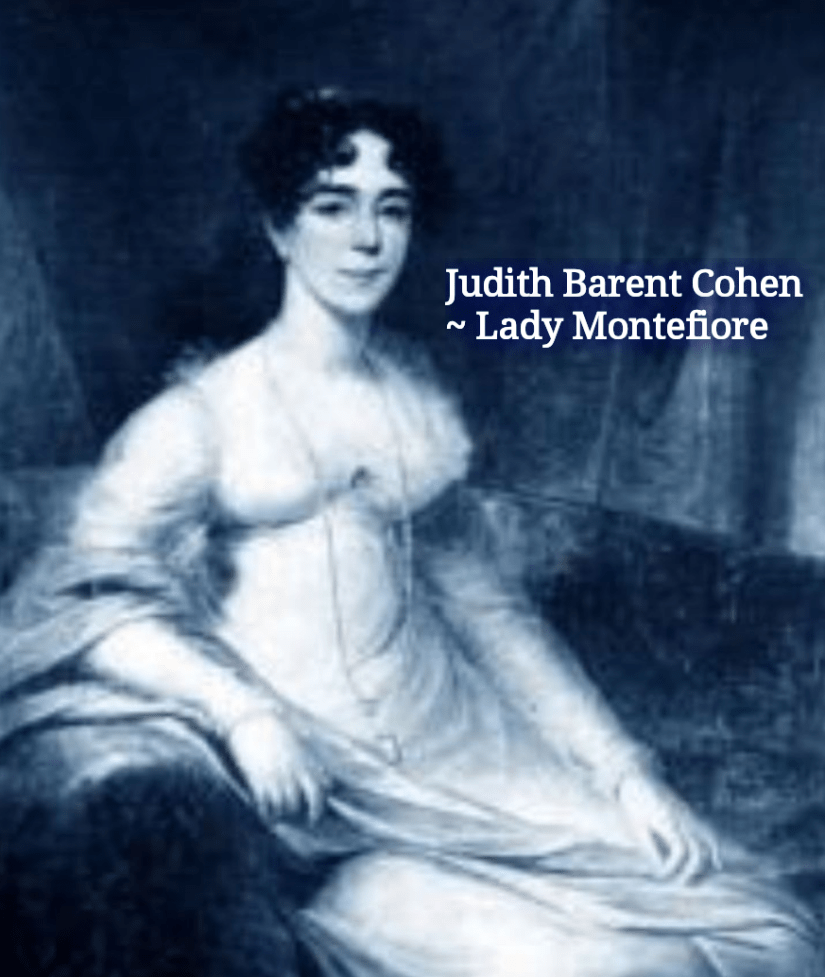
During the nineteenth century, Jews were experiencing unprecedented mobility in English society; and while this certainly was a blessing, the process of acceptance in the Anglican world threatened to erode their level of religious observance. The simple act of sharing a meal among friends presented certain complications. Cookbooks of the era did not take into consideration the ingredients or combinations that were prohibited in a kosher kitchen, such as the mixing of meat and dairy, or the partaking of shellfish or pork. Lady Montefiore (née Judith Barent Cohen 1784-1862) was the first to affirm, in so public a fashion, the existence of a distinctive Jewish cuisine and to draw from both Sephardic and Ashkenazi traditions (in general terms, Sephardic Jews hail from the Iberian Peninsula, but also such places as Italy, Greece, and Northern Africa. Ashkenazi Jews encompass Eastern Europe).
Much like Jane Austen, Lady Judith was a keen observer of human nature. Her book, The Jewish Manual; or, Practical Information in Jewish & Modern Cookery, with a Collection of Valuable Recipes & Hints Relating to the Toilette, therefore, was much more than a guide to cooking within the Jewish dietary laws known as kashrut. She meant “to guide the young Jewish housekeeper in the luxury and economy of the table, on which so much of the pleasure of social intercourse depends.” She encouraged homemakers to present elegant dinners, and to not draw any undesirable attention to the kosherness of the preparations. The end result would produce “haute cuisine that was invisibly Jewish and gastronomically exceptional.”
Montefiore was a great proponent of female education; and in keeping with Austen, she had a profound understanding of a woman’s lot in Regency England. The author pointedly wrote about the importance of cultivating the mind, and stated that womanhood should encompass “individuality, self-control, reason, intellect and fine feeling.” Miss Elizabeth Bennet is the personification of that description, don’t you think? In her final chapter entitled “Influence of the Mind as regards Beauty,” Lady Judith professes that “all the milk of roses and essence of lavender in the world could not make a woman beautiful whose inner life was not up to standard.” It seems that Lady Judith and Miss Austen were of the same mind. Recall Mr. Darcy’s rejoinder when he said: “And to all this she must yet add something more substantial, in the improvement of her mind by extensive reading.”
“Let those females, therefore, who are the most solicitous about their beauty, and the most eager to produce a favorable impression, cultivate the moral, religious and intellectual attributes, and in this advice consists the recipe of the finest cosmetic in the world.”
Judith Barent Cohen was a child of an immigrant linen merchant; and while her father was successful, Judith identified with the “middling” class. Although they practiced strict religious observance at home, her father was a devotee of Moses Mendelssohn, a leader in the Jewish Enlightenment movement. Because of this alignment to a philosophy that encouraged secular studies and modernization, Judith was highly educated and spoke several languages. After her marriage in 1812, she held a place of some importance within England’s upper class. Her book offered suggestions “so that a lady’s physical appearance, accomplishments, inner qualities, and even her table could be an extension of herself—not as a Jew, but as a civilized person.”
Here is a snippet from The Meyersons of Meryton, where Mrs. Bennet—of all people—teaches us a lesson in civility:
“Do tell us about your good works, Mrs. Meyerson. Your husband mentioned such provocative activities. I would hear it from your own lips.”
“Mr. Meyerson tends to flatter when, in truth, I am the fortunate one. Charitable works are a blessing for the giver as well as the receiver.”
Mary nodded her agreement and quoted a favorite verse, “One who is gracious to a poor man lends to the Lord, and He will repay him for his good works.”
“Truly, the repayment, if it may be considered as such, is the great privilege to work alongside generous, intelligent women such as Judith Montefiore. Currently we are working on establishing a school for underprivileged Jewish girls. They will learn a trade and be able to find work in Jewish houses which, you must understand, are always looking for employees who are familiar with our ways.”
“Pray, enlighten us,” Lady Lucas said. “While it is true that good help is hard to come by, why should standards be any different in a Hebrew household?”
“The girls are taught to work in kosher kitchens for the elite in our society who keep our dietary regulations,” Mrs. Meyerson replied.
“If your people wish to socialize with The Upper Ten, they must needs learn to adapt to British fare and give up their dietary regulations altogether!” Lady Lucas retorted rather emphatically.
“Many families, sadly, have done just that, and others, such as in my household, attempt to find a solution that is appropriate for their circumstance. My husband and I, as well as Mr. and Mrs. Montefiore, do not concern ourselves overly much with kashrut when we are away from home. In truth, I tend to make do with what is put before me, but Judith is quite formidable! She is ever experimenting and creating new recipes, refusing to lower her standards, for she is adamant we need not suffer by keeping faith with our laws.”
“I dare say, if these Montefiores are truly in society, they would not venture to impose their peculiar ways upon the ton.”
“You would be mistaken, Lady Lucas, for my cousins entertain many prominent families of the highest social circles and, even more astonishing, their Christian acquaintances are demanding their own chefs learn to prepare a kosher cuisine. It appears The Upper Ten find it not only satisfying, but a delight to their fastidious digestion.”
Mrs. Bennet smiled at one lady and then the other. While Lady Lucas was a person of some import in Meryton, it was clear the Meyersons had notable connections in Town. Who was to say that their acquaintance would not prove to be advantageous for her girls? It was necessary to speak a little; it would be odd to be entirely silent on the subject. Therefore, Mrs. Bennet, in her effort to appease both parties, believed she had found some common ground. “Perhaps,” she suggested, “these recipes would not only benefit ladies of the Hebrew persuasion. Pray recall, Lady Lucas, we ourselves are charged to make dishes without meat or dairy many times throughout the year such as during the Lenten or fasting holy days. Perhaps it is not so peculiar as it appears to be at first glance.”
Elizabeth overheard this exchange and was astonished. Why, her mother’s words were practically revolutionary!
Originally posted on Austen Authors.net on October 30, 2020