Organized by the Association of Jewish Libraries (AJL), the Book Carnival is hosted by a different participant’s site on the 15th of every month. It’s my turn and I’m delighted to welcome you to my blog.
I hope you enjoyed the Chanukah festivities in your corner of the world. What with the candle lighting, dreidel spinning and gift giving—not to mention the making of latkes and sufgenyiot—did you find some quiet time to enjoy a good book or two? If you are looking for more reading material, you’ve certainly come to the right place! Check out these amazing links and entries:
Please note that the Association of Jewish Libraries started a podcast, “Nice Jewish Books,” and launched it featuring Talia Carner and her novel, THE THIRD DAUGHTER (finalist in the National Jewish Book Council Award in the book Club category)
Also, The NJ Jewish Ledger ran a profile of author Talia Carner in connection of her appearance at the National Council of Jewish Women.
On her blog, Book Q&As with Deborah Kalb, Deborah interviewed Helaine Becker about her new children’s picture book, The Fabulous Tale of Fish & Chips.
Heidi Slowinski recently reviewed Roy Hoffman’s Chicken Dreaming Corn. Hoffman’s book is literature depicting life as this historical fiction novel explores the Jewish experience in the south.
Barbara Bietz interviews Jeff Gottesfeld about his new picture book, THE CHRISTMAS MIRACLE, a story of faith, friendship, and community.
The Book of Life Podcast pairs Red and Green and Blue and White by Lee Wind with The Christmas Mitzvah by Jeff Gottesfeld. These two 2021 holiday picture books are both based on true stories of allyship and they have a lovely synergy.
The Sydney Taylor Shmooze is a mock award blog that brings you reviews of Jewish kidlit that is potentially eligible for the Association of Jewish Libraries’ Sydney Taylor Book Award. Check out this month’s reviews!
The new Storytime Solidarity website offers quality resources for getting your storytimes started or boosting them to the next level. A guest post on their blog, “If Hanukkah Is Not the Jewish Christmas, What Is It?” by Heidi Rabinowitz, explores Hanukkah and its context within the U.S.
Shiloh Musings reviewed a real “cliffhanger,” The Devil’s Breath by Tom Hogan, which a very different sort of Holocaust story. A Jewish couple imprisoned in a concentration camp are asked by the camp head to discover who’s pilfering the stolen gold.
A Jewish Grandmother finds herself in a dilemma reviewing Why We Fly” in which she finds one of the subplots problematic. Kimberly Jones and Gilly Segal’s book is for youth and depicts a religious and ethnically mixed American community in which Jews dating non-Jews doesn’t raise eyebrows. One of the two main characters is Jewish, and she’s very idealistic.
Reuven Chaim Klein just posted 5 book reviews at the Rachack Review. Do take a look!
I’ve been addressing Jane Austen’s work and the correlating themes found in Judaic text. The reason for this exercise stems from my desire to find historical fiction or historical romance novels that contain a modicum of Judaica. Of course, Austen’s work isn’t considered historical fiction. Her stories were contemporary; her readers would have recognized their world amongst the backdrop of her settings. But that’s not my point. Sorry!
While I have scoured endless book titles and conducted mind numbing Internet searches in the hopes of finding some hidden gem, I have very little to show for my effort. That was the impetus to take pen in hand, so to speak, and to write my own fanfiction. And why not? Jane Austen’s work continues to inspire and entertain a diverse, world-wide audience. We are presented with modern interpretations of her classics novels, time-travel storylines, and narratives that focus on any number of ethnicities and cultures. Evidently, our thirst for new and tantalizing Austenesque plots and themes is not so easily quenched! And for this particular reader, it seemed only logical that the Jewish community be represented in Austen’s fandom.
That being said, I am not an advocate of racelifting. By that I mean, I have no need to replace a character’s Anglican faith for Judaism. I am satisfied with the introduction of Jewish protagonists and themes that are a true reflection of our community as a whole. For other authors and readers, I understand that it is imperative to see a Jewish character cast in the original role. And that’s okay. That’s the magic of fanfiction. InThe Meyersons of Meryton, I introduce a rabbi and his family to Austen’s fictional town in Hertfordshire. In Celestial Persuasion, I create a friendship in-between Captain Wentworth and the Isaacs siblings that stretches far beyond England’s shores. With Destiny by Design~ Leah’s Journey, I showcase a story that is loosely based on my ancestors’ experiences. Although this novel is not a J.A.F.F. (Jane Austen Fan Fiction), there is a definite nod to the author and her work. These novels, along with my first title, Becoming Malka, are my small contribution to the lesser known genres of Jewish Historical Fiction and Jewish Historical Romance.
As we are now officially in the “holiday season,” there is an opportunity to address diversity and Jewish characters in other forms of entertainment. For example, Hallmark has attempted to incorporate Jewish storylines and characters in their holiday lineup. These shows are a bit cringe-worthy, I’ll admit it, but at least they’re trying. I’d encourage them to try a littleharder. While I do want to see Jewish representation in these soapy movies, I do not want to see Hanukkah downgraded to a Christmas-wanna-be. The whole point of the Maccabean revolt was not to assimilate to the dominating culture. It is a fine line, I understand. Hallmark can do better.
Over at Disney, we were introduced to a Jewish heroine for one episode of Elena of Avalor. The character is supposed to be a Sephardic princess, but she uses Yiddish terminology and speaks of Ashkenazi traditions. And, I’m sorry to say, the princess is not very attractive. Like the folks over at Hallmark, the imagineers could have put forth more effort. This piece needed a little more research into the character’s cultural background and a lot more generosity in developing her aesthetic. Perhaps they could have taken a page from the variety of diverse characters showing up in other animation, comics, and television series and given the Jewish community a proper heroine.
And speaking of television, did you hear the collective “oy!” when fans of Downton Abbey found out that Lady Crawley’s father was Jewish? The writers did not stop there. The series also introduced a Jewish family of the upper echelons of society. Apparently, Lord Sinderby’s family had fled the pogroms and persecution of Imperial Russia some sixty years ago. Sparks fly when his son, Ephraim (he goes by his second name, Atticus) meets and falls in love with Lady Rose…who is not Jewish. This all-too-familiar predicament, as well as other issues of anti-Semitism in Edwardian England, are brought to the forefront. While I was not entirely pleased with the outcome, I was glad that at least our community’s presence was addressed.
With the success of Sanditon and Bridgerton—and the plethora of costume dramas in the world today— it seems clear we are in need of the escapism that these shows provide. We fantasize and yearn for the days of polite society and social graces. How much more pleasing is it to read a novel or watch a show that allows one to identify with a character— someone who stands to represent one’s community, one’s values, and heritage in a positive light? It is time to come out from the shadows of the likes of Heyer, Dickens, and Shakespeare. Their Jewish characters were cliché and demeaning. The Jewish community has played a proud and active role in nearly every culture around the world. We are connected to that history by a chain that spans over five thousand years.
Jane Austen certainly instilled her biblical knowledge and values into her novels. She commented on societal issues with her wit and keen power of observation. Her readers, no doubt, recognized and identified with these truths. If one of my books brings a sense of connection, a sense of community, a sense of pride to a Jewish reader, I would have fulfilled my goal. My books are a link in that ancient chain. They are another opportunity to say: Hineini —I am here. We are here. And we’re not going anywhere.
Throughout this series, I have been looking at Jewish themes that can be found in Jane Austen’s work. That’s not to say that the renown author intentionally incorporated Judaic messages in her writing; however, as I’ve pointed out in my previous posts, Austen was raised in an observant environment and would have been quite at home quoting from the Good Book or referencing various biblical storylines. I am enjoying finding the similarities. I hope you are too!
SELICHAH, MECHILAH, and KAPPARAH ~ The different forms of Forgiveness.
I previously touched upon the subject of repentance, but the matter requires further discussion. The theme of granting forgiveness can be found in nearly every book that Jane Austen penned. Just think for a moment. Elizabeth forgives Darcy, Elinor forgives Edward, Fanny forgives Edmund, and everyone is only too willing to forgive Emma!
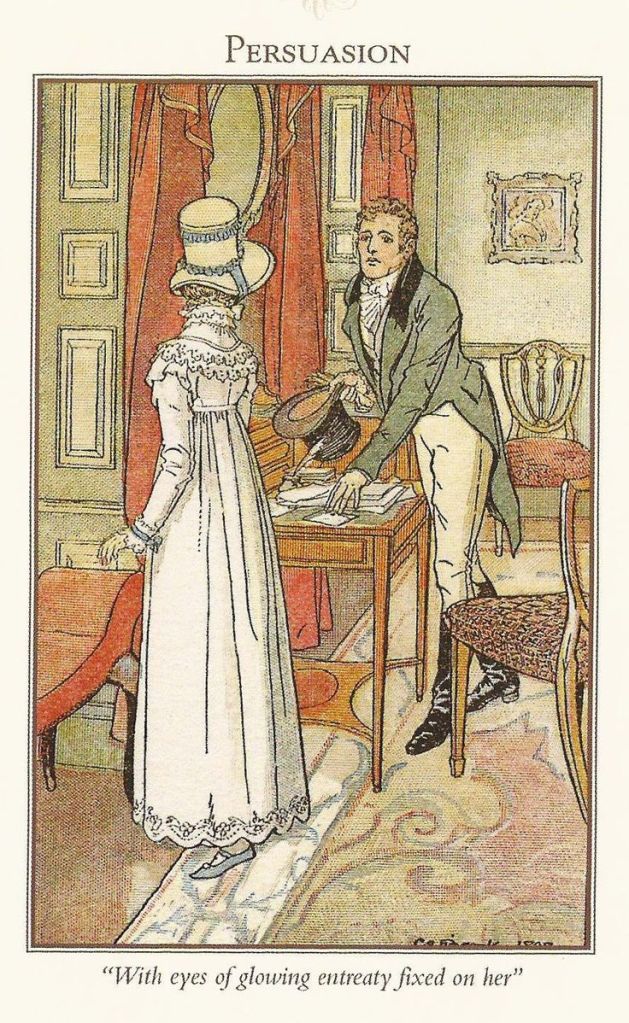
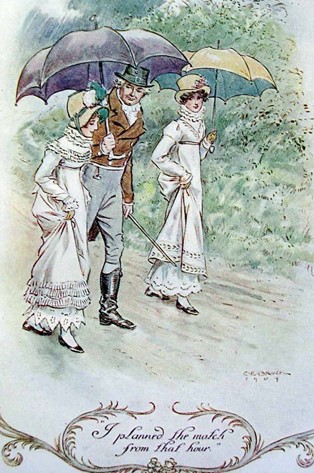
Illustration by C.E. Brock
In Persuasion, we are introduced to a couple long separated by distance and pride. Captain Frederick Wentworth has spent years holding a grudge, nursing his bruised ego and feeling the victim. For those who don’t know the story: Miss Anne Elliot had entered into an understanding with the gentleman, but —for better or for worse—was persuaded to end the budding relationship. Years pass before the two are brought back together again. Captain Wentworth tells his new friends that he finds Miss Anne, “altered beyond his knowledge.” Ruthless, heartless man! The gentleman is still licking his wounds…
He had not forgiven Anne Elliot. She had used him ill, deserted and disappointed him; and worse, she had shewn a feebleness of character in doing so, which his own decided, confident temper could not endure.”
It has been eight years and he still didn’t understand her! Had he used the time to reflect and to try to comprehend Anne’s actions, it would have been emotionally and mentally healthier for all concerned. Of course, that would have changed the arc of the story and no one understood that better than Austen.
In Northanger Abbey, we are introduced to a young lady just coming out into society. She has very little to say in her favor; and in fact, our heroine spends her days daydreaming and imagining herself the helpless victim of some gothic novel.
No one who had ever seen Catherine Morland in her infancy would have supposed her born to be a heroine.”
Catherine is invited to stay with family friends in Bath, and finds herself, quite suddenly, in over her head. With no real experience of socializing with others who have more—shall we say—life experiences, her naivete and imagination run wild. She wrongly suspects General Tilney (the father of the young man she comes to admire) of a crime he did not commit. In the end, she is somewhat exonerated, but the acknowledgment doesn’t come without some distress.
Your imagination may be overactive, but your instinct was true. Our mother did suffer grievously and at the hands of our father…No vampires, no blood. But worse crimes, crimes of the heart.”
Like any biblical story that focuses on Teshuva, Catherine experiences growth through pain. She recognizes her failings, repents, and determines to improve her behavior. The arc of her story is in keeping with Austen’s philosophy. The mean-spirted and conniving Thorpe siblings, however, do not see the error of their ways and they suffer for it. Austen uses their storyline to illustrate her point once again. Those who merit a HEA (happily ever after) will be rewarded in the end.
My characters shall have, after a little trouble, all that they desire.”
I can’t help but think of the period leading up to the holiest of days in the Jewish calendar: Yom Kippur, the Day of Atonement. We begin by commemorating the holiday of Selichot and use the time before “the gates begin to close” to think of those we have wronged.
Asking for forgiveness, for selichah, is the first step we must take. This is where we realize our error, we apologize to the injured party, and we show remorse.
When our poor behavior has caused much pain, we speak of mechilah. We ask that our transgressions be wiped away. We want things to be as they were; or better yet, to go on stronger than before. This can prove to be difficult for the injured party; for though many of us can forgive, it is very difficult to completely forget.
If the wrongdoing is of biblical proportions, a person may feel they are not worthy of forgiveness. They believe that there can’t be a positive outcome, no matter the excuse, no matter how many promises are made. Most people are not capable of forgiving an act of this magnitude. In fact, the forgiveness we seek, the kapparah, is beyond human capacity. The atonement, in fact, comes from a higher source, such as on Yom Kippur. This is when G-d looks into your heart, sees your repentance and says, “Be comforted.”
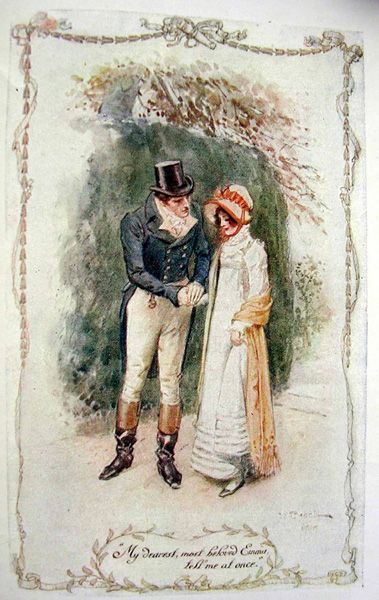
Illustration by C.E. Brock
In Persuasion, Jane Austen presents us with a scenario that is just as relevant today as it was three hundred years ago. Secure in his righteousness, Captain Wentworth needlessly wallows in Anne’s perceived betrayal. Obstinately holding on to his resentment only succeeds in polluting his view of the truth! Their meeting again gives them both a second chance to speak their heart. It’s a story full of angst and it is sometimes intolerable to witness their pain. When the captain overhears Anne speaking of love and loss to another gentleman, he finally comes clean. Captain Wentworth writes to Anne and bares his soul—as he should have done years ago.
You pierce my soul. I am half agony, half hope. Tell me not that I am too late, that such precious feelings are gone for ever. I offer myself to you again with a heart even more your own than when you almost broke it, eight years and a half ago. Dare not say that man forgets sooner than woman, that his love has an earlier death. I have loved none but you. Unjust I may have been, weak and resentful I have been, but never inconstant.”
In the ensuing paragraphs, Austen satisfies our need for the couple’s reconciliation. Anne and Frederick speak honestly to one another, exposing their vulnerabilities and the various misunderstandings that led to such despair. They forgive one another (selichah), their love is stronger for it (mechilah); and because they merit a HEA, they are comforted (kapparah). Quintessential Austen. Brilliant. Just brilliant!
In my latest novel, Celestial Persuasion, it is clear that Miss Abigail Isaacs shares similar characteristics with her newfound friend, Captain Wentworth. Fear and resentment have colored her view, not only of her ever-changing circumstances, but of a certain gentleman. As Mr. Bennet— of Pride and Prejudice fame— urges: read on, friend, read on…
A soft scratch upon the door shook her out of her musings, miserable and disheartening as they were. Abigail bade the interloper to enter, as she wiped away her tears.
“I have brought you some broth, my dear,” said Mrs. Frankel. “I thought you might be hungry, as we had not had to opportunity to dine. Do you think you might take a little?”
“I am much too shaken to eat, though I thank you for your concern. Will you not have it in my stead?”
“I have had some sent to my room, Avileh. I will leave you to rest then—oh, but I nearly forgot!” Mrs. Frankel exclaimed. “I have a letter for you, my dear. It is from Mr. Gabay.”
“Mr. Gabay! Whatever could he want? He barely spoke two words together in my presence. I fear his affections have been won over by Miss Kendall, Frankie dearest. They must have quarreled, for he was scowling all evening. Did you not notice?”
“No, indeed. However did you come to such a conclusion? Truly, my dear, you can see clear into the heavens but you cannot see what stands right before you.”
“Whatever do you mean?”
“Never you mind. Have a bit of your soup and read your letter,” she insisted, placing the envelope upon the bed. “Good-night, my dear.”
Abigail watched as Mrs. Frankel closed the door behind her. She eyed the broth with little interest and settled her gaze upon the letter instead. What could he have to say? Another jest? Another commentary on the state of the new union? Upon closer inspection, she noted that he had hastily folded the missive, it had not been sealed and it had not been addressed. Though she had had her fill of surprises to last a lifetime, her curiosity would not be neglected. She would read his letter and be done with it. For what could he possibly have to say that would lighten her heart?
What do you think? Will Mr. Gabay’s words cause more harm than good? Will Abigail be able to forgive past transgressions, even if that means forgiving herself? I invite you to read the story and come to your own conclusions. Until next time, thank you for stopping by!
In this series, I have been examining the works of Jane Austen and finding parallel lessons within the vast teachings of Judaism. I am not a literary scholar or theologian, but I am drawn to the subject and am enjoying my findings. I hope that you, dear reader, feel the same way. As the title suggests, this is the third post of the series. I began by pointing out the long-held Jewish tradition of midrash~ the reworking of sacred text in order to personalize a story or to reimagine a story in a different setting. It is my theory that Jane Austen had mastered this skill. She was raised by an Anglican minister and was devout in her faith. Having been exposed to the sacred text of the Five Books of Moses (the Pentateuch) the whole of her life, she would have easily been able to combine her knowledge with her wit and keen sense of observation in the creation of her novels.
Lo tov he–yot ha-adam le’vado ~ It is not good for Man to be alone
I realize that the quote mentioned above is from Genesis, but are you familiar with the Book of Ruth? I find even a cursory review of that story—or any story in the Torah, for that matter—shares similar socioeconomic truths found in Austen’s fictional town or settings. Don’t believe me? I offer Sense and Sensibility as an example for comparison. In the biblical story, Naomi (Mrs. Dashwood) has lost her husband. Her sons are out of the picture as well (think Mr. John Dashwood). She is practically penniless and loses her home (Norland Park). Naomi (Mrs. Dashwood) has lost her place in society without the protection of her men. We are then introduced to Ruth, one of Naomi’s daughters-in-law. In my mind, Elinor Dashwood matches Ruth’s stalwart qualities. Ruth is the fearless, faithful, and rational daughter. Ruth (Elinor) strives to maintain some order and to see her family flourish once again. In comes Boaz, a man alone (Mr. Edward Ferrars or Colonel Brandon, if you prefer) to save the day!
Whether we read Torah or an Austen novel, we understand that the marriage state is desirable for the female protagonist. It ensures her financial and physical wellbeing. For the male, marriage obviously allows for the continuity of the family line; an heir to take on the role of provider and protector. Marriage, of course, is a sacred and divine institution. Entering into this holy covenant is a necessity to propagate the human race (Gen. 1:28). But in order for the marriage to be successful, both the biblical author and our Regency author require that the couple have a deeper understanding of the importance of morality and their significant role in preserving the fabric of society. It is evident in both types of stories that happy endings are granted to those of moral character. Elinor exudes this characteristic. When Marianne asks her sister how she could bear her disappointment regarding the loss of Edward, Elinor replies:
By feeling that I was doing my duty. My promise to Lucy, obliged me to be secret. I owed it to her, therefore, to avoid giving any hint of the truth; and I owed it to my family and friends, not to create in them a solicitude about me… I did not love only him; and while the comfort of others was dear to me, I was glad to spare them from knowing how much I felt.”
Elinor Dashwood is held up as a role model. We are meant to admire her qualities, to condole with her when she suffers, and to celebrate her merited happiness. In our biblical story, we know that Boaz admires Ruth’s dignified and modest behavior. He feels protective of her and fulfills his duty towards Ruth— that is, once the scene is set and all obstacles to their union are removed. Likewise, Elinor and Edward find their happiness. But the couple is only rewarded because they adhered to societal rules and remained fixed to their moral compass. The story would not have the same meaning if Edward reneged on his promise to Lucy and ran into Elinor’s waiting arms. Not wanting to leave Colonel Brandon on his own, Austen grants Miss Marianne and the gentleman their H.E.A. as well; but only after the young lady reevaluates her life, and is found deserving of such happiness.
My illness has made me think…My feelings shall be governed and my temper improved. They shall…be regulated, [they] shall be checked by religion, by reason , by constant employment.”
Naturally, Austen does not grant Lucy Steele the same consideration as the other couples. Lucy doesn’t deserve it, neither does her popinjay-of-a-husband, Robert Ferrars. To do so would go against Austen’s philosophy and theology. I’m certain the biblical author would agree.
In my latest novel, Celestial Persuasion, Abigail Isaacs is a young lady with many unique qualities. Charts and instruments and mathematical equations are her forte; but when it comes to matters of the heart, Abigail is at a loss. Having known disappointment at a tender age, she is quite determined not to err again. Don’t misunderstand me, dear reader. She no longer finds fault with the young man of her youth. Oh no. She squarely lays the blame at her own door. Because of this, Abigail decides she can’t trust her instincts. The intoxicating sensations of her first love are overwhelming, they cloud her judgment and eclipse her path.
In the following passage, see how Abigail unburdens her heart to a new friend, Mariquita Sanchez de Thompson.
Mariquita smiled. “I know what it means to live in the shadow of men. But no more of that! All this talk of study and work…what of love? Why have you not married?”
“Ah, here is a frequent and familiar question. You must seek alliance with Mrs. Frankel and join in her enduring campaign.” Abigail thought to make light of it but sensed she would fail. “In truth, it is a painful subject to discuss.”
“If it haunts you so, perhaps you do better to share it with a friend. It will extinguish the power it holds over your heart.”
Abigail arose and began to pace the length of the gallery. She battled with the emotions that raged within and recognized that a transformation was, indeed, under way. The girl she had been in Exeter would not have dreamed of exchanging such intimate history with a relative stranger. But she recalled Mariquita’s candid declaration of her own tribulations and now felt tempted to pronounce her own.
“I was but seventeen when I found myself in love,” began Abigail. “I was a pretty young thing then and believed myself quite capable of living a happy, full life as a wife. His name was Mr. Bloom. Gabriel Bloom. He was four-and-twenty when he came to live with us, as an apprentice to my father’s medical practice. I had taken one look at him and fell under his power. His golden hair and light eyes shone like the sun. Everyone who knew him could not help but enjoy being in his presence.” She paused, staring across the garden yet seeing something altogether different in her mind’s eye.
“And was he a good student? Did he hold your father’s favor?”
“No, not at all. In fact, he would fail miserably at his tasks. But such was his affability, that my father granted him leniency time and time again. As time progressed, Papa could no longer disregard the errors or his lack of skill. Gabriel would laugh even as Papa scolded him. The admonishments continued, and yet Gabriel would not be moved. Somehow he believed his patients would heal, and better themselves, simply by his caring heart and tender ministrations. And then one day, Gabriel offered for me and promised a life full of laughter and adoration. I was mesmerized; his conquest was complete, and I willingly accepted.”
“Did your father dismiss Mr. Bloom from his service?”
She shook her head, as a tear made its way down her cheek. “If only that had been the case. Perhaps it would have been Gabriel’s salvation—and mine. What came to pass was altogether more painful. Papa had gone to Uppercross, a village not far from home. There had been a fever spreading around the villagers, but we had not thought it had reached Exeter or the surrounding farms. That evening, we had a knock upon the door. It was one of our neighbors, distraught and concerned for his babe. The child had broken out in a rash and was burning with a fever.”
“Oh, my dear!” cried Mariquita. “Tell me your father returned in time to save the child.”
“He did not. I begged Gabriel not to go in my father’s stead, but he chided my lack of faith. Quoting some witticism, he packed away his potions and powders with no regard to my pleas. Instead he rushed out following in the farmer’s footsteps.”
Abigail returned to her place alongside her friend and took up her now-tepid tea as if it could provide the sustenance necessary to complete her story. “The child did not survive, and when my father returned, he found a shell of a man. Gabriel could not forgive himself, though my father had reviewed the case and found no error had been committed. For weeks he suffered from a merciless depression. He refused to work; and when my father pressed him, one night at my urging, Gabriel became incensed. He railed at us, saying that we were in the wrong. How could he claim any happiness for himself? he demanded. He thought himself unworthy of any such absolution.”
“Indeed, it is a sorrowful tale,” said Mariquita.
“Gabriel left that evening, late at night when we were all abed. He scribbled a note begging my father’s forgiveness—and mine. My father wrote to his home and sought information from his parents. They had not heard from him in months. Then, one day, a patient came to the house. He told my father he had seen Gabriel Bloom in Plymouth. He was penniless—a vagrant, they said. I thought of him, wandering the streets, alone and miserable. Such needless suffering. I was heartbroken, but that sentiment rapidly evolved into something darker. I grew angry and afraid. You see, I had trusted him implicitly. All prudent thoughts were lost when I was with him, his hold over me was absolute. Had I followed Mr. Bloom in his wake of self-destruction, I would have condemned myself.”
“For all his devil-may-care affectations, it seems the poor young man was not strong enough to face life’s trials,” Mariquita replied. “You, my dear friend, are much stronger. Of that there can be no doubt.”
“Yet, sometimes, in the deepest, darkest part of the night,” Abigail murmured, “when the house is silent and still, I feel I understand him completely.”
“How so, querida?”
“I have come to Buenos Aires to start my life anew, but my heart remains heavy. I have lost everyone I have ever loved. My brother’s life was taken mercilessly. My mother and father are gone, long before their time. And I lost my Mr. Bloom—my only love, I fear.”
“Why should that be? You are young yet.”
Abigail’s weary sigh affirmed her resignation. “Like Mr. Bloom, I am not altogether certain that I merit much happiness. No, I will live out my days filling each moment with productivity and, hopefully, in service to others.”
“That is utter foolishness!” cried Mariquita. “Once I have you securely tucked under my wing, you will soon heal your wounds and fly free! And there are many of my acquaintance who are—let us say, they are well situated in society. You will wish to speak to them about your projects.”
The impromptu meeting did much to unite the women, for the bonds of friendship are made stronger when put to the test. Mariquita made her farewells with the understanding that they would meet in two days’ time. As she saw the carriage off, Abigail sent up a prayer of gratitude. She had never spoken of this burden, though she believed Mrs. Frankel had some notion of it, for she was known to recite Deuteronomy chapter and verse whenever she saw Abigail appear downhearted: I have set before you life and death, the blessing and the curse, And you shall choose life…
Gabriel Bloom did not do away with his life, but neither did he choose to live it. Did she truly wish to follow in his footsteps? Did she have the courage to live life to its fullest? Her head began to ache, the emotions of the morning wiping away any impetus to work. She found a cozy nook with a comfortable chair. Settling in under a soft coverlet, Abigail closed her eyes and was soon fast asleep.
I mentioned earlier that Abigail is a young lady accustomed to calibrating instruments and taking measurements. She jots down her findings and follows their projected trajectories. But will she follow her internal compass and allow love into her heart, or will she reject all the signs—Heaven sent, or otherwise— and continue to walk alone? You’ll have to read the story and find out for yourself. Next time, we’ll look at Persuasion and Northanger Abbey. Thanks for stopping by!
It is a truth universally acknowledged that our sages and their faithful students have been reinterpreting biblical texts in the hopes to discover new insights, to make them more accessible, or even to reveal different conclusions. As I mentioned in the original post of this series, it is in keeping with our traditions to recreate these sacred passages, to personalize the story with our own life experiences or our imaginations. In Judaism, these reworkings are known as midrash.
Jane Austen was the daughter of an Anglican minister. Her upbringing in the church would have given her sufficient exposure to Judaic theology to help me make my point: Austen used her knowledge of sacred text and reimagined the lessons into the workings of her famous novels. Today we’re going to examine Emma for Judaic themes.
TESHUVA ~ Repentance
In most cases, it is the author’s duty—and the reader’s expectation—to allow a story to unfold in such a manner that the protagonist evolves throughout the tribulations of the novel. The transformative journey is, after all, what the audience craves. Setting aside the specifics, it is within this transformation that the reader intimately identifies with the struggle, the lesson, and the resolution.
But it hasn’t always been this way. Interestingly enough, in many ancient cultures, such as within Greek society, it was not an accepted belief that one could change one’s behavior. Rather, it was thought that a person behaved just as his or her destiny foretold. Great Britain’s Rabbi Sacks (baruch dayan ha’emet) spoke of this message in a sermon fittingly prepared for Yom Kippur, the Day of Atonement. He even mentioned Jane Austen’s Emma.
A well-to-do, “handsome” young lady, it could be said that Emma Woodhouse has been spoiled the whole of her life. In addition to that, she is a bit of a snob.
She possess the power of having rather too much her own way, and a disposition to think a little too well of herself.
With little else to do, she goes about the county doing—what she believes to be—good works. In fact, Austen’s heroine is a yenta. She imagines that her matchmaking skills will bring about much happiness and shalom bayit to every hearth and home in Highbury. But Emma’s attempts at pairing her acquaintances are not as successful as she would have hoped. This is not surprising in the least! How can a young lady understand the workings of the heart in others, when she doesn’t understand herown? It is through personal struggles that Emma comes to understand her errors. When she is faced with her own heartache, Emma determines to change her ways.
Every year, as we commemorate the High Holy Days, we repeat the words of the Unetaneh Tokef prayer and consider our missteps, our mistakes, and our failures. But then we hear: “Teshuvah (Repentance), Tefillah (Prayer), and Tzedakah (Charity) avert the evil decree.” During the ten days in between Rosh Hashanah and Yom Kippur, we are meant to examine our lives and to reflect on bettering ourselves. In Rabbi Sacks’ sermon, he postulates that Judaism was probably the first religion to ponder Free Will for this very reason. We can decide to do better.
Jane Austen presents us a storyline that highlights a young woman’s emotional growth. Three thousand years after the sacred text of the High Holy Days appear in our liturgy, Austen allows her protagonist to confess her sins, to show remorse, and to show a desire to improve herself.
Emma grows before our very eyes when she decides to learn from her mistakes. She becomes more charitable towards the other members of Highbury’s diverse society. She becomes more charitable towards herself when she opens her eyes, and her heart, to Mr. Knightly.
In my latest novel, Celestial Persuasion, I introduce Miss Abigail Isaacs, a young lady whom most believe to be past her last prayers. While she has had an offer of marriage, Abigail’s dreams have been shattered on more than one occasion. Her friends encourage her to marry, for security at the very least. This she cannot accept. Rather than opening her heart to the possibility of love, Abigail retrenches and strives to build a life of seclusion, safe within the confines of an astronomer’s observatory.
I have begun to believe that I am not meant for love.”
According to those familiar with her upbringing, Abigail’s education and access to the world of academia has had secondary effects. She is quick to judge and often times thought to be haughty. Her snobbish ways are not unlike Emma’s—though she is not a woman of means—and her comments are usually kindly meant. She is bookish and awkward in the company of strangers. In truth, she is an innocent; and more often than not, Abigail misjudges perilous situations and societal obligations. It is when she is entrusted into the care of Lieutenant Raphael Gabay that Abigail meets her greatest challenge. The gentleman has little patience with her improper pride.
Might I suggest you set down your astronomer’s paraphernalia to examine what is before you, here on earth, and not in the night’s sky? You have excused me of shielding my truths with incessant jesting, but it is you, madam, who hides behind instruments and tomes.“
Will the young lady repent and change her ways? Can she forgive, and forget, and give love another chance? Join Abigail on her journey to the Viceroyalty of Rio de la Plata and find out for yourself. But stay tuned! Next time, I’ll discuss Sense and Sensibility.
As an emerging author in the realm of Jane Austen Fanfiction (J.A.F.F.), I have introduced Jewish characters thus far into the world of Pride and Prejudice, as well as Persuasion. I purposely didn’t alter the beloved characters created by Austen’s imagination. I mean, of course, that Anglicans remain Anglicans. Instead, I present the reader with a different—more inclusive—makeup of the communities where said characters reside.
Some people may question why I chose this path, rather than the racebending or race-lifting phenomenon we are seeing today in fandom. Transforming the Bennets or Mr. Darcy as Jewish role models would not have satisfied my creativity. Instead, I wanted to personalize the canon with my heritage, so that our collective experiences in that period—known as The Regency—would not go unacknowledged. Some may question why I would want to meddle with works of art in the first place. They are classic novels, loved the world over. The answer is simple: It goes back to the practice of creating a midrash.
I’ve read several editorials and essays that pose an intriguing hypothesis. The authors stipulate that the concept of fanfiction is an accepted and familiar practice in Judaism. And I wholeheartedly agree. It is a truth universally acknowledged that our sages and their faithful students have been reinterpreting biblical texts in the hopes to discover new insights, to make them more accessible, or even to reveal different conclusions. It is in keeping with our traditions to reimagine these sacred passages, to personalize the story with our own life experiences or even to postulate the unknown—the “what-ifs.” These new interpretations or reworkings are known as midrash.
According to penlighten.com, “Fanfiction is basically fiction written by fans or, to put it in a better way, admirers of the original work. Fanfiction writers include much of the same characters and also sometimes choose to add new ones. Fanfiction stories often reflect the writer’s view (in this case, the view of the reader of the original work) as to what should have happened in that particular story.”
The great Ibn Ezra’s opinion on Midrash Aggadah was pretty clear. There are words, and there are meanings. As long as the reader gets the meaning of the text, it doesn’t matter how the message is communicated. Therefore (Finally! I’m getting to my point!) in my next series of blog posts, I mean to provide a ‘drash on Judaic themes in Regency literature by expressing how we can find Judaism in Austen’s work. Hopefully, this will encourage other authors, and readers, to open their minds to this particular genre. And that might have the happy chance of prompting even more discussion!
While Austen was the daughter of an Anglican minister, she didn’t follow the admonishments of clergymen such as James Fordyce, a Presbyterian minister infamous for his Sermons for Young Women. However, her work—or her “pestiferous” novels, as labeled by Fordyce—were characterized by morality. This could be recognized by her characters manners, their sense of duty to society, and their religious affinity. Furthermore, no self-important or indolent clergyman was safe from Austen’s eagle eye and sharp wit.
Without a doubt, she had strong opinions of correct and proper behavior, but Heaven help the poor soul that was caught in her crosshairs! She examined and cross-examined everyday life. Everyone was fair game. Everything was questioned and brought to light.
That is the epitome of Jewish study, is it not?
Throughout Austen fandom it has been said that Jane very likely never met a Jewish person; but her upbringing in the Anglican church would have given her sufficient exposure to Judaic theology and that is enough for me to proceed. Without further ado, ladies and gentlemen, today’s post will deal specifically with Pride and Prejudice.
EISHET CHAYIL~ A Woman of Valor
In Chapter Eight, we find Mr. Darcy, Miss Elizabeth Bennet, Miss Caroline Bingley, Mr. Bingley and Mr. and Mrs. Hurst in the drawing room. Miss Bennet is holding her own against Miss Bingley’s abuse. She is being chided for wishing to read, instead of joining the party at cards. The point of the conversation is to draw Mr. Darcy’s attention to Miss Bennet’s lack of social graces and accomplishments. But Miss Bingley miscalculates in offering her definition of a lady of Quality and Mr. Darcy, indubitably, puts her in her place.
All this she must possess,” added Darcy, “and to all this she must yet add something more substantial, in the improvement of her mind by extensive reading.”
Elizabeth Bennet expresses her amazement at Mr. Darcy’s description of an accomplished woman. To my ears, it all sounded vaguely familiar.
I am no longer surprised at your knowing only six accomplished women. I rather wonder now at your knowing any.”
Where do we find similar commentary within our liturgy?
Take a look at Proverbs, and in particular, Eishet Chayil, A Woman of Valor Who Can Find? Austen’s use and understanding of biblical language seems to be jumping off the page! Without a doubt, Jane Austen was familiar with these words. Her own dear brother made certain to memorialize her using a quote from the same Proverb 31.
She opens her mouth with wisdom; and in her tongue is the law of kindness”
In today’s society, a woman is expected to be a superhero. She must be a good daughter, wife and mother. She must be teacher, nurse, caregiver, friend, homemaker, and provider. As Jewish families gather around the Shabbos table, husbands sing King Solomon’s praise of their Eishet Chayil. I would guess many women, exhausted and possibly overwhelmed, may secretly wonder if they are worthy of such a tribute. Can anyone truly live up to such perfection? I believe that is Elizabeth Bennet’s question. She challenges Mr. Darcy’s remark with great bewilderment.
I never saw such capacity, and taste, and application, and elegance, as you describe united.”
But according to a midrash, King Solomon was not actually describing one perfect woman. He was describing the combine attributes of our matriarchs and biblical heroines. They each brought their own treasured qualities and values. King Solomon did not expect one woman to do it all. Rather, the idea was that each woman should be held in high regard for her own precious and unique gifts.
Mr. Darcy, through the wisdom and creativity of Austen, was able to comprehend “a great deal.” He observed Miss Bennet’s skirts covered “six inches deep in mud…her hair, so untidy, so blowsy!” Instead of censuring her lack of grace, he saw a woman who cared not for her appearance. Her mission that day was to attend her sister, Jane, who was ill and needed nursing. He saw a woman who could not be swayed by the pressure of the group and stood her ground to read a book, rather than to play at cards. We know that Mr. Darcy despises cunning and deception; and in my view, Austen portrayed Elizabeth Bennet —at least in this chapter—as an Eishet Chayil. Her true character is showcased by her good actions and generous spirit.
LASHON HARA~ Gossip
We are introduced to George Wickham, that evil cur, in Chapter Fifteen when he arrives in Meryton to join the militia. He is handsome and amiable. Miss Elizabeth Bennet quickly falls for his charms. Although she prides herself for being astute and a good judge of character, Elizabeth is easy prey for Wickham’s mean-spirted insinuations and outright lies.
Mr. Wickham was therefore at leisure to talk to Elizabeth, and she was very willing to hear him, though what she chiefly wished to hear she could not hope to be told—the history of his acquaintance with Mr. Darcy.
It is not until Chapter Thirty-six, when Elizabeth is presented with a letter from Mr. Darcy, that she comes to terms with her error in judgement. Had she behaved according to the precepts of her faith, her upbringing, and her own good sense, Elizabeth would have refrained from participating in such idle gossip.
She grew absolutely ashamed of herself. Of neither Darcy nor Wickham could she think without feeling she had been blind, partial, prejudiced, absurd.
In allowing herself to listen to Wickham’s diatribe against Mr. Darcy, Elizabeth all-too eagerly solidified her poor impression of an innocent man. And in doing so, Elizabeth causes needless distress to herself, Mr. Darcy, to her family, and to Meryton at large. Shortly after, George Wickham’s evil nature is exposed for all to see when he steals away with Lydia Bennet, the youngest sister. Elizabeth suffers cruelly for the part she played in her family’s undoing, not to mention her own broken heart. Again, I say, this speaks to how much Austen’s Judeo-Christian upbringing influenced her work.
In our tradition, we are commanded to remember how siblings, Miriam and Aaron, listened to gossip about Moses’ private affairs with his wife… “And God heard.” Miriam was considered the instigator of the incident and was severely punished with Zora’at—leprosy. When you take into consideration that brother and sister spoke to Moses privately and apparently with his best interests at heart, it is clear that the sin of lashon hara is grave, indeed. Mr. Wickham and Elizabeth spoke behind Mr. Darcy’s back. A worse affront, to be sure. Elizabeth’s penalty was not of biblical proportions; nevertheless, Austen’s message comes through all the same.
ZELOPHEHAD and his FIVE DAUGHTERS
Several years ago, a clever man suggested that the film, Fiddler on the Roof, shares common themes with Austen’s Pride and Prejudice. In his blog, Robert Lockard brings up the similarities in between the Mother/Father relationship, rejecting a marriage proposal, forbidden love, soul mates, and losing one’s home. Needless to say, the author also mentions that the Bennets have five daughters, as do Tevye and his wife. I’m willing to take it one step further. Could Austen have been thinking of Zelophehad and his five daughters when she plotted out her storyline?
In Numbers 27, we are introduced to a family of five sisters: Mahlah, Noah, Hoglah, Milcah and Tirzah. As their father, Zelophehad, has died, the women are dependent on marriage to secure their future. Just as we see in the Bennet household with regard to the entail of Longbourn, these sisters may not inherit their father’s land. But here is where the two stories differ. Unlike the Bennets, these sisters speak up! They take their claim to Moses, who refers the question to God. And He says:
The plea of Zelophehad’s daughters is just: you should give them a hereditary holding among their father’s kinsmen; transfer their father’s share to them
Numbers 27:7
Of course, if Austen followed the suggestion found in her bible, her plot would have lost its arc. Mr. Darcy— and his ten thousand a year— would have been superfluous! Perish the thought! I still hold fast to my hypothesis and will continue with my examination of Judaic themes in Austen’s novels; only now, I will offer up my own work as an example.
LECH LECHA~ Go forth or Go towards yourself
In my book Celestial Persuasion, Abigail Isaacs finds herself at a crossroads. With few alternatives before her, Abigail chooses to heed her brother’s wishes and leaves home and hearth to make her way to a strange and distant land. I can’t help but connect this with the message that was given to Abram.
Go from your land, from your birthplace and from your father’s house, to the land which I will show you.”
Genesis 12:1
In researching this parsha (this section), I was drawn to a Kabbalistic interpretation of these famous words. Go from your land, becomes Go from your will—set aside your plans, your limited views of what you can become. From your birthplace, is understood to mean, walk away from your emotional self—which, as often is the case, is the product of one’s environment. From your father’s house, refers to the intellect or that which has the authority over one’s feelings and behavior. This interpretation fits my protagonist to a T.
Abigail Isaacs is a woman torn. She had set her eyes on a certain path and dedicated herself to fulfilling that one goal. In the process, Abigail closed the door on love, on the possibility of being hurt, of making mistakes. Tucked away in her observatory, she was safe. She set hard boundaries and felt secure. When her brother seemingly speaks to her from beyond the celestial veil, Abigail—much like Abram—is challenged to go forth and to become what she was always meant to be. I only can add that I hope you pick up a copy of the book and see how the story unfolds.
That’s all for today, my friends, but stay tuned. Next time, we’ll take a look at Emma.
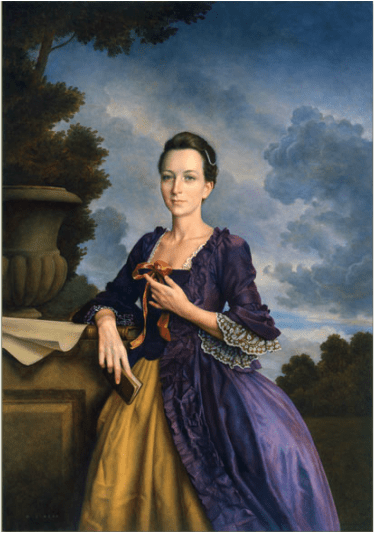
I believe I was in the third grade when I read Martha Washington’s biography. By then, I was an avid reader and historical was my favorite subject. I remember being fascinated by our nation’s First Lady’s history; although technically, this title was not coined until after her death. I learned of her first marriage and how she soon became a young widow with four children.
Now a woman with property and means of support, Martha Dandridge Custis didn’t need to marry for financial reasons; nevertheless, she did remarry. And even though I was only eight years old, the romantic in me was captivated by Martha’s “love match” with the up-and-coming, Colonel George Washington.
Although Martha was attractive and well-liked amongst society, her life was not exactly charmed. Two children, Daniel and Frances, were lost to her before they reached the age of five—most likely from malaria. It did not end there. Her daughter, affectionally called Patsy, suffered from debilitating seizures and died at the age of 17. Martha’s remaining son, John, died a few weeks before his twenty-seventh birthday from a “virulent illness.” But, as the story goes, Mrs. Washington continued on, serving her husband and her country through the Revolutionary War and beyond.
I’ve learned from experience that the greater part of our happiness or misery depends on our disposition and not on our circumstances.”
Martha Washington
As a young wife, Martha Dandridge Custis, moved amongst the upper echelons of Virginia’s society. She had been educated like most young ladies of her sphere, but when she became Mrs. Washington, Martha was in a position to do much good.
Determined and practical, she hosted weekly receptions where people of various backgrounds had the opportunity to exchange ideas and philosophies with the president. It was her intention that these so-called levees be dignified, yet informal so that the general society could take part in building the new nation.
All these memories flooded my mind while I was researching Mariquita Sanchez de Thompson and her famous tertulias or salons. Much like America’s First Lady, Mariquita defined and redefined the roles of what it meant to be a wife, mother, and patriot.
Mariquita was born into an elite family of the Viceroyalty with important ties linking back to Spain. She was of petite stature, but she held her own against her parents and the strict societal rules of the day. Strong-willed and independent by the age of fifteen, she defied her parents and refused to marry the man of their choosing.
It is precious to me to defend my rights.”
After experiencing what one could easily label a Shakespearean rebellion, Mariquita was able to marry as her heart dictated. She and her new husband became linked with public life and supported the cause for freedom. They hosted events to promote patriotism and to encourage free thinking.
Mariquita Sanchez
The Thompsons had five children throughout their marriage. They moved in the highest circles and were beloved amongst their society. It was, therefore, a great tragedy when Martin Thompson died while returning from a diplomatic trip to the United States of America in 1817.
Similar to Martha, Mariquita was a woman of means and didn’t necessarily need a husband for financial support. Nevertheless, in 1820, she remarried. Isn’t it interesting to note that her second husband was a gentleman by the name of Washington. Washington de Mendeville, to be exact.
It appears the Mendeville marriage was not a great success; however, Mariquita did not let that deter her aspirations. She continued her political work and was known for her association with The Patrician Ladies (Damas Patricias).
Just a few of the Damas Patricias of Argentina
She advocated for women’s rights. She established schools for women and girls and founded the Sociedad de Beneficencia, to aid the poor and needy. It appears that great minds do think alike— look back at Martha Washington’s quote that speaks to one’s disposition for happiness.
I don’t deny that I enjoy a traditional historical romance. But there has to be more than “boy meets girl.” Whether the storyline is set in a posh drawing room in England or the vast American frontier, I am attracted to the protagonist’s courage, as well as her growth. I cheer for her unwavering steadfastness shown in the face of turmoil and tragedy. Miss Abigail Isaacs in Celestial Persuasion has much in common with the women mentioned in this post. Although she is a fictional character, I hope readers will admire her strength, determination, and heart. I suppose that is the magic of novels. Through the written word, we can identify with impossible scenarios and a variety of character attributes. Their heart aches and struggles resonate with us. Their triumphs spur us on. We may even aspire to be such women~ Women of Valor.
Excerpt from Chapter Four:
The next morning, Abigail lingered in bed with a cup of hot chocolate, dutifully presented by a young maid. She had spent a sleepless night, staring into the black sky and seeking answers from above. She had prayed for guidance and for strength; but such was her grief, not even espying her favored constellation provided Abigail any comfort. Unaccustomed to vacillation, she was impatient with herself; and in truth, not a little overcome by her circumstances. She longed for days of yore when her little family celebrated the Sabbath as one. Though she was quite young, Abigail could yet recall the Friday evening meals, the rituals, and the blessings. Her father beaming with pride would preside over the table and praise his Eishet Chayil, with the ancient words of King Solomon: A Woman of Valor, who can find? Her worth is far beyond rubies. She and Jonathan would not be forgotten. They too would receive a parental blessing before partaking of the evening meal. Thus cossetted and cared for, their physical bodies were nurtured, as well as their spiritual selves. For as their mother would say, on the Sabbath, their souls were lifted and the uncertainties of life were set aside. Now wiping away her tears and throwing off the bed linens, Abigail arose to brave the day.
It was much later, whilst she and Mrs. Frankel were at luncheon, Pearson solemnly approached his lordship’s guests holding a silver salver, which he presented with utmost care. Abigail reached for the note and nodded her gratitude. Making quick work of the missive, she sighed heavily and informed her companion that his lordship would be delayed.
“It seems we are to have a quiet day, Frankie.”
“Perhaps all is how it ought to be, my dear. We will amuse ourselves, or not—we two are quite comfortable with one another—we are not compelled to do otherwise.”
They removed themselves into the drawing room, where a fire was set ablaze for their comfort. Mrs. Frankel kept her thoughts to herself and knitted away at heaven only knew what. Abigail did not question her companion’s efforts and turned to find her own escape in the pages of a book. When the sun finally began its descent, Abigail set down the novel and moved to the window to watch the changes in the sky. She did not hear the knock at the door, or Pearson’s somber salutation; therefore, when a man’s voice bade them a good afternoon, Abigail was quite startled.
“Are you so anxious for the Sabbath to end?”
Sufficiently recovered, Abigail was able to reply. “On the contrary, Mr. Gabay. One wishes to delay the inevitable. I have not yet seen three stars together.”
“We shall both have to remain alert then, and let Mrs. Frankel know when she may begin the prayers for Havdalah.”
“Excellent notion, young man,” Mrs. Frankel declared, and went off to find Mrs. Garrett to gather some spices, wine, and candlesticks for the evening ceremony.
“Forgive me, Miss Isaacs.” Remembering his manners, he performed a gallant bow. “I appear to have arrived early. Has his lordship not returned?”
“We had a missive from Lord Fife. He has been detained and we are awaiting his return just now. You are most welcome to join us, sir.”
“I find you a bit pale. I do hope you are in good health,” said the gentleman.
“Thank you, yes. We have not had an opportunity to be out of doors, and I fear that my mind has been much occupied.”
“I can well imagine.”
“I am not certain that you can, Mr. Gabay.” Abigail grimaced at her severe response but was helpless to muster great civility. “My grief has been sullied with uncertainty; my life has been uprooted and I find that I cannot mourn my brother when my heart is so burdened.”
The gentleman looked upon the young lady and astonished her with a grin. “I have often contemplated the ceremony of Havdalah, have you not?”
She was yet unaccustomed to the gentleman’s wit; and because of this, Abigail made every attempt to keep herself in check. Much as she wanted to condemn his ill-timed levity, her raised brow afforded him the impetus to continue with his discourse.
“The ritual—the symbolism—it challenges our senses,” said he, “as if to awaken us from a pleasant dream. Do you not find it so?”
“Indeed.” Begrudgingly, she accepted the sudden change of topic. “We are told to remember the Sabbath day and keep it holy. I would agree with your assessment, for we are in a dream world from sundown on Friday night until three stars appear the following evening. We are then awakened, as you say, with the ceremony of Havdalah—commanded to mark the separation from that holiness to the mundane.”
“My dear Miss Isaacs, mundane is not the word I would choose. Pray forgive my impertinence; but every week we are instructed to leave behind Perfection—or our concept of what that might be—in order to hurl ourselves, like a star shooting across the sky, into the chaos that is His creation. Into life.”
Raphael Gabay crossed the room and peered through the glass pane at the evening’s sky. Not finding what was required, he continued with his thought. “I ought not risk being thrown out by Pearson—perhaps I should behave in a more gentlemanlike manner—but your countenance assures me that you are, indeed, troubled. And it pains me to see you so.”
Abigail looked at him through her lashes and pondered his sincerity. “Your concern speaks well for your manners, sir, but I doubt very much our short acquaintance allows for such a declaration.”
“On the contrary. I believe my discernment is beyond reproach. Your idyllic life in Devonshire, surrounded by those you loved and the things you know, was your Perfection. But your brother is asking you, seemingly from beyond the celestial veil, to leave that place—not compromise or settle, but to see what else awaits you in the new world.”
“And what of your plans, sir? Does your soldier’s philosophy provide you sufficient cause to quit your home and family?”
“Ah—that was well done, Miss Isaacs. Implementing a defensive tactic in order to fell an opponent is a sound strategy on the battlefield. However, I am only too happy to respond to your enquiry which, of course, lessens the strength of your attack.” Mr. Gabay smiled and made himself comfortable on the divan before continuing. “I am a second son, madam, and have been given a certain freedom to live my life with some abandon. No doubt, I have caused my father some distress having no set course for the future; but try as I might, Miss Isaacs, I have never found my true calling. Therefore, the matter is very simple in my case. I am for Buenos Aires because I believe in this cause and respect the men at the lead. For now, that is enough for me. But I put it to you, Miss Isaacs: what is your destiny?”
Having heard his soliloquy, Abigail could no longer hold on to her vexation. She experienced an epiphany recalling her words to Mrs. Frankel the night in the inn. What was her destiny? If the ancient dictates of Gersonides, Ibn Ezra, and Zacuto were to be believed, it was apparent. Her celestial traits must not go unheeded.
I hope you enjoyed today’s post. There are so many Women of Valor in history. Can you name one or two you admire? Drop me a line and let me know!
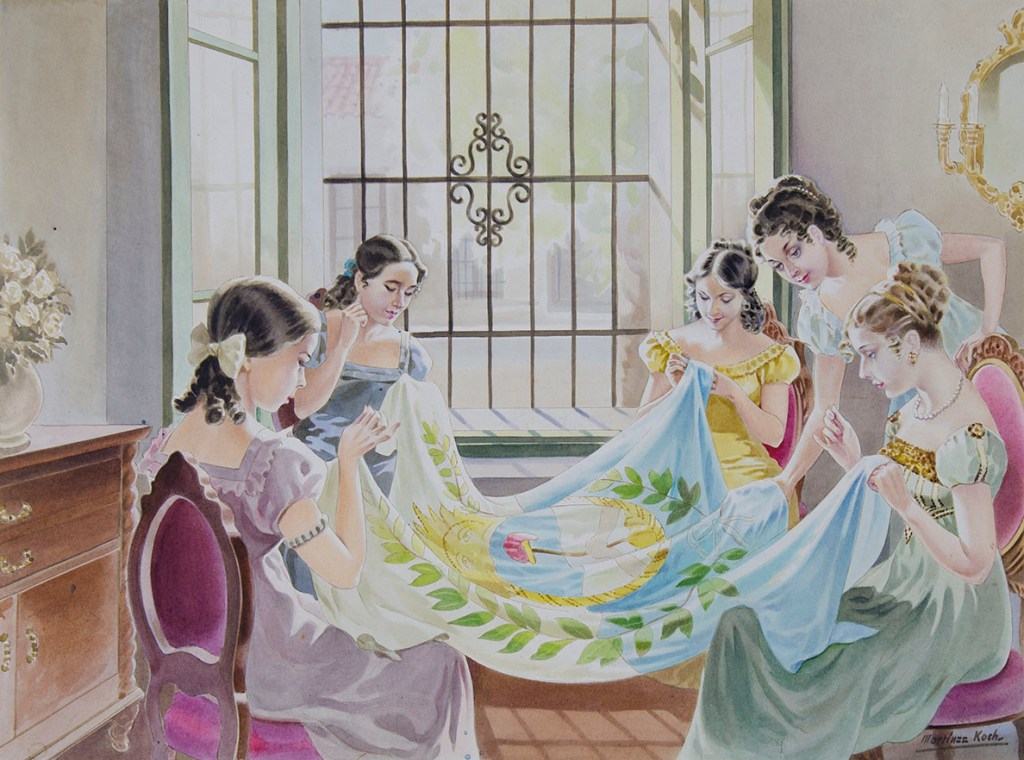
It was May 30, 1812, when fourteen women of Buenos Aires’ elite society gathered for a fund raising event. A collection was taken in support of the ragtag criollo army fighting against the Spanish crown. Each women —listed below—financed one pistol each. Obviously, it was not nearly enough to battle the Spaniards; but they inspired other women to do their part by crafting uniforms and eventually, as the story goes, stitching together the first Argentine flag.
My new novel, Celestial Persuasion, unfolds in the Viceroyalty of Rio de la Plata at the cusp of Argentina’s independence. After a series of astonishing events, the protagonist, Abigail Isaacs, finds herself in Buenos Aires. Here she writes to Captain Wentworth…
I received a missive this morning, presented by a liveried servant. It was an invitation from a Mr. and Mrs. Martin Thompson for Tuesday next. You can well imagine my astonishment, Captain Wentworth, as we are so newly arrived that I have not yet regained the use of my land legs. I have not a clue who these good people might be, or how they came to know of my arrival in the city. It was Mrs. Tavares who supplied the necessary information and assured me that I might respond to the invitation without compunction. It was all due to Lord Fife and his connections with society. I imagined the Thompsons were fellow compatriots, perhaps an elderly couple from Sussex or Bath. Imagine my astonishment when Mrs. Tavares explained the truth of the matter. Mrs. Thompson, in fact, is María Josepha Petrona de Todos los Santos Sánchez de Velasco y Trillo. The articulation of the lady’s name alone was quite an undertaking! It practically encompassed my daily Spanish lesson in its entirety. Mrs. Tavares was only too happy to impart her knowledge. To begin with, much to my relief, the lady is simply known as Mariquita Sanchez de Thompson. She is the daughter of a distinguished family of Río de la Plata, with an impressive lineage tracing back to Spain and Portugal. She married Martin Jacobo Thompson and the pair have become the toast of the town.
Mrs. Tavares’s countenance upon seeing the invitation was quite telling. I have never witnessed such excitement. It would seem that an invitation to Mrs. Thompson’s salon is paramount to taking tea with one of the patronesses of Almacks! One must understand, these social gatherings include some of the most renowned citizens of the Viceroyalty. I am to expect an introduction to compatriots and locals, aristocrats and artisans. If I am to trust in my housekeeper’s accounting, Mrs. Thompson is an extraordinary example of female ingenuity. She is known as a great advocate for the new republic. Mrs. Tavares assures me that a more fervent patriot cannot be found among those who support the cause. Not only did the lady donate three ounces of gold to the coffers, she lends her domestic skills for the sewing of uniforms.
In short, Captain Wentworth, I am undone at the thought of attending Mrs. Thompson’s salon. I fear I lack the talent of conversing easily with strangers; although you may believe that an odd statement after I have, after all, rambled on for two pages complete. Your close ties with Jonathan, and your own insistence, have made you less a stranger and more a relative.
I hope you enjoyed the excerpt! You can find Celestial Persuasion on Amazon in both digital and paperback formats. Happy reading!
As you have read in my previous posts, I began piecing together a story that involved Captain Wentworth and his good friend—and ship’s physician—Jonathan Isaacs. Naturally, this sliver of an idea resulted in hours and hours of research. I knew nothing about the Navy, nothing about officers, and nothing about the Jewish factor that I wanted to thread into this particular tapestry of a story. Now, before I write another word: Tell me you don’t see the similarities between the naval officers of Argentina’s Regency era and those of Austen fame.
Need I say more?
Apparently, I do! My story unfolds in Exeter, where the Isaac family lived in close proximity to Barton Cottage. That, of course, is a fictional location; nonetheless, one well known to fans of Sense and Sensibility. In any event, the head of the Isaacs family was a country doctor, but I wanted Jonathan to be a physician in service to the Crown. This is where the questions began. Were there Jews in Exeter during the Regency era? Were they allowed to serve in the Navy? Did they have any connection to that world at all? It was then that I discovered a veritable treasure trove!
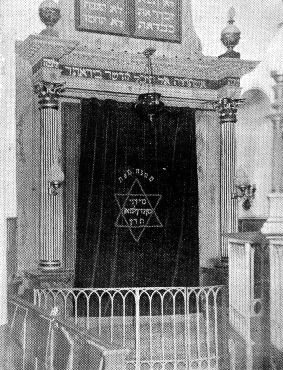
Exeter synagogue
Jewish Communities and Records- The Jews of South-West England (Jewishgen.org) provides this information and more! It soon became clear to me that there was Jewish life in Exeter, Plymouth, Falmouth and Penzance, as well as several other towns throughout Devon in the years dating from 1750 to 1900. There is evidence from earlier still, but the records I focused on were those of the Regency and Victorian eras (where the details were irrefutable). And in stark contrast to what Dickens and Heyer portray in their works, the Jewish community of South-West England was comprised of a small, yet respectable, upper middle class.
7 families kept one servant indicating that they may have been in the £150 – £300 per annum income bracket; two families each with two servants may have earned about £500 per annum; and the one family with three servants was possibly in the £750 per annum income group.
By 1796, five Jews had shops in the fashionable shopping area of Exeter sufficiently well established as to warrant inclusion in the Exeter Pocket Journal, a local newspaper. There were two silversmiths, an engraver who sold a variety of goods, a pawnbroker, and a stationer. And in addition to these and other trades, there were naval agents.
To say that conditions were harsh in the Royal Navy throughout the eighteenth and early nineteenth centuries would be an understatement, but the ever-present hope of prize money made the cruel life somewhat bearable. Think of how Captain Wentworth’s life changed course when he was awarded his prize money! Officers had bankers to look after their interests. The seamen, however, turned to local tradesmen of naval towns for assistance. They were the link to the naval authorities in London. This system, at first, was unofficial and based on mutual trust. I present Abraham Joseph, an Exeter tradesmen, as a fine example. He earned such trust, as his obituary in the Flying Post (1794) indicates:
As an agent for seamen, his practice was well worthy of the imitation of every person in that business, as several orphans and indigent widows can testify.
At some point in 1809, legislation was enacted which required all seamen to register with a licensed navy agent. In order to obtain a license, the tradesman had to post a bond with two sureties, under penalty of £200. Sometimes, a would-be navy agent was a man of high social standing; nevertheless, everyone had to swear that they were worth more than £5,000 in order to qualify. The first list of 174 licensed navy agents included 66 Jews. It was said that Jewish tradesmen were held in high esteem and the proof was in their rapid growth in that particular community. Between 1807 and 1814, navy agents as a whole increased sevenfold throughout England. The number of Jewish agents increased thirtyfold!
The British fleet was manned by nearly 35,000 seamen by this time. Jewish shopkeepers throughout the port towns specialized in doing trade with the ships. They were allowed to go on board with goods that appealed to the “simple seamen,” such as “old watches and seals, watch chains, rings, fancy shoes, scarlet and blue silk handkerchiefs, clay pipes, and fresh food of every description.” Honest traders with good references were most welcome. In 1813, Joseph Joseph presented the following royal command which granted him access to the crewmen at port:
I do hereby certify that Joseph Joseph of Plymouth has at different times supplied the Crews of His Majesty’s Ships when under my Command with Clothing to my entire satisfaction, and I do hereby recommend him to the Admirals, Captains, and Officers of His Majesty’s Navy, to be permitted to transact any Business that may be done on board the respective Ships under their Command.
St. James’s Palace ~ December 2, 1812
How do I top a letter of recommendation from St James’s Palace? With this:
Members of both congregations at Exeter and Plymouth would, on occasion, travel up to Dartmoor prison to practice acts of chesed, or lovingkindness. By the end of 1814, there were 2,340 American prisoners of war being held at Dartmoor, and a number of them were Jewish soldiers and sailors. Commodore Uriah P. Levy, was among them. Notably, this officer created the law which abolished the act of flogging in the United States Navy. Captain Levi Charles Harby was another Jewish sailor being held captive. During his imprisonment, a Jewish baker from Plymouth would make the daily trip to sell his baked goods. One day, he offered a loaf of bread to Captain Harby. The officer refused it. The baker, however, insisted. Inside the loaf, he had hidden a newspaper clipping that told of an important battle at New Orleans. This encouraged the captain to escape, apparently with the help of the baker! The story went on to report that Captain Harby was able to find his way back to his men. He continued to serve his country with great success and it was in no small part, thanks to the baker mench from South-West England.
Seeing that we— here in the U.S. —are celebrating our freedom today, I’d say that little tidbit is quite fitting! Happy Independence Day!
It seemed like the day would never arrive, but here we are! I am excited and nervous and hopeful and, well…excited! I can’t wait for you to read my latest book and tell me your thoughts.
A Jewish Regency Romance Set Against the Backdrop of Argentina’s Struggle for Independence.
Celestial Persuasion is now available on Amazon in both digital and paperback format. This has been a labor of love and inspiration, but now the real work begins. I’m an independent author, which means I need your help to spread the word. Please tell your friends! Share my posts on your social media. Are you on Goodreads? You can help me by adding the book to your “Want to Read” shelf. Actually, you could take it a step further and create a new shelf and call it “Jewish Regency Romance” or “Jewish Historical Fiction.” Vote for the book in the Listopia section. There are many great categories from which to choose, like this one, or this oneor this one ! If you don’t know how to add or vote for the book, ASK ME! I’m only too happy to help. 🙂 Last, but not least, read the book! Leave a rating or a review on Amazon, Goodreads, or on your blog. The momentum created by your input is priceless. It helps me engage with other readers and brings my work out into the forefront—protecting me from those nasty algorithms!
Caroline Herschel was the perfect role model for my protagonist, Abigail Isaacs. Her extraordinary contributions to Astronomy were certainly an inspiration, but Caroline had two other interesting attributes. One was her Jewish heritage, the other was her relationship with her brother, William. The similarity with Abigail and her brother, Jonathan was bashert: It was meant to be.
I am grateful for your support and your interest. Please continue to watch this blog for future posts and interesting tidbits.















 Mirta Ines Trupp~ Author