New Post

Tradition! Tradition! Gossip, Cake, and a Relatable Glimpse into Early America

We often imagine the Founding Fathers discussing constitutions and revolutions. But sometimes they were simply husbands writing home. In June 1787, Founding Father and physician Benjamin Rush attended the Jewish wedding of Rachel Phillips and Michael Levy in Philadelphia. His wife, Mrs. Rush, was not invited. The lady, apparently, was in New Jersey. I don’t require much prompting to imagine something like this:

“My dear, I know you far too well and can imagine the conversation we should have, were I by your side—taking our final cup of tea by the fireside. You should want to know all! Not only that I was invited, but who was in attendance. How was the bride attired? What were their customs, how did they differ from our own…”

The facts, however, don’t require imagination!

We have the letter!

Even more interesting: more than two centuries after the bride and groom exchanged their vows, so much of the experience feels familiar. What details still ring true for me? I’ll tell you!
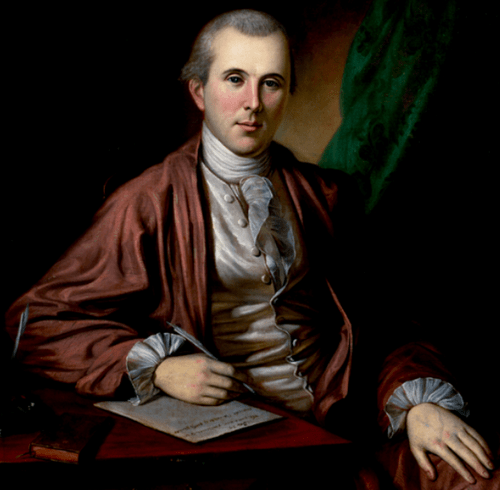
Dr. Benjamin Rush

More than the ketubah (the wedding contract), the smashing of the wine cup, or the beauty of the bride—it was Rush’s observation that members of the congregation were talking while the prayers were being recited. Today, in 2026, in every congregation—in this country and across the planet—congregants are still talking through sermons, prayers and song.

In that moment, the wedding ceased to be a distant historical event and became something instantly recognizable. Before text messages, before Instagram stories, before group chats, Benjamin was writing a wonderfully detailed letter because he knew his wife, Julia, wanted the full report.

Here is his account, written just days after the wedding.

I accepted the invitation with great pleasure, for you know I love to be in the way of adding to my stock of ideas upon all subjects. At 1 o’clock the company, consisting of 30 or 40 men, assembled in Mr. [Jonas] Philips’ common parlor, which was accommodated with benches for the purpose. The ceremony began with prayers in the Hebrew language, which were chanted by an old rabbi, and in which he was followed by the whole company. As I did not understand a word except now and then an Amen or Hallelujah, my attention was directed to the haste with which they covered their heads with their hats as soon as the prayers began, and to the freedom with which some of them conversed with each other during the whole time of this part of their worship.

As soon as these prayers were ended, which took up about 20 minutes, a small piece of parchment was produced, written in Hebrew, which contained a deed of settlement and which the groom subscribed in the presence of four witnesses. In this deed, he conveyed a part of his fortune to his bride, by which she was provided for after his death in case she survived him.

This ceremony was followed by the erection of a beautiful canopy composed of white and red silk in the middle of the floor. It was supported by four young men (by means of four poles), who put on white gloves for the purpose. As soon as this canopy was fixed, the bride, accompanied with her mother, sister, and a long train of female relations, came downstairs. Her face was covered with a veil which reached halfways down her body. She was handsome at all times, but the occasion and her dress rendered her in a peculiar manner a most lovely and affecting object. I gazed with delight upon her. Innocence, modesty, fear, respect, and devotion appeared all at once in her countenance.

She was led by her two bridesmaids under the canopy. Two young men led the bridegroom after her and placed him, not by her side, but directly opposite to her. The priest now began again to chant a Hebrew prayer, in which he was followed by part of the company. After this, he gave to the groom and bride a glass full of wine, from which they each sipped about a teaspoonful. Another prayer followed this act, after which he took a ring and directed the groom to place it upon the finger of his bride in the same manner as is practised in the marriage service of the Church of England. This ceremony was followed by handing the wine to the father of the bride and then a second time to the bride and groom. The groom, after sipping the wine, took the glass in his hand and threw it upon a large pewter dish which was suddenly placed at his feet. Upon its breaking into a number of small pieces, there was a general shout of joy and a declaration that the ceremony was over. The groom now saluted his bride, and kisses and congratulations became general through the room.

I asked the meaning, after the ceremony was over, of the canopy and of the drinking of the wine and breaking of the glass. I was told by one of the company that in Europe they generally marry in the open air, and that the canopy was introduced to defend the bride and groom from the action of the sun and from rain. Their mutually partaking of the same glass of wine was intended to denote the mutuality of their goods, and the breaking of the glass at the conclusion of the business was designed to teach them the brittleness and uncertainty of human life and the certainty of death, and thereby to temper and moderate their present joys.

Mr. Phillips pressed me to stay and dine with the company, but business and [junior partner] Dr. [James] Hall’s departure, which was to take place in the afternoon, forbade it. I stayed, however, to eat some wedding cake and to drink a glass of wine with the guests. Upon going into one of the rooms upstairs to ask how Mrs. [Rebecca] Philips did, who had fainted downstairs under the pressure of the heat (for she was weak from a previous indisposition), I discovered the bride and groom supping a bowl of broth together. Mrs. Phillips apologized for them by telling me they had eaten nothing (agreeably to the custom prescribed by their religion) since the night before.

Upon my taking leave of the company, Mrs. Phillips put a large piece of cake into my pocket for you, which she begged I would present to you with her best compliments. She says you are an old New York acquaintance of hers.

I can almost smell the broth that the newlyweds devoured. And the cake! I can’t help wondering what kind was served. Were guests given the choice of  Plum Cake or Sephardic delicacies like Almond Macaroons and Marzipan? Maybe a honey—lekach—cake was served to satisfy the Ashkenazim.  I can almost taste it!

What about you?

I can imagine Mrs. Phillips—a Jewish balabusta (homemaker)—preparing the pekeleh (the small bundle) for her Anglican friend, Mrs. Rush. If that isn’t the most universally recognizable act of hospitality, I don’t know what is! I can hear her saying:  “Take some cake home for your wife.”

This joyful gathering was more than just a beautiful celebration; it was the literal origin story of an extraordinary American legacy. While many colonial Jews in Philadelphia were Sephardic, this marriage blended traditions. The bride’s father, Jonas Phillips, was actually an Ashkenazi immigrant from Germany who was fluent in Yiddish (so much so that when British authorities intercepted his letters during the Revolutionary War, they reportedly concluded he was writing in a secret military code)! Rachel’s mother was a Machado—a Sephardic name. The groom’s family was Sephardic as well.

Rachel and Michael Levy would eventually become the parents of Commodore Uriah P. Levy—the famous naval officer who championed the end of the cruel practice of flogging in the U.S. Navy. Just as his parents’ wedding blended into the fabric of early America, Commodore Levy fiercely defended his place in it. He famously bought and restored Thomas Jefferson’s dilapidated home, Monticello, in 1834. Having spent his own naval career being relentlessly persecuted for his faith, Levy viewed Jefferson as the ultimate architect of American religious liberty. For the Levy family, preserving Monticello wasn’t just about real estate—it was a physical defense of Jewish rights and a profound act of patriotic gratitude.

Now, let’s delve into the weeds, shall we?  

As a modern reader, I found a few of Rush’s observations fascinatingly out of sync with traditional Jewish practice, revealing just how a non-Jewish observer in 1787 interpreted the rituals.

The Priest:
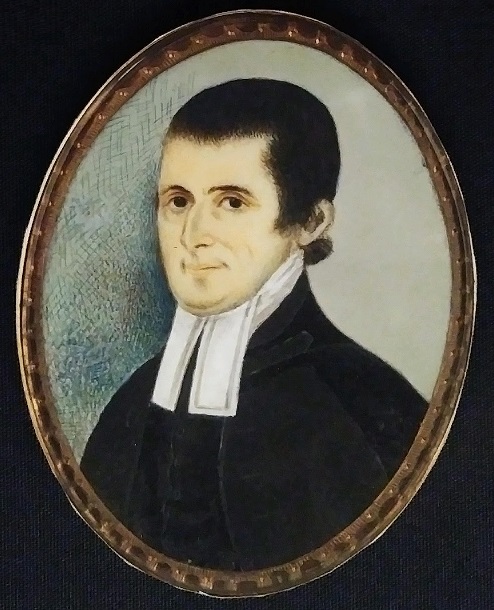
Reverend Seixas

Of course, the wedding official wasn’t a priest, but he wouldn’t have been a rabbi either! Not in 1787 Philadelphia. He may have been a hazan, a cantor, or a lay ministerial person. During this period, the title “reverend” was often used even for Jewish clergy—such as in the Reverend Gershom Mendes Seixas. The first ordained rabbi in the United States of America appears to have been Rabbi Abraham Joseph Rice in 1840.

The Weatherproof Canopy:
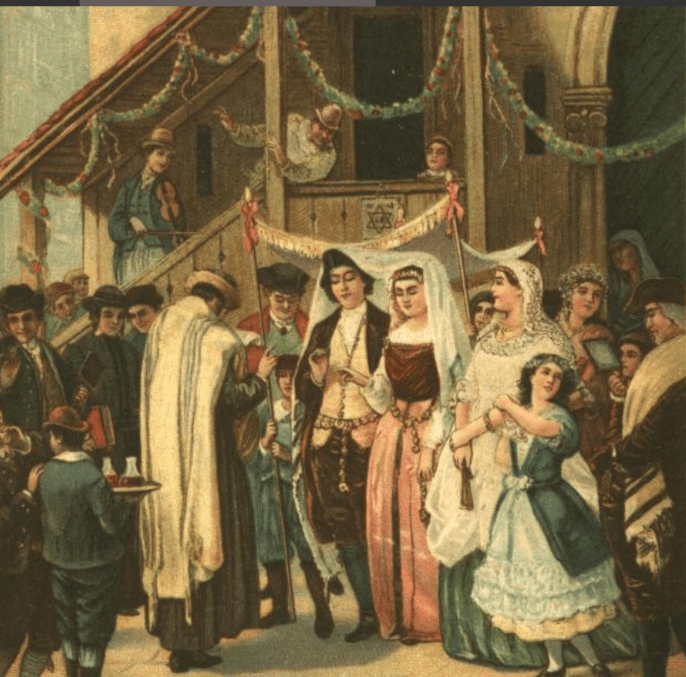
The wedding guest’s explanation regarding the chuppah (wedding canopy)—as a historical defense against the sun and rain in Europe—didn’t hold water (that’s me chuckling while writing).

My understanding has always been that the chuppah carries a deeper spiritual meaning. It typically represents the new home the couple will build together, modeled after Abraham and Sarah’s hospitable tent. It also traditionally symbolizes Divine Protection—such as the Canopy of Peace (Sukkat Shlomecha) that hovered over the Israelites at Mount Sinai.

Don’t Point—It’s not polite:
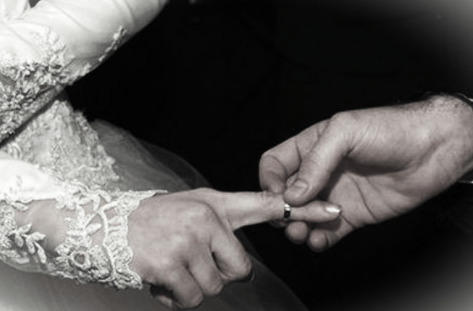
Rush noted that the ring was placed “in the same manner as is practised in the marriage service of the Church of England.” In an Anglican wedding, the ring goes on the fourth finger of the left hand to trace the vena amoris (the vein of love) directly to the heart. But in a traditional Jewish ceremony, the ring is actually placed on the right index finger. This is a strict legal requirement; the pointing finger is the easiest to hold upright, ensuring the two mandatory witnesses can clearly see the ring exchange as it happens. Most modern brides simply move the band to the left hand after the ceremony.
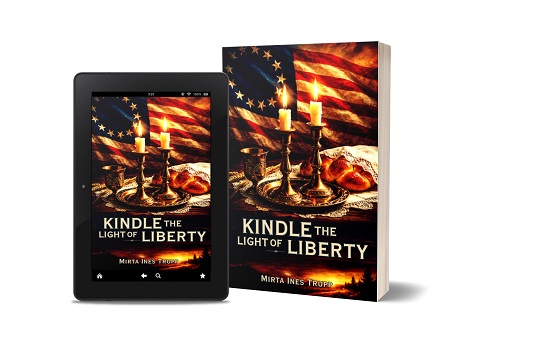
From Benjamin Rush’s affectionate letter to his wife to a young couple breaking a glass in a crowded Philadelphia parlor, early American history is paved with these vibrant, deeply human moments of faith and freedom. But these families didn’t just witness the birth of a nation—they helped build its foundation. To discover more incredible, untold stories of the individuals who fought for faith and freedom in the early Republic, look out for my new book, Kindle the Light of Liberty, releasing this Independence Day on July 4, 2026.

With love,

New Post

Jewish Historical Romance: A Jewish Colonial Love Story of the American Revolution

I can’t think of any author who wouldn’t appreciate the chance to talk about their new book—the research, the premise, the inspiration…well, you get my meaning. I had such an opportunity when I was asked to participate in an Author’s Q & A with Writergurlny. Click on the highlighted link to read the interview, or read a few snippets here:

Getting the full scope of history goes well beyond a generic textbook. For every well-known person, there are many others whose names and histories are lost to time. Mirta Ines Trupp’s new historical novel, Kindle the Light of Liberty, is set in Philadelphia during the American Revolution.

AB: What was the inspiration for the book?

MIT: First of all, thanks for the opportunity! I appreciate your interest in my latest book.

The inspiration for Kindle the Light of Liberty grew from three longtime passions. As a grateful naturalized citizen of this country, I wanted to contribute to the celebration of America’s 250th anniversary by exploring a lesser-known aspect of the nation’s founding—the experiences and contributions of Jewish Americans during the Revolutionary era. I am also passionate about writing Jewish protagonists in wholesome, accessible fiction. Too often, Jewish characters are absent from historical novels or appear only in stories centered on persecution. I wanted to create a compelling, “clean” read that allows Jewish characters to take their place at the heart of an engaging historical story—one filled with courage, hope, and the pursuit of liberty. Finally, as a devoted Jane Austen reader, I have long admired her ability to illuminate universal truths through the lives of ordinary people. Austen showed that questions of family, duty, love, and social belonging can be every bit as compelling as grand historical events. In Kindle the Light of Liberty, I sought to emulate that vision by placing personal relationships and moral choices against the backdrop of a transformative moment in history, allowing readers to experience the American Revolution through the hearts and minds of the people living it.

AB: Did the idea of Rose come from anyone specific?

MIT: Rose wasn’t based on any one specific person, but she was certainly influenced by a few different sources. As I mentioned, I am a longtime Austen fan. I would be hard-pressed to deny the influence of Miss Elizabeth Bennet of Pride and Prejudice fame. I’ve always admired Lizzy’s intelligence, wit, and willingness to speak her mind, even when doing so is not the easiest path. Those qualities definitely found their way into Rose’s character. At the same time, I often joke that all of my heroines are, in some sense, a blend of myself and the women who came before me. Rose reflects some of my own interests, values, and perspectives, but she is also inspired by the resilience, strength, and determination I imagine in my female ancestors.

As a historical novelist, I spend a great deal of time thinking about the lives of the women who preceded us—the challenges they faced, the choices they made, and the dreams they carried. In many ways, Rose became a way for me to honor both my own heritage and the remarkable women whose stories were never written down but whose lives helped shape the generations that followed.

AB: What made you choose the American Revolution as opposed to another time?

MIT: That’s a great question. As I mentioned earlier, one of the original inspirations for the novel was the upcoming commemoration of America’s 250th anniversary. I wanted to explore the colonial era, but through a lens that readers don’t often encounter. When most people think about Jewish involvement in the American Revolution, if they think about it at all, they tend to recall a handful of financiers and wealthy merchants. I was struck by how history reduced Jewish colonials to a single dimension. Ancient tropes and European stereotypes shouldn’t dictate how historical novel readers—Jewish or not—understand the past.

The Revolutionary period offered a fascinating opportunity to challenge those assumptions and expand the narrative. I wanted to portray Jewish characters as fully realized people—patriots, neighbors, friends, daughters, sons, and, when called upon, individuals capable of courage and sacrifice. The American Revolution was not only a struggle for independence; it was also a moment when many different groups were asking what it meant to belong in a new nation. That question felt as relevant to me as ever, and it made the Revolutionary era the perfect setting for Rose’s story.

AB: What kind of research did you do? Was it more internet-based, or did you rely on physical texts?

MIT: My research was actually conducted mostly online. One of the great advantages of not living in colonial times is that so much history is literally at our fingertips. Newspapers, letters, diaries, maps, genealogy records, academic articles, and digitized books that once required travel to specialized archives can now be accessed from home. The challenge is no longer finding information—it’s finding the time and patience to follow the trail of sources wherever they lead, and remembering to come up for air once you’ve disappeared down a research rabbit hole!

That said, online research doesn’t mean superficial research. Many of the sources I consulted were digital versions of primary documents and scholarly works. In fact, even my beloved Jane Austen was part of my online research process. Her novels are available free of charge through Project Gutenberg, which makes it easy to search passages and revisit particular scenes. Of course, I also keep a well-worn copy of Pride and Prejudice on my desk. Whether I’m reading a digitized eighteenth-century newspaper or a printed history book, the goal is always the same: reliable information. It needs to help me understand the period as accurately and vividly as possible so that readers can feel as though they have stepped back in time.

AB: The hardest part of historical fiction is melding the real people/events with the fictional ones. How do you go about it?

MIT: That’s probably the hardest—and most rewarding—part of writing historical fiction. The events themselves are often well documented, but people are much more complicated than the brief descriptions history leaves behind. When I encounter a historical figure, I try to look beyond the labels that have been attached to them. Take Rebecca Franks, for example.

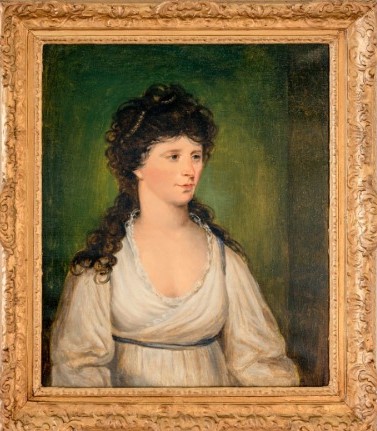
Rebecca Franks

On the surface, she can be easy to categorize. She came from a prominent Jewish family, yet she was a Loyalist. She was a known flirt, witty, and resourceful (to put it kindly). She married an Englishman and ultimately lived in Britain as part of the aristocracy. Viewed from a certain angle, she might appear to have turned her back on both her countrymen and her heritage. But I found myself asking a different question: What made her the person she became? What hopes, fears, disappointments, and demands shaped her choices? The moment you start asking those questions, a historical figure stops being a name in a book and becomes a human being.

In many ways, that approach is influenced by a central idea in Judaism. At Passover, we are instructed to see ourselves as if we personally came out of Egypt. At Shavuot, we are encouraged to imagine ourselves standing at Sinai. Jewish tradition asks us to enter the story rather than merely observe it. As a novelist, I try to do something similar. I place myself in the position of my characters—both the real historical figures and the fictional ones—and ask what the world looked like through their eyes. What would I have believed? What would I have feared? What would I have hoped for? Once I can answer those questions, the boundary between history and fiction becomes much easier to navigate. The historical record provides the framework, but empathy helps fill in the spaces between the facts. That’s where the story comes alive.

AB: Philadelphia is as much of a character as the people. Did you deliberately choose the city, or was it an organic decision?

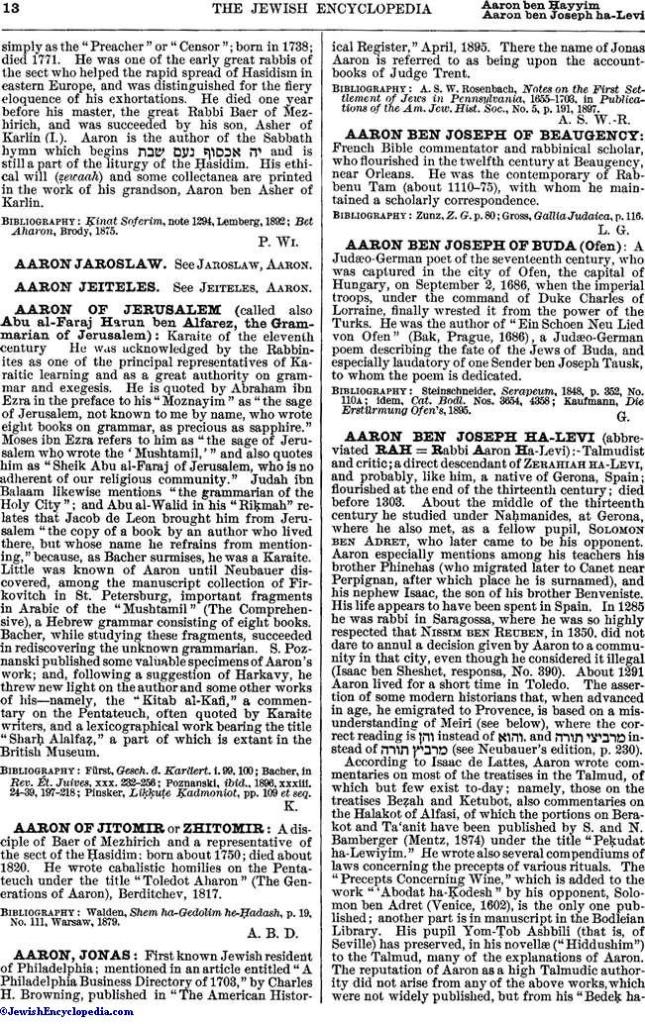
MIT: Absolutely deliberate! From the very beginning, I knew that if I was going to tell a story about Jewish life during the American Revolution, Philadelphia was the natural setting. I was drawn first to the city’s rich Jewish history. Philadelphia was home to one of the earliest and most important Jewish communities in colonial America, and many of the individuals I wanted to write about either lived there or passed through it. One figure who particularly intrigued me was Jonas Aaron, who arrived in Philadelphia in 1703 and is often considered the city’s first known Jewish resident. His presence is a reminder that Jewish history in Philadelphia stretches back long before the Revolution itself.

At the same time, Philadelphia was the political heart of the Revolution. The Continental Congress met there. Benjamin Franklin walked the streets. Betsy Ross lived and worked there. It was a city where world-changing events and ordinary daily life existed side by side. I was also fascinated by Philadelphia’s Quaker roots. William Penn’s vision created a colony that was remarkably welcoming for its time. While no eighteenth-century society was free from prejudice, Pennsylvania offered opportunities for religious minorities that were difficult to find elsewhere. Quakers, Jews, Anglicans, Presbyterians, and many others lived alongside one another, creating a vibrant and diverse community. That diversity made Philadelphia an ideal place to explore questions of identity, belonging, and citizenship during the founding of the nation.

AB: Rose and Nathan have a specific Elizabeth Bennet/Fitzwilliam Darcy energy to their relationship. Was this a deliberate choice, or did it emerge as a natural part of the writing process?

MIT: That’s a fair observation—Pride and Prejudice has been such a long-standing touchstone for me; Elizabeth and Darcy’s dynamic was always part of my creative landscape. At the same time, I didn’t want to simply recreate Austen in an American Revolutionary setting. Several of my other novels are “Austenesque” or straight-up Jane Austen fan fiction (JAFF), but I tend to introduce Jewish protagonists to the narrative, rather than portray Austen’s characters as Jews. There’s a reason for that approach.

What I’ve always found most powerful in Austen’s work is how clearly she shows the real stakes for women in her world: the very real fear of not marrying, of lacking financial security, of being labeled a spinster and therefore considered somehow “unfulfilled” or even nonessential in society. She also captures how profoundly a family’s social standing could shape the entire trajectory of a woman’s life, and how a single “wrong” choice could carry lifelong consequences. Those concerns absolutely echo through Rose and Nathan’s story, and in that sense, they do shadow Elizabeth and Darcy’s world. But as I wrote, those familiar Austen themes began to branch outward in new directions. Rose and Nathan are shaped by their Jewish identity, by a long history of displacement and persecution, and by the added weight of what it means to belong—or not belong—in a young nation trying to define itself. Their choices are not only about love, marriage, or reputation, but also about survival, continuity, and the question of whether a community that has endured centuries of exclusion can truly find a stable place in this new world. So I would say Austen gave me the emotional framework, but Rose and Nathan ultimately grew into something more layered—I hope! They are rooted in her world of social constraint and romantic tension, yet expand into broader historical and cultural realities that define their own lives.

New Post

June 11, 1776 to June 11, 2026: A Date Worth Celebrating

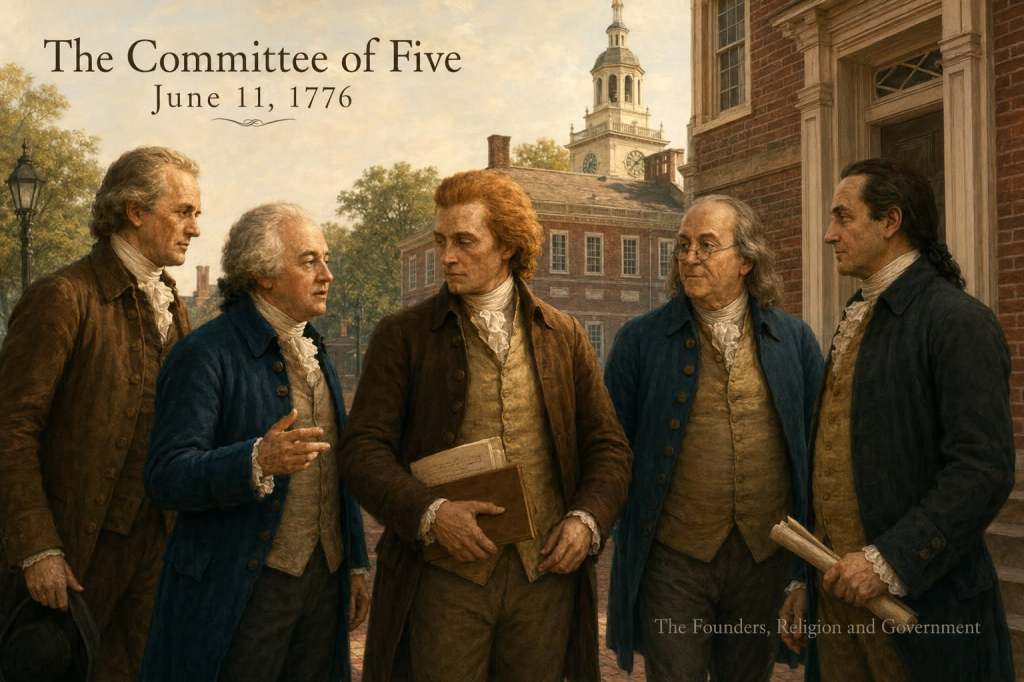
On June 11, 1776, the Second Continental Congress appointed the Committee of Five—Thomas Jefferson, John Adams, Benjamin Franklin, Roger Sherman, and Robert Livingston—to draft what would become the Declaration of Independence. Their task was nothing less than putting into words the principles upon which a new nation would be founded. Two hundred and fifty years later, on June 11, 2026, I am delighted to share a milestone of my own. The ebook pre-order for Kindle the Light of Liberty is now live on Amazon.

The timing feels especially meaningful.

My novel is set during the Revolutionary era and follows Rose, a young Jewish woman in Philadelphia, as she navigates friendship, family, faith, and the uncertain birth of a nation. Like the men charged with drafting the Declaration, my characters find themselves living through extraordinary times when the future is unwritten, and every choice carries consequences.

As I researched the period, I was struck by how often Jewish participation in the Revolution is remembered through a narrow lens, focused primarily on a handful of financiers and merchants. Kindle the Light of Liberty seeks to broaden that picture by portraying Jewish characters as fully realized people—friends, neighbors, patriots, and family members whose lives were shaped by the same hopes, fears, and sacrifices as their fellow Americans. Readers may also recognize traces of the social and emotional tensions that drew me to Jane Austen’s novels. Rose faces many of the same concerns that shaped women’s lives in Austen’s world: the importance of marriage, family expectations, financial security, and the consequences of a single ill-considered choice. Yet Rose and Nathan’s story unfolds within a different historical reality. Their lives are shaped not only by questions of love and reputation, but also by their Jewish identity and by the larger question of what it means to belong in a new nation still defining itself.

The journey toward publication has already brought wonderful opportunities to discuss the history behind the novel. On May 1, 2026, I was honored to appear as a guest author on History Imagined, where we discussed Jews in colonial America and the fascinating historical research that helped shape the story.

Early ARC (Advanced Reading Copy) readers have also begun sharing their thoughts.

From Claudia F. on Goodreads: Trupp takes the qualities I love most about Austen—witty observations, complex family relationships, social expectations, and a romance built on misunderstanding and mutual respect—and places them in Revolutionary Philadelphia…with Jewish patriots to boot! The result feels both familiar and entirely fresh.

From Judy K. on Goodreads: Trupp has done it again! As America prepares to celebrate its 250th anniversary, I can think of no better book to begin the festivities than “Kindle the Light of Liberty.”

From Mrs. W. on Goodreads: As America approaches its 250th anniversary, there seems no better time to remember that Jewish patriots were present at the nation’s founding—not standing on the sidelines, but helping to shape the course of events. 

On May 30, 2026, Writergurlny posted a thoughtful review of Kindle the Light of Liberty, highlighting the novel’s blend of historical detail, friendship, and romance. I’m also pleased to share that I’ll be returning to Writergurlny in the near future for an author interview.

There are several exciting events coming up over the next few months:

As America approaches the 250th anniversary of independence, I am grateful for the opportunity to share a story set during the nation’s founding era. Historical fiction allows us to look beyond the familiar names and dates and imagine the lives of ordinary people who experienced extraordinary events firsthand. Through Rose’s eyes, readers can explore a Revolutionary America that includes voices too often overlooked, including the small but vibrant Jewish communities that helped build the new nation.

Thank you to everyone who has supported this book, reviewed it, hosted me on your blogs, or simply shared your enthusiasm for Revolutionary-era history. I look forward to celebrating the launch of Kindle the Light of Liberty with all of you in the weeks ahead.

Happy June 11th. Two hundred and fifty years ago, a committee began drafting a document that would change history. Today, I am honored to share a story inspired by the people who lived through those extraordinary times.

With love,